HINCAPIE RECEIVED A YELLOW CARD FOR THIS CHALLENGE! Link of Watching it Live Here

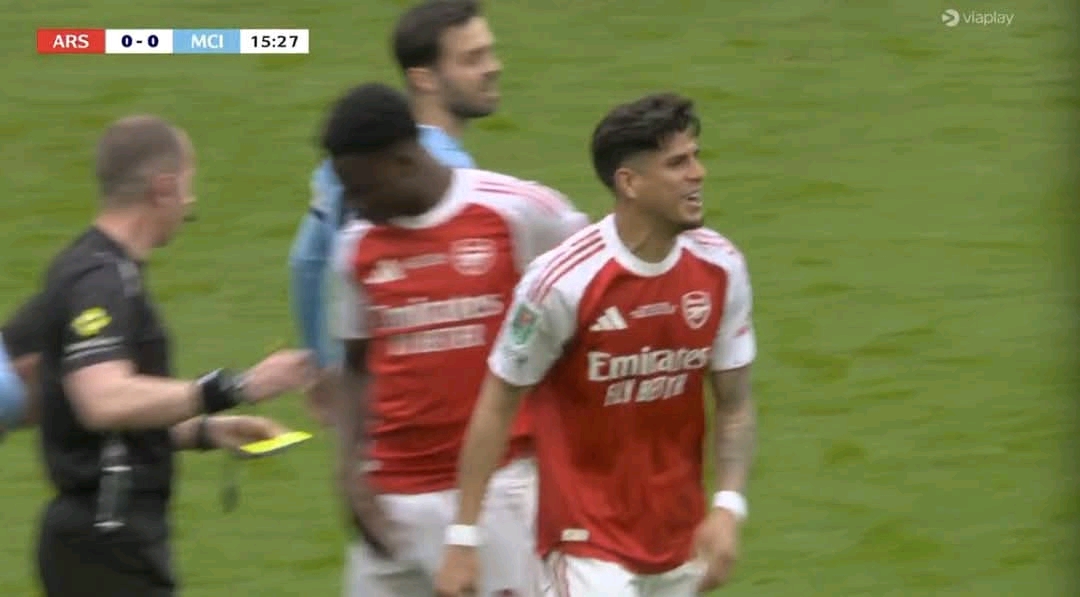
The moment happened so fast, yet it felt like everything slowed down at the same time. The crowd was alive, the tension was rising, and every touch of the ball carried weight. It was one of those games where every small action could change everything, where one mistake could turn the mood of an entire stadium. And then it happened — the challenge that would spark debate, anger, and endless discussion.
Hincapié saw the danger before most people did. The opponent was breaking forward with speed, pushing into space, and looking ready to create something special. The defenders were already under pressure, trying to recover their shape, but there was a clear gap opening up. In that split second, Hincapié had to decide — step in and stop the attack, or hold back and risk something worse happening.
He chose to act.
As he moved in, his body language showed urgency. There was no hesitation in his mind, no time to think about consequences. Football at that level does not give you the luxury of thinking too long. It is instinct, reaction, and courage. He stretched forward, aiming to win the ball, but the timing was just slightly off. The contact came, and immediately the reaction followed.
The opponent went down.
For a moment, there was silence — not complete silence, but that strange kind where thousands of voices pause at the same time, waiting to see what the referee would do. Then the noise exploded. Some fans shouted in anger, others in support. The benches reacted instantly. Teammates raised their hands, appealing. Opponents surrounded the referee, demanding action.
And right there, standing in the middle of it all, was Hincapié.
He looked calm on the outside, but inside, there must have been a mix of emotions. He knew what he had done. He knew it was a risky challenge. But he also knew why he did it. Sometimes in football, players take calculated risks. They accept that they might be punished, but they do it for the team, to stop something more dangerous from happening.
The referee did not take long.
A whistle. A pause. A hand reaching into the pocket.
The yellow card came out.
That single moment changed the feeling of the game. It was not just about the card itself. It was about what it meant. A warning. A mark against his name. A signal that he would now have to be careful for the rest of the match. One more mistake, one more mistimed challenge, and things could become much worse.
Hincapié accepted it without a big reaction. No dramatic protest, no angry outburst. Just a small nod, maybe a quiet word, and then he walked away. That reaction said a lot. It showed he understood the decision, even if he might have felt it was a bit harsh. It showed maturity, control, and focus.
But around him, the debate was already starting.
Some fans believed it was a clear yellow. They saw the contact, the intensity, the fact that he stopped a promising attack. For them, the referee had no choice. It was the correct decision, simple and fair.
Others disagreed. They argued that he got part of the ball, that the challenge was not as dangerous as it looked, that the opponent exaggerated the fall. In football, these arguments never end. Every angle, every replay, every slow-motion clip adds more fuel to the discussion.
The commentators had their say too. Some praised the referee for being consistent. Others questioned whether the game is becoming too strict, too quick to punish physical challenges. They talked about the balance between protecting players and allowing the game to stay competitive and intense.
Meanwhile, the game continued.
For Hincapié, everything changed after that moment. Playing with a yellow card is like walking on a thin line. Every movement must be controlled. Every tackle must be timed perfectly. You cannot afford another mistake. You cannot let emotions take over.
It affects the way you play.
Maybe he became more cautious, holding back slightly in situations where he would normally go in strong. Maybe he chose positioning over aggression, trying to read the game better instead of reacting late. These small adjustments can make a big difference, especially in a high-level match.
His teammates knew it too.
They might have offered him support, covering his side more, helping him avoid difficult one-on-one situations. Football is a team game, and moments like this bring players closer together. They understand the pressure, the responsibility, the risk.
But the opponents also noticed.
They saw the yellow card as an opportunity. They might have tried to target him, to force him into another challenge, to push him into making a mistake. It is a common tactic. When a defender is on a booking, attackers become more aggressive, more direct, more willing to take him on.
The psychological battle begins.
Hincapié had to stay strong, not just physically but mentally. He had to block out the noise, the pressure, the fear of making another mistake. He had to trust himself, trust his ability, and keep playing his game.
That is what separates good players from great ones.
The moment of the challenge itself kept replaying in people’s minds. The angle of his foot, the speed of his movement, the reaction of the opponent — all of it became part of the story. Fans would watch it again and again, trying to decide if it was fair or not.
In football, these moments live longer than the match itself.
They become talking points on social media, topics for debate among friends, clips that are shared and analyzed. Everyone becomes a judge, everyone has an opinion. And sometimes, those opinions are completely different.
But beyond all the noise, there is a simple truth.
Hincapié made a decision in a split second. He chose to stop the attack. He accepted the consequence. And he continued to play.
That is football.
It is a game of moments, decisions, risks, and reactions. It is not perfect. It is not always fair. But it is real. And that is what makes it so powerful.
As the match went on, the memory of the challenge stayed with him. It is impossible to forget something like that completely. It sits in the back of your mind, reminding you to be careful, to stay focused, to avoid crossing the line again.
But at the same time, it can also give you energy.
Sometimes, a moment like that wakes a player up. It sharpens their focus. It makes them more determined, more alert, more involved in the game. It pushes them to prove that they can handle the pressure.
Hincapié had a choice.
He could let the yellow card limit him, make him passive and unsure. Or he could use it as motivation, as a reminder to stay sharp and disciplined.
From the way he carried himself, it looked like he chose the second option.
Every pass, every movement, every defensive action after that moment carried a sense of control. He was careful, yes, but not afraid. That balance is not easy to find. It takes confidence, experience, and mental strength.
The crowd continued to react to everything he did.
Every time he went close to another challenge, there was a reaction. A collective intake of breath. A sense of anticipation. Would he risk it again? Would the referee be watching closely? Would there be another card?
That tension added another layer to the match.
Football is not just about what happens with the ball. It is also about emotions, expectations, and drama. Moments like this create stories within the game, small battles that run alongside the main action.
And this was one of those moments.
Even after the final whistle, the discussion did not stop. People continued to talk about it. Was it the right decision? Was it too harsh? Did it change the game?
Different answers came from different people.
But one thing was clear — it was a moment that mattered.
For Hincapié, it was part of his performance, part of his story in that match. It showed his willingness to fight, to take responsibility, to make tough decisions. It also showed the risks that come with that approach.
In football, you cannot separate the two.
Aggression and control. Courage and caution. Risk and reward. They are all connected. And every player must find their own balance.
That challenge, that yellow card, was a perfect example of that balance.
It was not just a foul. It was a decision. A reaction. A moment of pressure. A test of character.
And in the end, it became one of those moments that people remember, not because it was perfect, but because it was real.
That is the beauty of football.