The night started with hope, belief, and a feeling that maybe, just maybe, the long wait was finally coming to an end. For fans of Italy national football team, this was not just another match. This was everything. This was about pride, history, and ending years of pain that had slowly turned into frustration. Standing in their way was Bosnia and Herzegovina national football team, a side full of hunger, determination, and a dream of making history once again.
The stage was tense, the atmosphere electric. From the very first whistle, you could feel the urgency in Italy’s play. They were not here to entertain; they were here to survive, to fight, to reclaim their place on the biggest stage in football. And when the breakthrough came early, it felt like destiny was finally on their side. Moise Kean rose to the moment and delivered a goal that sent Italian fans into wild celebration. It was only 15 minutes into the game, but it felt like a statement. Italy were back. Italy were ready.
But football has a cruel way of changing stories in seconds.
As the first half continued, the game slowly began to shift. Bosnia did not panic. They stayed calm, waited, and believed their moment would come. Then came the turning point, the moment that would change everything. Alessandro Bastoni was shown a red card. Just like that, Italy’s control disappeared. The confidence turned into fear. The structure began to collapse.
With one man down, Italy were forced to defend deeper and deeper. Bosnia sensed the weakness. They pushed forward, increasing the pressure, moving the ball faster, stretching the Italian defense. The tension grew with every minute that passed. Italy tried to hold on, but it felt like a ticking time bomb.
Then it happened.
In the 79th minute, Bosnia found their equaliser. The stadium erupted, and suddenly the game was alive again. Everything Italy had built in the first half was gone. The lead, the control, the confidence—it all vanished. Now, it was a battle of nerves.
As the final whistle blew, the score remained level, and the match moved into penalties. For many, this was where Italy still had hope. After all, they had a goalkeeper known for his heroics in shootouts. Gianluigi Donnarumma had built a reputation as a giant in these moments. He had been the hero before. He had saved his country before. And now, once again, all eyes were on him.
But what followed was something nobody expected.
Instead of calm leadership, controversy took over. Instead of heroic saves, there was chaos, tension, and a moment that would quickly spread across the football world. During the penalty shootout, after one of Italy’s misses, Donnarumma became involved in a heated exchange with Bosnia’s goalkeeper, Nikola Vasilj.
At first, it looked like the usual mind games that often happen in shootouts. Goalkeepers try to distract each other. Players try to gain any small advantage. It is part of football. But this felt different. This felt bigger.
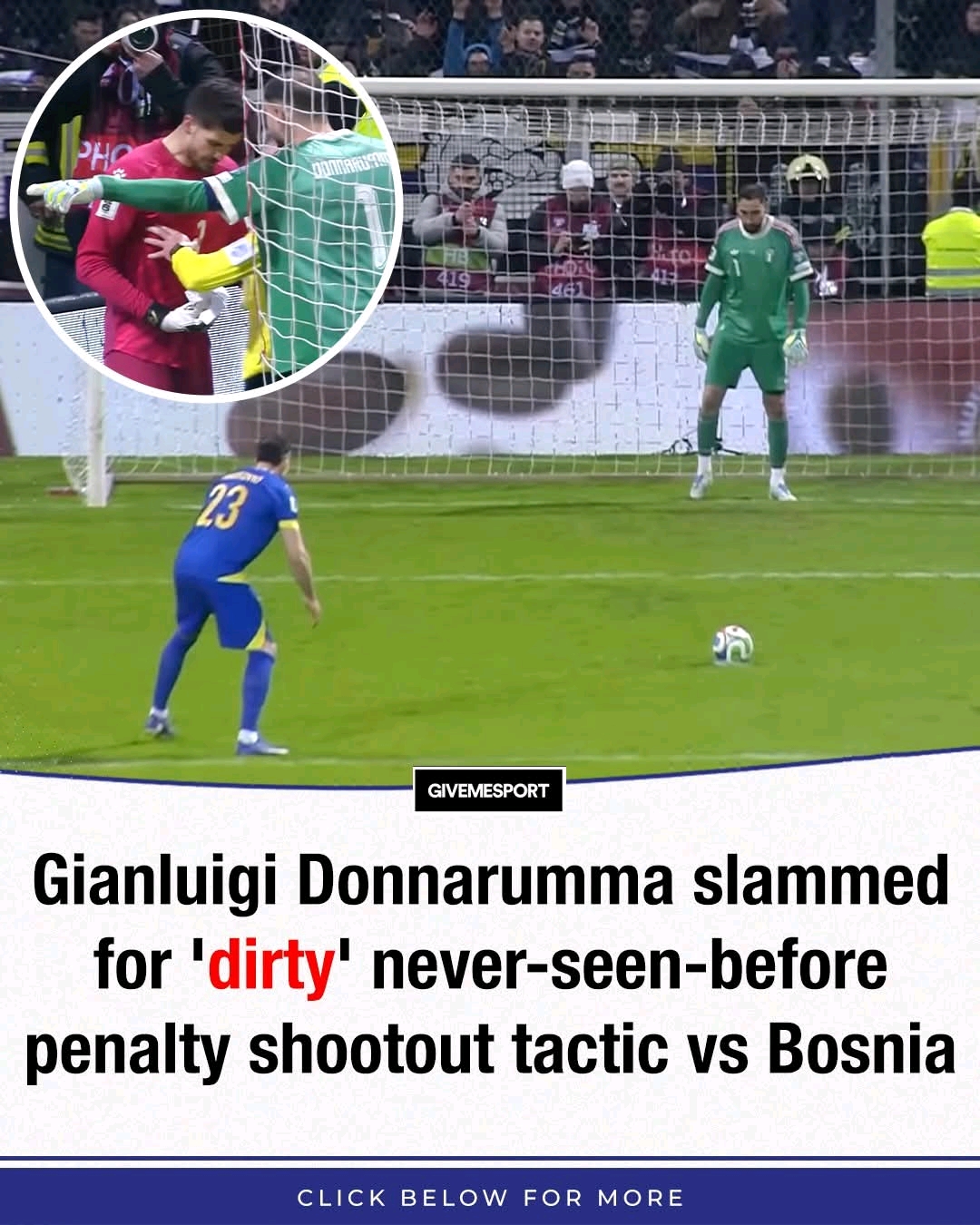
Reports later revealed what really happened. In a moment that shocked many, Donnarumma reportedly went into the goalmouth and grabbed a cheat sheet belonging to Vasilj. This piece of paper contained information about Italian penalty takers—their preferred sides, their habits, their tendencies. It was a small but important tool, something teams prepare carefully for moments like this.
But instead of ignoring it, Donnarumma allegedly tried to damage it. Some reports even suggested he attempted to tear it apart.
The reaction was immediate.
Fans, pundits, and analysts began to question his actions. Was it clever gamesmanship? Or was it something more—something that crossed the line? The debate quickly spread, and opinions were divided.
The referee, Clément Turpin, was forced to step in. The situation was tense, emotions were high, and for a moment, it looked like things could get worse for Italy. Donnarumma had already been booked earlier in the match. Another yellow card would have meant a red card. It would have been a disaster.
But in the end, he escaped punishment.
He stayed on the pitch. He stayed in goal. And Italy still had a chance.
But sometimes, moments like that do not bring strength. Sometimes, they bring more pressure.
As the shootout continued, Italy began to fall apart. One by one, their players stepped up, and one by one, they failed to deliver. Sandro Tonali was the only player who managed to score. The rest struggled. Francesco Pio Esposito missed. Bryan Cristante also failed.
Each miss increased the tension. Each failure pushed Italy closer to the edge.
On the other side, Bosnia were calm, focused, and clinical. They did not let the moment overwhelm them. They stepped up and delivered when it mattered most.
Then came the final kick.
Esmir Bajraktarević stepped forward. The weight of a nation was on his shoulders. One shot to make history. One shot to send Bosnia to the World Cup.
He did not miss.
The ball hit the net, and just like that, it was over.
Bosnia had done it.
They had secured their place at the World Cup for the first time since 2014. It was a moment of pure joy, a moment that would be remembered forever. Players celebrated, fans cried, and history was written.
For Italy, it was the complete opposite.
Another failure. Another heartbreak. Another chapter in a story that continues to hurt.
This defeat was not just about one match. It was about a pattern. A worrying trend that has followed Italy for years now. Once a dominant force in world football, they now find themselves struggling to even qualify for major tournaments.
The last time Italy truly celebrated on the World Cup stage was back in 2006. That unforgettable final, marked by the famous incident involving Zinedine Zidane and Marco Materazzi, ended in glory. Italy were champions. The world was theirs.
That team was full of legends. Andrea Pirlo controlled games with elegance. Francesco Totti provided magic. And in goal, Gianluigi Buffon stood as a symbol of greatness.
Even the current manager, Gennaro Gattuso, was part of that team. He knows what it means to win. He understands the passion, the fight, the identity of Italian football.
But this current generation is struggling to reach those heights.
Since that triumph in 2006, Italy’s World Cup journey has been filled with disappointment. In 2010, they failed to win a single game in the group stage. In 2014, the story repeated itself. Then came the unthinkable—they failed to qualify. Not once, but multiple times.
And now, once again, they find themselves on the outside, looking in.
The defeat to Bosnia feels like more than just a loss. It feels like a symbol of deeper problems. Questions will be asked. About the players. About the manager. About the system.
And of course, about Donnarumma.
His actions during the penalty shootout will be talked about for a long time. Some will defend him, saying he was trying to help his team, trying to gain an advantage in a high-pressure moment. Others will criticise him, saying it was unnecessary, that it distracted from his main job—stopping penalties.
In the end, it did not work.
Italy lost.
And the image that remains is not one of heroism, but one of frustration.
Football can be cruel. One moment, you are the hero. The next, you are the subject of criticism. Donnarumma knows this better than anyone. He has experienced the highest highs and now, once again, a painful low.
For Bosnia, this is a new beginning. For Italy, it is another painful reminder.
The journey continues, but the questions remain.