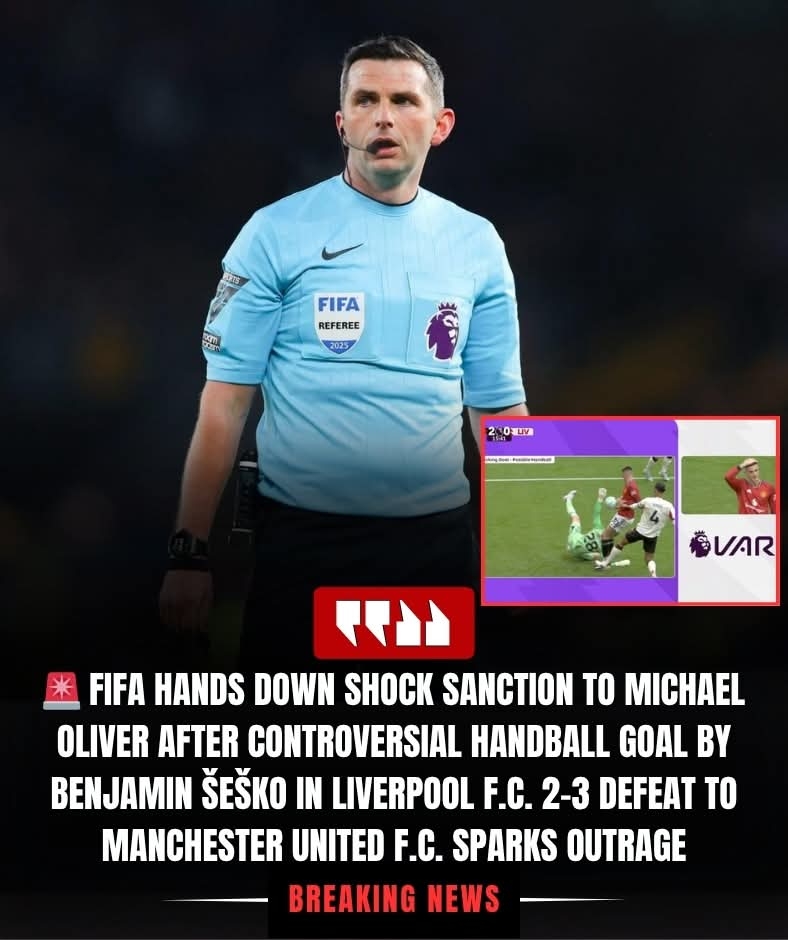
🚨 REFEREE SHOCK: FIFA HANDS BAN TO MICHAEL OLIVER AFTER VAR CONTROVERSY
The football world woke up to a storm that no one could ignore. It was not about a last-minute goal, not about a title race twist, not even about a transfer rumor. This time, it was about something that continues to divide fans, players, and managers every single week — refereeing decisions and the power of VAR.
And at the center of it all stood one man.
Michael Oliver.
A referee known for his experience, his calm presence, and his ability to handle big matches. But now, his name is being discussed for a completely different reason. Reports have emerged that FIFA have taken action against him following a controversial incident that has left fans furious, players confused, and the entire Premier League talking.
The incident itself happened during a dramatic clash between Liverpool and Manchester United. A match that already carried massive pressure, massive expectations, and massive consequences. These are the kinds of games where every decision matters, where every moment can change everything.
And in this case, one moment did exactly that.
It was in the first half when the situation unfolded. A dangerous attacking move, bodies in the box, tension rising. Then the ball made contact. Immediately, players reacted. Some shouted for a handball. Others continued playing. The crowd roared, unsure of what had just happened.
All eyes turned to the referee.
And then, as has become the norm in modern football, attention shifted to VAR.
This is where things became complicated.
Replays were shown. Angles were analyzed. Slow motion clips were examined again and again. To some, it looked clear. To others, it looked debatable. And to many, it looked like a decision that could go either way.
But the final call stood.
No intervention that changed the outcome in the way many expected. The goal linked to the incident remained. And just like that, the match took a turn.
Liverpool players were visibly frustrated. They surrounded the referee, questioning the decision. Their body language said everything. They felt something had gone wrong.
Manchester United players, on the other hand, pushed forward. In football, you take what you are given. The game continued. But the tension did not disappear.
Fans inside the stadium reacted loudly. Some cheered. Others protested. But it was outside the stadium where the reaction truly exploded.
Social media became a battlefield.
Clips of the incident spread everywhere. Fans from different sides argued endlessly. Some claimed it was a clear handball. Others defended the decision. Some blamed VAR. Others blamed the referee.
And then came the biggest reaction of all.
Questions about consistency.
Because this was not just about one incident. It was about a pattern. About how similar situations have been judged differently in the past. About how the rules seem to change depending on the moment.
That is what made this situation even more intense.
Days passed, but the conversation did not slow down. If anything, it grew stronger. Pundits discussed it. Former players gave their opinions. Managers spoke carefully, but their frustration was clear.
And then, the shock announcement arrived.
FIFA had reportedly decided to take action.
A sanction. A ban. A statement that this decision had crossed a line.
For many, this was unexpected. Referees are often protected. Mistakes are usually reviewed quietly, internally. Rarely do situations reach this level of public consequence.
But this time, it did.
The reported punishment has sent shockwaves across the football world. Not just because of what it means for Michael Oliver, but because of what it represents.
It raises questions.
Are standards changing?
Is there now more accountability for referees?
Or is this just a response to the pressure from fans and media?
For Michael Oliver, this is a difficult moment. A referee with years of experience, suddenly at the center of global criticism. One decision, one moment, now defining the conversation around him.
Refereeing is not easy. Every decision is made in real time. Even with VAR, even with technology, there is still interpretation involved. There is still pressure. There is still uncertainty.
But at this level, expectations are extremely high.
Fans expect perfection.
Players demand fairness.
And when something goes wrong, the reaction is immediate and intense.
Inside refereeing circles, this situation has created tension. Officials understand the pressure. They know how quickly things can turn. Today it is one referee. Tomorrow it could be another.
There is also concern about the role of VAR.
VAR was introduced to reduce mistakes. To bring clarity. To make the game fairer. But instead, it has created new debates. New controversies. New frustrations.
Because even with technology, decisions are still made by humans.
And humans can disagree.
That is what makes situations like this so complicated.
For Liverpool fans, this feels like injustice. A moment that changed the game. A decision that cost them. A result that could have been different.
For Manchester United fans, it is part of football. Decisions go for you, decisions go against you. That is the nature of the game.
But for the league as a whole, this is bigger than one match.
It is about trust.
Trust in referees.
Trust in VAR.
Trust in the system.
When that trust is shaken, the entire game feels the impact.
FIFA’s reported action suggests that something must change. That certain standards must be met. That decisions of this magnitude cannot be taken lightly.
But it also creates pressure moving forward.
Referees may become more cautious. More hesitant. More aware that every decision could be reviewed, criticized, and potentially punished.
Will that improve the game?
Or will it create more uncertainty?
That is the question many are asking.
Players, too, are watching closely. They want clarity. They want consistency. They want to know what is allowed and what is not.
Because in moments like this, confusion is the biggest problem.
Managers will also take note. Some will feel justified in their previous complaints. Others will worry about what this means for future matches.
The conversation around refereeing is not new. It has been part of football for decades. But with VAR, it has reached a new level.
Every decision can be replayed.
Every angle can be analyzed.
Every mistake can be highlighted.
There is nowhere to hide.
And in this case, the spotlight has been intense.
As the news continues to spread, one thing is clear.
This incident will not be forgotten quickly.
It will be discussed in future matches.
It will be referenced in future decisions.
It will remain part of the ongoing debate about how football should be officiated.
For Michael Oliver, the focus now is on what comes next. How he responds. How he rebuilds. How he moves forward from one of the most challenging moments of his career.
For FIFA, it is about maintaining credibility. Showing that decisions matter. That standards are enforced.
And for football as a whole, it is another reminder that the game is not just played on the pitch.
It is also shaped by decisions.
Decisions that can change results.
Decisions that can change seasons.
And sometimes, decisions that can change everything.
This was one of those moments.
A moment that started with a handball incident.
But ended with a shock that the entire football world is still trying to understand.