“Arsenal have lived off those scrappy, aggressive goals all season. Blocking keepers, crowding the six-yard box, little nudges here and there. Suddenly, when it happens against them, it’s clear and obvious. Give me a break.” – Joe Hart after West Ham’s late equaliser v Arsenal was disallowed.

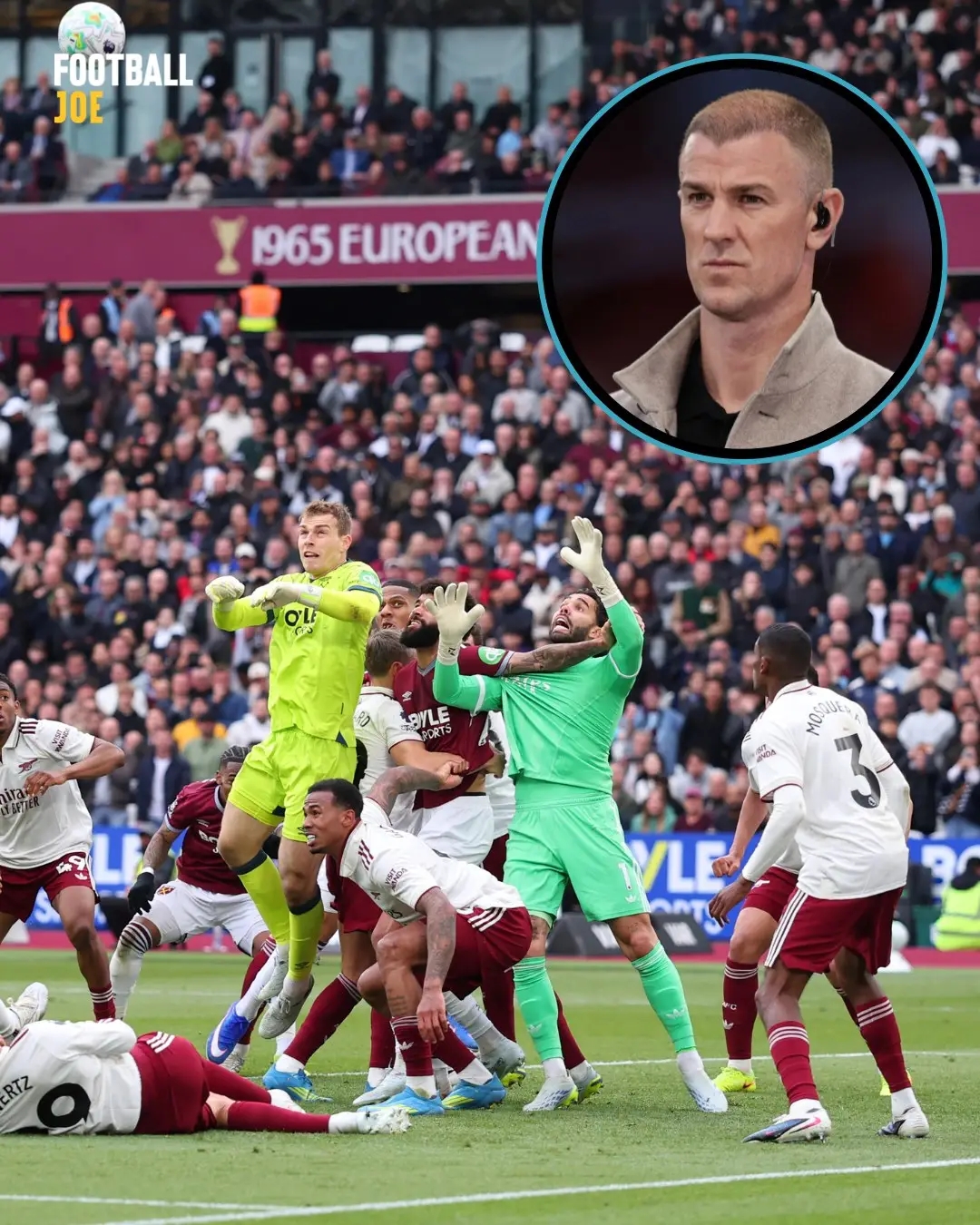
The words came out with frustration, with disbelief, and with a tone that many football fans instantly understood. When Joe Hart spoke after the dramatic clash between West Ham United and Arsenal, it was not just a reaction to one decision. It felt like a release of everything that has been building up all season.
“Arsenal have lived off those scrappy, aggressive goals all season,” he said. “Blocking keepers, crowding the six-yard box, little nudges here and there. Suddenly, when it happens against them, it’s clear and obvious. Give me a break.”
That statement did not just echo in the studio. It spread across social media, across fan discussions, across football circles everywhere. Because deep down, it touched on something bigger than just one disallowed goal.
It touched on consistency. It touched on fairness. And most importantly, it touched on perception.
To understand why this moment has become so powerful, you have to go back to what actually happened on the pitch. It was one of those games where everything was tight, tense, and full of pressure. Arsenal were chasing the title, knowing that every point matters. West Ham were fighting for survival, knowing that one moment could define their season.
When Leandro Trossard scored late in the game, it looked like Arsenal had done enough. The away fans celebrated, the players pushed forward, and the clock continued to tick.
But football is never that simple.
In the final moments, West Ham won a corner. The ball was delivered into the box, bodies were everywhere, arms were raised, shirts were pulled, and chaos took over. Then the ball found the back of the net.
For a split second, the stadium exploded.
Players ran, fans screamed, and hope came alive.
But then came the pause.
The referee stood still. The players looked around. And everyone knew what was coming next.
VAR.
In today’s game, that four-letter word can change everything. It can turn heroes into villains, celebrations into silence, and joy into frustration.
The replay showed contact in the box. It showed a West Ham player holding onto David Raya. It showed movement, obstruction, and a moment that could be interpreted in different ways depending on who you ask.
After the review, the decision was made.
No goal.
Foul on the goalkeeper.
Just like that, West Ham’s moment was gone.
And that is where Joe Hart’s words begin to carry weight.
Because what he was really saying was not just about that one incident. He was questioning a pattern. A feeling that certain types of goals, certain types of physical play, are accepted in some situations but punished in others.
He was asking a simple question that many fans are now asking:
Why is it okay sometimes, but not okay now?
Football has always had a physical side. Especially during corners. Players push, pull, block, and fight for position. It is messy. It is chaotic. And it is often where matches are decided.
Teams like Arsenal have used that to their advantage this season. They have scored goals from corners, from crowded situations, from moments where physical presence makes the difference.
And no one complained when those goals were given.
No VAR intervention. No long delays. No overturned decisions.
So when a similar situation happens against them, and suddenly it becomes a foul, it creates confusion.
That confusion turns into frustration.
And that frustration turns into statements like the one Joe Hart made.
But to be fair, there is another side to the story.
The laws of the game clearly state that goalkeepers must be protected. Any action that stops them from playing the ball — especially holding their arms — can be considered a foul.
In this case, the referee and VAR believed that is exactly what happened.
From a technical point of view, the decision can be defended.
But football is not played in slow motion.
It is played in real time.
And that is where the problem begins.
Because in real time, these kinds of contacts happen all the time. Every corner has some level of pushing, pulling, and blocking. If every single one was reviewed with the same level of detail, many goals would be ruled out.
So the question becomes:
Where do you draw the line?
That is the heart of this entire debate.
Joe Hart’s frustration is not just about Arsenal. It is about the lack of a clear line. It is about the feeling that decisions change depending on context, pressure, or even narrative.
And that is dangerous for the game.
Because once fans start believing that decisions are inconsistent, trust begins to fade.
And without trust, every decision becomes suspicious.
Every VAR check becomes controversial.
Every result becomes questioned.
That is exactly what is happening now.
Fans of West Ham feel robbed. They believe they deserved that goal, that moment, that point. For them, it is not just about rules — it is about survival, about staying in the league, about everything their club is fighting for.
On the other side, Arsenal fans will argue that the rules were applied correctly. That a foul is a foul, no matter when it happens. That protecting the goalkeeper is important, especially in such crowded situations.
And they are not wrong either.
This is what makes football so powerful and so frustrating at the same time.
Two sides. Two perspectives. Both believing they are right.
Meanwhile, the bigger picture continues to unfold.
Arsenal move closer to the title. Every win, every decision, every moment pushes them forward. Under Mikel Arteta, they have built a team that knows how to win, even in difficult situations.
West Ham, however, are left looking behind. Looking at what could have been. Looking at a moment that slipped away not because of a missed chance, but because of a decision.
And in football, those moments hurt the most.
Because you cannot control them.
You can train, prepare, and fight for every ball. But when the final decision is taken out of your hands, it leaves a different kind of pain.
Joe Hart understands that feeling. As a former goalkeeper, he knows how difficult it is to deal with pressure in the box. He knows what it feels like to be blocked, to be challenged, to fight through bodies just to reach the ball.
But he also knows the other side.
He knows that not every contact is given as a foul.
He knows that sometimes, you just have to deal with it.
And that is why his words hit differently.
Because they come from experience.
Because they come from someone who has seen both sides of the game.
As the season approaches its final stages, these debates will only grow louder. Every match matters. Every point counts. And every decision is magnified.
The Premier League is known for its intensity, its drama, and its unpredictability. But now, it is also becoming known for its controversies.
VAR was introduced to bring clarity.
To reduce mistakes.
To make the game fairer.
But instead, it has created a new kind of debate.
Not about whether decisions are right or wrong, but about whether they are consistent.
And until that question is answered, moments like this will continue to divide fans, players, and experts alike.
Joe Hart’s words will not be forgotten quickly.
Because they capture something real.
Something that many people feel but cannot always express.
A sense that the game is changing.
A sense that the rules are being interpreted differently.
A sense that sometimes, football is no longer just about what happens on the pitch.
But despite all of this, the game goes on.
The next match will come.
Another decision will be made.
Another debate will begin.
And somewhere, another voice will rise to question it all again.
Because that is football.
Beautiful.
Chaotic.
Emotional.
And sometimes, deeply controversial.