Respect, Anger, and Big Reactions After VAR Drama 🗣 *“I’m not even a fan of Rangers FC, but I fully support this move. Respect to the club!”* 🗣 *“Shame on VAR and the officials — this is ruining football! “Strong response. At least Rangers had the courage to speak out

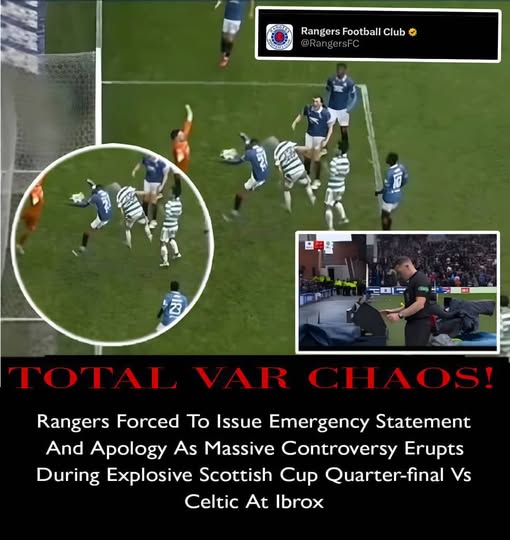
There are moments in football that transcend the ninety minutes. Moments that ripple far beyond the final whistle, beyond the dressing rooms, beyond the match reports and the post-game punditry. Moments that force supporters, clubs, governing bodies, and the watching world to confront uncomfortable truths about the game they love. The VAR controversy that erupted during the Scottish Cup clash between Rangers FC and Celtic FC at Ibrox was precisely one of those moments — and the fallout has been nothing short of seismic.
When Rangers released their official statement in response to the Scottish Football Association’s apology over the controversial VAR incident, it wasn’t simply a club reacting to a bad refereeing decision. It was something far more significant. It was an institution drawing a line in the sand. It was a declaration that enough was enough. And judging by the reaction from football fans not just in Scotland, but across the globe, a great many people were ready to stand behind that line.
To understand the weight of Rangers’ response, you first have to understand what happened at Ibrox on that afternoon — a game already crackling with the electricity that only an Old Firm encounter can generate. The Scottish Cup, one of the most storied domestic cup competitions in world football, provided the backdrop. Two of the most decorated clubs in British football history provided the cast. And VAR, that technology introduced to eliminate controversy and deliver justice, somehow managed to produce exactly the opposite.
The details of the decision itself have been dissected, debated, and replayed countless times since. What matters is not merely what was decided, but how it was decided — the process, the delay, the confusion, and ultimately the conclusion that left the Ibrox faithful stunned and the wider footballing community deeply unsettled. In a fixture where every decision is magnified tenfold, where emotions run at a frequency that most derbies can only dream of matching, the officiating call in question landed like a grenade.
Supporters inside the stadium were left baffled. Those watching at home were reaching for their phones before the dust had even settled. Within minutes, the footage was everywhere — social media, fan forums, WhatsApp groups, television studios. The consensus forming in real time was damning: this was wrong. And not just slightly wrong, not a judgment call that reasonable people might disagree on, but fundamentally, inexcusably wrong.
In the aftermath, the Scottish Football Association did something that governing bodies rarely do with any meaningful speed or genuine humility — they apologised. An acknowledgment was issued, conceding that an error had been made in the VAR process during the match. For many, it was a moment that should have brought closure. An official body admitting fault. A rare admission that the system had failed.
But for Rangers FC, and for a significant portion of the football community, an apology — however unprecedented it may have seemed — was simply not sufficient. Because an apology, however sincere, does not undo a result. It does not restore what was taken. It does not address the systemic questions that the incident raised about the competence, consistency, and governance of officiating in Scottish football. And most critically, it does not guarantee that what happened will not happen again.
“Sorry” is a word. What football demands, at this level, is accountability. What it requires is structural change. What it needs is the confidence that the tools introduced to make the game fairer are actually making it fairer — not becoming new instruments of confusion and controversy.
When Rangers released their official club statement, it was clear that considerable thought had gone into every word. This was not a knee-jerk reaction fired off in anger. This was a carefully constructed, measured, and powerful piece of communication — the kind that signals an institution that takes itself seriously and demands to be taken seriously in return.
The club acknowledged the SFA’s apology, but made clear that acknowledgment is not the same as acceptance. Rangers articulated what many had been feeling but few had been willing to say in such direct terms: that the standards of officiating and the application of VAR in Scottish football are not good enough, and that the consequences of these failures extend beyond individual matches. They affect integrity. They affect trust. They affect the very foundations upon which competitive football is supposed to stand.
What struck observers most forcefully was the tone — firm without being inflammatory, assertive without being reckless. There was no finger-pointing at Celtic. There was no attempt to weaponise the moment for tribal gain. Instead, Rangers positioned themselves as advocates for something larger: the protection of the game’s integrity, the demand for proper standards, and the right of every club and every set of supporters to know that what happens on the pitch will be decided by football, and football alone.
It was, by any fair assessment, a bold and principled stand. And the response from the wider football community reflected that.
Perhaps the most striking dimension of the entire saga has been the reaction from football supporters who have no allegiance to either club involved. In a sport where tribalism is often the dominant force — where anything one side does is reflexively opposed by the other — the response to Rangers’ statement cut across the usual dividing lines in a remarkable way.
“I’m not even a fan of Rangers FC, but I fully support this move. Respect to the club.”
That sentiment, expressed in one form or another across social media platforms and fan forums, was repeated thousands of times. Supporters of clubs from across Scotland, England, and beyond were lending their voice to the idea that Rangers had done something worth applauding — not because of which club they are, but because of what they chose to stand for in this moment.
“Strong response. At least Rangers had the courage to speak out.”
Courage is an interesting word to use in this context, but it is entirely appropriate. Because clubs, even large and powerful ones, do not routinely challenge governing bodies publicly. The machinery of football administration has a way of discouraging dissent. Relationships matter. Future decisions matter. Clubs that make too much noise can find themselves navigating a landscape that has quietly shifted against them. To speak out the way Rangers did — clearly, publicly, and on the record — required a willingness to accept that there might be a cost.
It would be a mistake to view this controversy as a purely Scottish problem, or as a purely Rangers-Celtic problem. The dysfunction on display at Ibrox is part of a much wider crisis of confidence in VAR that has been building across European football for several years.
Since its introduction to top-level football, VAR has delivered a deeply mixed legacy. There have been moments where it has intervened and delivered clear justice — overturning obvious errors, identifying clear handballs or offside positions that the naked eye simply cannot catch. But there have been many more moments where it has done the opposite: where the lengthy delays, the marginal lines, the inconsistent application of rules, and the cold, clinical overturning of naturally scored goals have drained the emotion and the humanity from the sport.
Supporters across Europe have grown increasingly frustrated. Managers, players, and pundits have voiced concerns. Even many of those who were VAR’s earliest and most vocal supporters have begun to question whether the implementation has matched the promise. The technology, they argue, is not the problem. The protocols, the inconsistency, and the lack of transparency are.
Scottish football, in particular, has faced intense scrutiny. With a smaller pool of match officials, with fewer resources dedicated to training and development, and with the enormous pressure that comes from one of the most passionately contested domestic rivalries in world football, the margin for error is impossibly thin. A mistake in a League One match somewhere is unfortunate. A mistake in an Old Firm Scottish Cup tie is an earthquake.
The anger expressed in the immediate aftermath of the incident was raw, understandable, and — to a significant extent — justified. Because beneath the heat of that frustration lies a genuine and legitimate fear: that football is drifting away from the values that made it the most beloved sport on the planet.
Football’s power has always rested on its simplicity. A ball. A pitch. A goal. The eruption of joy when the net ripples. The agony of a near miss. The unfiltered, spontaneous emotion that connects a child watching their first ever match to a seventy-year-old supporter who has seen thousands of them. VAR, at its worst, interrupts that emotional circuit. It inserts delay, doubt, and clinical analysis into moments that were always supposed to belong to instinct and passion.
When supporters say VAR is ruining football, they are not simply venting frustration at a bad decision. They are expressing a deeper unease about the soul of the game. They are asking: who is this for? Is this technology serving the sport, or is the sport increasingly serving the technology?
These are questions that UEFA, FIFA, and domestic governing bodies across the world are going to have to answer — and answer convincingly — if they are to restore the faith of the people who actually fill the stadiums, buy the shirts, and pay the subscriptions that keep the whole machine running.
Strip away the emotion and the noise, and what Rangers FC’s statement ultimately amounts to is a series of very reasonable demands.
They are asking for consistency. Not perfection — no one in football expects perfection — but a consistent and clearly articulated set of standards that are applied equally, regardless of the teams involved. Every supporter of every club in Scotland, and indeed every country where VAR operates, has the right to know what the rules are and to trust that those rules will be applied without fear or favour.
They are asking for transparency. One of VAR’s most damaging characteristics has been its opacity. Decisions are made in a review area, with conversations that supporters and broadcasters cannot hear, following processes that are never fully explained in the moment. When a decision is wrong, the reasoning behind it should be made public, and those responsible should be held to account. Not punished unfairly — but accountable.
They are asking for improvement. Not the abandonment of VAR — that ship has sailed, and the technology, used properly, can genuinely improve the game — but meaningful investment in training, in protocol development, in the quality of decision-making at every level. The SFA’s apology is a start. But an apology without a plan is just words.
And perhaps most importantly, Rangers are asking for their voice — and the voices of clubs like them — to be heard and taken seriously by those who govern the game. Football clubs are not simply commercial entities to be managed and administered. They are institutions. They carry history, identity, and community on their shoulders. When they speak, they deserve to be listened to.
This controversy arrives at a moment when Scottish football finds itself at something of a crossroads. The domestic game has seen genuine progress in recent years — in investment, in infrastructure, in the quality of its product on the European stage. Both Rangers and Celtic have demonstrated that Scottish clubs can compete meaningfully in UEFA competition. The profile of the Scottish Premiership has never been higher.
But for that progress to continue, for Scottish football to build credibly on the platform it has constructed, the foundations must be solid. And the foundations of any football league, any cup competition, any domestic football pyramid, are the integrity of its officiating and the confidence that supporters have in the fairness of the competition.
If that confidence is eroded — whether by one bad decision or by a pattern of bad decisions — everything built above it becomes fragile. Sponsors question their investment. Broadcasters reassess the value of rights. Supporters disengage. And the sport suffers.
The SFA has an opportunity here. Not just to apologise, and not just to move on, but to use this moment as the catalyst for genuine, meaningful reform. The kind of reform that would make Scottish football stronger, fairer, and more trustworthy. That would be a legacy worth building. That would turn a controversy into something constructive.
There is something quietly remarkable about a moment when a football club — an Old Firm club, no less, one historically associated with a very particular set of loyalties and passions — receives expressions of support and solidarity from fans across the footballing world who have no personal stake in its fortunes.
“Respect to the club.” Not for their history. Not for their trophies. But for their willingness, in a difficult moment, to stand up and say what needed to be said.
Football needs clubs that are willing to do that. It needs institutions large enough and brave enough to challenge the status quo, to hold governing bodies accountable, and to advocate for standards that protect the sport for everyone — not just for themselves.
Rangers FC, through this statement, positioned themselves as exactly that kind of institution. Whatever one’s allegiances, whatever one’s feelings about the Old Firm rivalry, that is a moment worth acknowledging.
The VAR drama that unfolded in the Scottish Cup clash between Rangers and Celtic was not, in the end, just about one decision. It was about something far more fundamental: the soul of the game.
Football belongs to its supporters. It belongs to the communities that gather around it, to the generations of families who have passed it down like a sacred inheritance, to the children who fall in love with it for the first time and spend the rest of their lives in its grip. It does not belong to governing bodies. It does not belong to television companies or sponsors or algorithm-driven engagement metrics.
When a club stands up and says — clearly, publicly, and at potential cost to themselves — that the game must be better, that its supporters deserve better, that the integrity of competition must be protected, they are doing something that matters. They are fighting for that soul.
The anger is real. The frustration is legitimate. But in the middle of it all, something worth holding onto has emerged: the sense that football, even now, still has people inside it who care enough to fight for what it should be