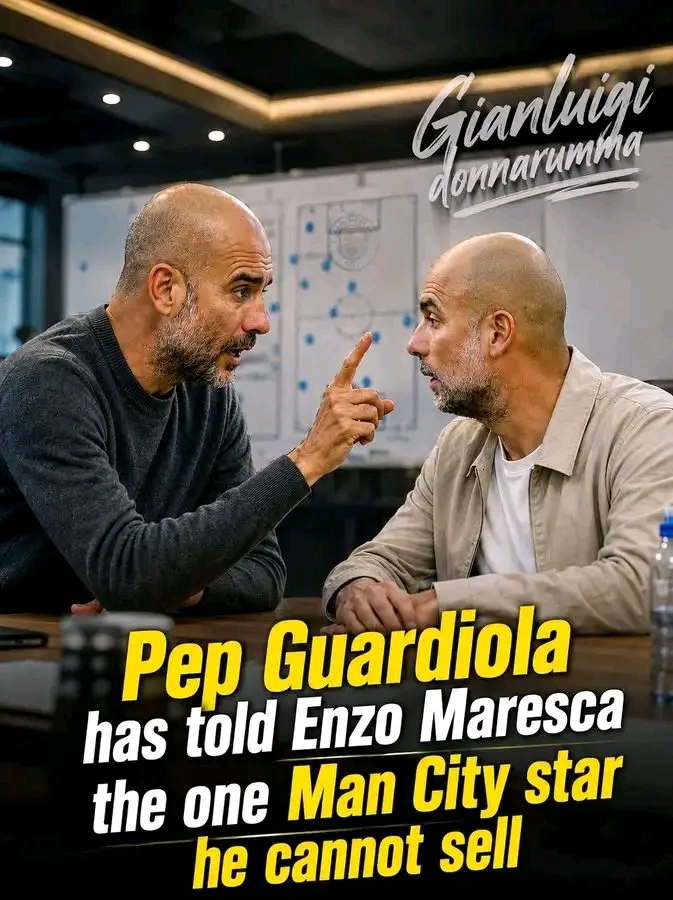
Pep Guardiola has already made it clear to Enzo Maresca that he cannot afford to sell Phil Foden for any price. Guardiola earmarked the homegrown playmaker as a star of the future well before he had established himself in the first team, seeing him as the heir to City great David Silva. He went as far as saying he wouldn’t sell the then-teenager for €500million.

For years, Pep Guardiola has coached some of the greatest footballers of the modern era. From Lionel Messi at Barcelona to Robert Lewandowski at Bayern Munich and Kevin De Bruyne at Manchester City, Guardiola has worked with players most managers can only dream about. Yet despite all the world-class stars who passed through his dressing rooms, there was always something different about Phil Foden.
Long before the rest of the football world fully understood just how special Foden could become, Guardiola had already made up his mind. He saw the young English midfielder not simply as another academy prospect but as the future face of Manchester City. In Guardiola’s eyes, Foden was untouchable.
The legendary manager made that perfectly clear years ago when he stunned football fans by declaring that he would not sell the teenager for €500 million.
At the time, many supporters thought Guardiola was exaggerating to protect one of his brightest young talents. But as the years passed and Foden developed into one of the most technically gifted footballers in Europe, those comments began to look less like emotion and more like prophecy.
Now, with Guardiola officially gone from Manchester City and Enzo Maresca stepping into one of the hardest jobs in football, the message from Guardiola remains impossible to ignore.
Whatever happens during the new era at City, one thing is already clear: Phil Foden cannot be sold at any price.
The situation surrounding Manchester City has changed dramatically over recent months. Guardiola’s departure has created uncertainty across the entire club. Senior players are being linked with exits, rival clubs are circling around City’s biggest stars, and questions are growing about whether the club can maintain its dominance without the man who built the dynasty.
But while several names continue to appear in transfer rumours, insiders believe there is one player the club simply cannot afford to lose.
That player is Phil Foden.
Foden represents far more than just talent. He represents identity, continuity, and the emotional connection between Manchester City’s past, present, and future. In an era dominated by expensive signings and global superstars, Foden became the local boy who rose through the academy and conquered the world without ever abandoning the club that raised him.
Born in Stockport and developed inside City’s academy system, Foden was viewed as special almost immediately. Coaches spoke about his balance, intelligence, close control, and fearlessness from a young age. Even when surrounded by older players, he looked technically superior.
But talent alone does not guarantee success at the highest level.
Many young players shine in academy football only to disappear when the pressure of senior football arrives. Guardiola understood this better than anyone, which is why he handled Foden’s development so carefully.
Unlike many clubs that rush their young stars into the spotlight, Guardiola protected him. He resisted pressure to start him every week too early. He refused loan offers from clubs desperate to take him temporarily. Instead, Guardiola kept Foden close, allowing him to learn directly inside one of the best footballing environments in the world.
It frustrated some supporters at first.
Fans constantly asked why Foden was not playing more minutes. Pundits questioned whether Guardiola trusted young English players enough. Rival supporters joked that the teenager should leave if he wanted a real career.
But Guardiola ignored all the noise.
Privately, he believed Foden had the potential to become one of the greatest players Manchester City had ever produced.
More importantly, he saw similarities between Foden and one of the club’s most beloved legends: David Silva.
For nearly a decade, Silva had been the creative heartbeat of Manchester City. The Spanish playmaker transformed the club with his elegance, intelligence, and technical brilliance. He controlled games with calmness and precision, becoming one of the finest midfielders in Premier League history.
Replacing Silva looked almost impossible.
Yet Guardiola believed Foden possessed the intelligence and technical quality to eventually inherit that role.
The comparison was enormous pressure for a young player, but Guardiola never doubted it. He repeatedly praised Foden publicly, often more aggressively than expected. His famous €500 million comment became one of the clearest examples of just how highly he rated the youngster.
At a time when Foden had barely established himself in the first team, Guardiola was already telling the world that the midfielder was priceless.
And over time, Foden proved exactly why.
Season after season, his influence grew.
What made Foden so dangerous was his versatility. He could operate as a winger, attacking midfielder, central midfielder, false nine, or even deeper in build-up phases. Wherever Guardiola placed him, he adapted quickly.
Technically, he looked almost perfect for Guardiola’s football.
His first touch allowed him to escape pressure effortlessly. His movement between defensive lines constantly created space. He understood positional rotations naturally, and his acceleration over short distances made him almost impossible to stop in tight areas.
But beyond the technical brilliance, Guardiola loved Foden’s mentality.
The Manchester City manager has always valued players who are obsessed with improvement. He demands concentration, tactical discipline, and relentless work ethic every single day. Many talented players struggle with those expectations.
Foden embraced them.
Training sessions reportedly became mini masterclasses between Guardiola and his young protégé. The manager constantly challenged him to think faster, move smarter, and improve every aspect of his game.
Over time, Foden evolved from promising academy graduate into one of the defining players of Manchester City’s modern era.
He scored crucial goals in title races.
He delivered match-winning performances in the Champions League.
He became a leader inside the dressing room despite still being relatively young.
And perhaps most importantly, he became the emotional bridge between Guardiola’s golden era and whatever comes next.
That is why Guardiola’s warning to Enzo Maresca carries so much importance.
Maresca may now be responsible for rebuilding Manchester City after Guardiola’s departure, but he cannot rebuild by sacrificing the club’s identity. And in many ways, Phil Foden now is that identity.
Supporters see themselves in him.
Unlike many modern stars who arrive for huge transfer fees before leaving years later, Foden belongs to Manchester City emotionally. He grew up supporting the club. He understands the culture. He understands what the badge means to local supporters.
For fans worried about losing the spirit of Guardiola’s era, Foden represents stability.
Selling him would not simply weaken the squad technically. It would damage the emotional soul of the club.
That is why Guardiola reportedly made his feelings so clear internally for years. Even when enormous transfer speculation occasionally emerged from rival clubs, City never seriously entertained discussions.
The manager’s position remained absolute.
Phil Foden was not available.
Not for €100 million.
Not for €200 million.
Not even for €500 million.
In modern football, where almost every player has a price, Guardiola’s stance felt extraordinary. But he understood something many others were only beginning to realize: truly elite footballers who combine world-class ability with deep emotional loyalty are almost impossible to replace.
Now, however, the fear among supporters is growing again.
With Guardiola gone, rival clubs may believe City are more vulnerable than before. European giants are already monitoring several Manchester City stars, and uncertainty surrounding the future direction of the club has intensified transfer speculation.
Foden’s name naturally attracts attention.
Any club in world football would love to build around him. His age, technical quality, versatility, and commercial value make him one of the most desirable players on the planet.
Clubs such as Real Madrid, Paris Saint-Germain, and Bayern Munich constantly search for elite attacking midfielders capable of defining an era.
Foden fits that description perfectly.
But Manchester City understand what losing him would mean.
Especially now.
The club is already entering a period of transition. Guardiola’s departure alone creates uncertainty. Veteran leaders may leave. Tactical systems could change. Recruitment strategies may evolve.
In moments like these, clubs need players who represent continuity.
Foden is the ultimate continuity player.
He understands the standards Guardiola demanded.
He understands the tactical principles that made City successful.
He understands the pressure of competing for every trophy every season.
Most importantly, he understands the responsibility of carrying Manchester City forward into the next generation.
For Enzo Maresca, this creates both an opportunity and a challenge.
Maresca worked within Guardiola’s coaching structure previously and understands the football philosophy City want to preserve. But succeeding Guardiola is almost impossible emotionally because comparisons will happen immediately.
Results alone will not define him.
Fans will judge whether the spirit of Guardiola’s football survives.
And that survival depends heavily on players like Foden remaining central to the project.
Many insiders believe Foden could eventually become the captain of Manchester City permanently. He already carries leadership qualities quietly through his professionalism and performances. As older figures gradually move on, his influence inside the dressing room is expected to grow even stronger.
Guardiola likely understood this long before everyone else.
He always seemed emotionally attached to Foden in a unique way. While Guardiola often praised world-class stars publicly, his admiration for Foden carried something more personal. It felt almost protective.
He knew how rare players like Foden truly are.
Not just technically elite.
Not just tactically intelligent.
But emotionally connected to the club itself.
That combination is priceless.
And as Manchester City prepare for life after Guardiola, the importance of protecting Foden becomes even greater.
Because dynasties do not survive simply through money or tactics.
They survive through symbols.
Players who carry the identity of an era forward.
At Barcelona, it was players like Xavi, Iniesta, and Messi.
At Manchester United, it was the Class of ’92.
At Liverpool, Steven Gerrard carried the soul of the club through difficult transitions.
For Manchester City, Phil Foden now represents that kind of figure.
The academy graduate who became a superstar.
The local boy who conquered Europe.
The player Guardiola trusted more than almost anyone else.
And the one footballer the legendary manager believed should never, under any circumstances, be sold.
Not for €500 million.
Not for any amount.
Because some players are simply too important to lose.