After reviewing every major Premier League incident of 2025/26, it was concluded that Manchester City should have entered the final matchday 2 points clear of Arsenal. • Dalot should have been sent off • City should have had a penalty vs Newcastle

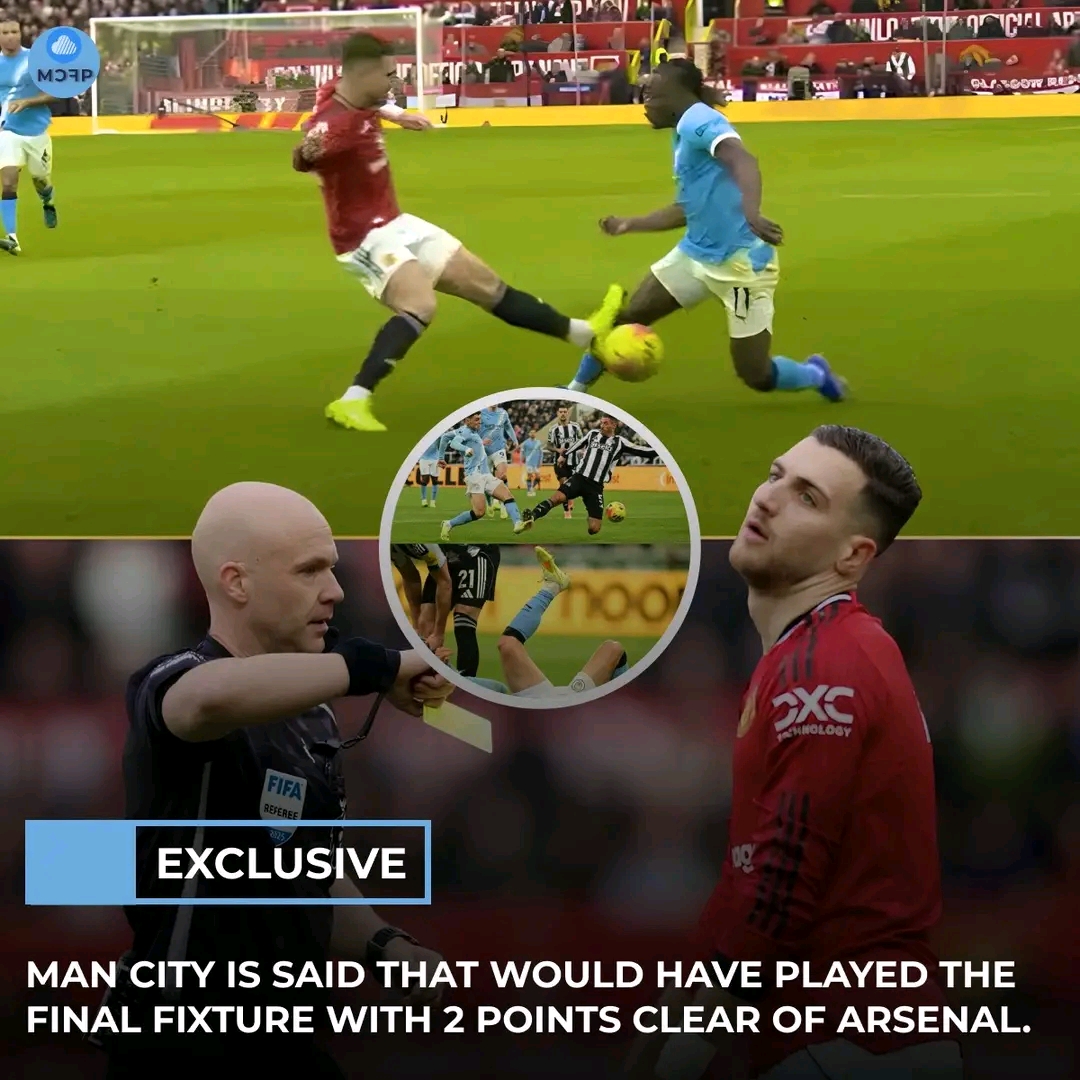
The final review of the 2025/26 Premier League season has exploded into one of the most controversial discussions in recent English football history, with fresh analysis suggesting that Manchester City were directly denied crucial decisions that could have completely changed the title race against Arsenal.
According to a detailed breakdown of every major refereeing incident reviewed across the season, including VAR interventions, missed calls, and post-match assessments, the conclusion is explosive and simple at the same time: Manchester City should have entered the final matchday two points ahead of Arsenal, not level or behind in the tense title battle that went down to the wire.
The findings have sparked outrage, debate, and renewed criticism of refereeing standards in the Premier League, with fans, analysts, and former officials all weighing in on what could have been one of the most decisive “hidden turning points” in a title race for years.
At the centre of the storm are two major incidents that the review has highlighted as clear mistakes: a missed red card for Manchester United defender Diogo Dalot, and a denied penalty for Manchester City in a crucial match against Newcastle United.
These two decisions alone, according to the analysis, would have changed not only the points total but also the psychological momentum of the entire title race.
The first incident involves Diogo Dalot, whose challenge during a key fixture was reviewed and later judged by the retrospective panel as deserving of a straight red card. The tackle, described in the report as “reckless and dangerous in real time and even more obvious on replay,” was not punished at the time with the full severity it warranted.
Instead of reducing Dalot’s team to ten men, the match continued at full strength, allowing the game to unfold in a way that many now believe unfairly influenced the broader league context. The report does not just focus on the incident itself but also on the ripple effect it created across the season, especially in a title race where every single point mattered.
The second incident, and arguably the one that has triggered even more frustration among Manchester City supporters, came in a high-pressure clash against Newcastle. Manchester City were denied a penalty in a moment that the review describes as “clear enough to be given in real time and unquestionable after VAR review.”
The incident occurred during a tightly contested match where City were pushing for maximum points. The failure to award the penalty meant City left the match with fewer points than their performance statistically suggested they deserved. According to the analysis, if the penalty had been awarded and converted, Manchester City would have secured an additional two points from that match alone.
When combined with the Dalot red card incident—which could have shifted results in another fixture entirely—the cumulative impact becomes enormous. The review concludes that these two decisions alone would have been enough to place Manchester City two points ahead of Arsenal going into the final day of the season.
This is not just about isolated mistakes. It is about timing, context, and consequence. Every Premier League season contains controversial decisions, but what makes this case so explosive is how these moments align directly with the title race.
The Premier League, widely regarded as the most competitive football league in the world, often comes down to fine margins. A single goal, a single penalty, or a single red card can decide the destiny of the trophy. In this case, the analysis suggests that those margins were not just fine—they were decisive, and potentially incorrect.
Supporters of Manchester City argue that this review confirms what they have felt all season: that key decisions did not go their way at critical moments. They believe the data now supports the idea that their team was not only competing against Arsenal on the pitch, but also against a series of refereeing errors that cumulatively shaped the outcome of the league.
On the other side, Arsenal supporters have pushed back strongly against the conclusions, arguing that football seasons cannot be rewritten through retrospective analysis. They insist that every team experiences controversial decisions over the course of a campaign, and that focusing on two incidents ignores the broader picture of consistency across 38 matches.
But the numbers in the review are difficult to ignore. The report breaks down points swings, expected outcomes, and match state changes that would likely have occurred if correct decisions had been made in real time. In both highlighted cases, the adjustments favour Manchester City in a way that directly impacts the title race.
The Dalot red card incident is particularly significant because it is not just about one match. A red card changes the dynamic of a game completely. It affects team structure, momentum, tactical approach, and psychological pressure. Playing with a numerical advantage often leads to higher chances of winning, and in a tightly contested league, those advantages are magnified across the season.
Meanwhile, the missed penalty against Newcastle is even more direct in its impact. Penalties are among the highest-probability goal-scoring opportunities in football. The review assumes a standard conversion rate and recalculates the likely outcome of the match based on statistical models. The conclusion is clear: Manchester City would have gained at least one additional point, and potentially two depending on game management after the goal.
When these two incidents are combined, the outcome shifts the entire league table narrative. Instead of entering the final matchday chasing or level with Arsenal, Manchester City would have been ahead by two points.
That shift is enormous in a title race. It changes strategy, pressure, and mentality. A team leading by two points going into the final day plays with control. A team chasing must take risks. That psychological difference alone can decide a championship.
The report has also reignited wider debate about VAR in the Premier League. Introduced to reduce clear and obvious errors, VAR was meant to bring consistency and fairness. However, critics argue that it has instead created confusion, inconsistency, and frustration.
In both highlighted incidents, VAR is central to the controversy. In the Dalot case, the argument is that VAR should have recommended a red card review. In the Newcastle penalty incident, the belief is that VAR should have intervened more strongly to correct the on-field decision.
Instead, in both cases, the outcome remained unchanged, and the consequences were felt across the entire season.
Former referees and analysts have also weighed in, with some agreeing that the decisions were incorrect, while others insist that football is a fast game where interpretation plays a major role. The debate reflects a deeper truth about modern football: even with technology, subjectivity still plays a huge role in defining outcomes.
For Manchester City, however, the conclusion of the review feels like a missed opportunity that cannot be recovered. They can point to performance, statistics, and dominance in certain matches, but the table remains the final truth—and that truth says they were not ahead when they potentially should have been.
For Arsenal, the situation is more complex. While they benefit from the final standings, the narrative now surrounding their position includes external factors beyond their control. Their title challenge is being viewed not only through their performances but also through the lens of refereeing controversies that affected rival outcomes.
This is what makes the report so sensitive. It does not accuse any team of wrongdoing. Instead, it highlights how human decisions within officiating can shape the destiny of an entire season.
As discussions continue, one thing is clear: this review will not be forgotten quickly. It has reopened debates about fairness, consistency, and the role of technology in football. It has also added another layer to one of the most intense title races in recent Premier League memory.
Whether fans agree or disagree with the conclusions, the impact of the analysis is undeniable. It forces the football world to confront a difficult question: when margins are this small, and decisions this influential, can any title race ever be considered purely decided on the pitch?
For Manchester City, the belief is now stronger than ever that the answer is no.
And for Arsenal, the challenge is to hold on to a title victory that now carries an asterisk in the minds of many supporters and analysts, fair or unfair.
In the end, the 2025/26 season will not only be remembered for goals, tactics, and performances, but also for the controversy that suggests the final table might have told a different story if just a few key moments had gone the other way.