Elliot Anderson has reportedly rejected a move to Manchester City, delivering a brutal assessment of the Premier League champions. The midfielder is said to have claimed City are “not at the level I need to play at”, triggering huge debate and disbelief across the football world

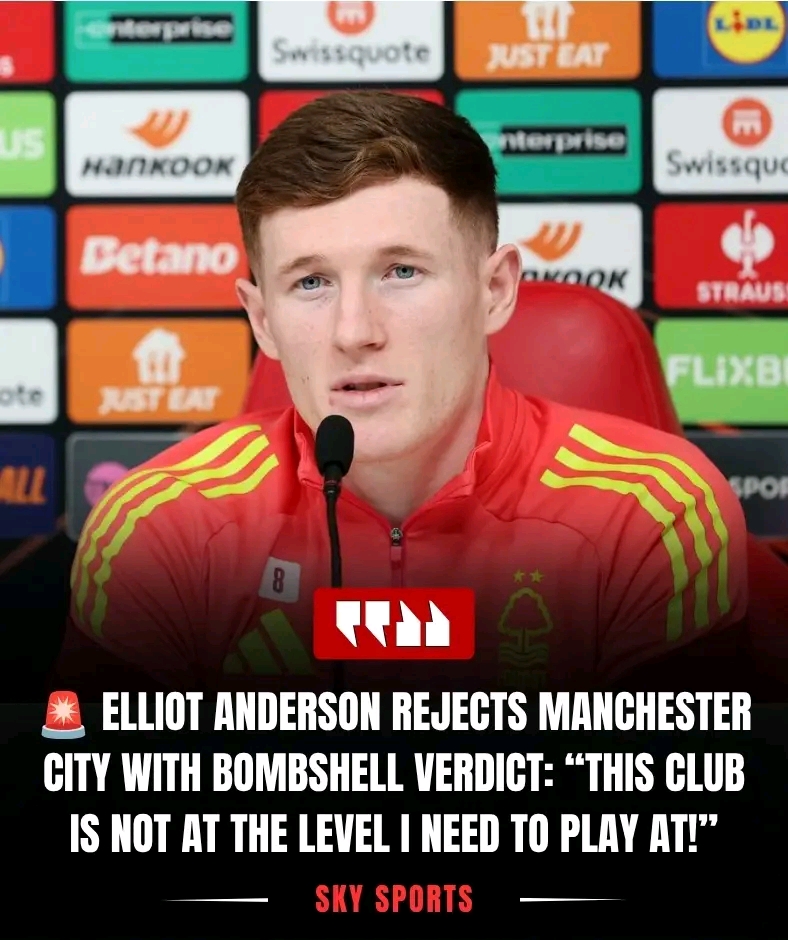
Elliot Anderson has suddenly become one of the most talked about names in football after reports claimed he rejected a move to Manchester City in a shock transfer twist that nobody saw coming. The story has spread fast across football circles, sparking debate, confusion and strong reactions from fans who are struggling to believe what they are hearing.
According to the reports, Anderson turned down the chance to join the Premier League champions and gave a brutal assessment that has shocked supporters. The key line that has caused the storm is the claim that City are “not at the level I need to play at”, a statement that immediately exploded across social media and created tension in football discussions everywhere.
For Manchester City fans, this is not just another transfer rumour. This is a direct rejection, at least in the way the story is being told, and it hits at the reputation of a club that has spent years building itself into one of the strongest forces in world football. City are used to being the team players dream of joining, not the team players allegedly question.
The reaction has been instant. Some fans refuse to believe the story at all, calling it exaggerated or taken out of context. Others are angry, feeling disrespected by the idea that a rising midfielder would dismiss the champions so openly. And another group of fans are simply confused, trying to understand what could lead a young player to make such a bold statement.
In modern football, transfer stories move fast, and sometimes faster than the truth itself. One comment, one phrase, or one interpretation can change everything. In this case, the reported words have already taken on a life of their own, spreading across platforms and building a narrative that is growing bigger by the hour.
The idea that a player would reject Manchester City is not something fans hear often. City have become a destination club over the last decade, attracting top talent from around the world. Under Pep Guardiola, they have dominated English football and established themselves as one of the most consistent teams in Europe. That is why this story feels so unusual and why it has triggered such a strong emotional reaction.
Supporters are now asking many questions. Is the report accurate? Was the comment taken seriously or said in a different context? Was it a misunderstanding or part of a wider interview that has been simplified? These questions remain unanswered, but the debate continues to grow regardless.
For Anderson, the attention is enormous. The young midfielder has been building his reputation step by step, earning recognition for his technical ability, energy, and intelligence on the pitch. He is seen as one of the emerging talents in English football, a player with potential to develop into a top-level midfielder if his progress continues on the right path.
That is why the reported rejection feels so dramatic. A young player at this stage of his career would normally be expected to welcome interest from a club like Manchester City, not dismiss it in strong terms. But football is not always predictable, and ambition can take many different forms.
Some analysts believe that if the quote is accurate, it could reflect a deeper confidence in his own development path. In modern football, some players prefer guaranteed playing time, a clear role, or a specific style of football that suits their growth. At a club like Manchester City, competition is intense, and breaking into the first team is extremely difficult even for talented players.
Others believe the statement, if true, could be a misunderstanding or part of a wider conversation that has been simplified. Football quotes are often shortened or taken out of context, especially when they circulate online. A full interview might show a different tone or intention compared to a single line that goes viral.
Manchester City themselves have not publicly reacted in detail, at least based on current reports. But internally, a club of their size would always monitor transfer situations closely, especially when it involves emerging English talent. City are known for their structured recruitment approach, carefully evaluating players over long periods before making moves.
What makes this story even more interesting is the emotional response from fans. Football supporters often react strongly to transfer rumours, but this one feels different because it touches on pride, reputation, and perception. For many City fans, the idea that their club could be seen as “not at the level” is difficult to accept, especially given their recent success in domestic and European competitions.
At the same time, rival fans have taken the opportunity to add fuel to the debate. Social media has been filled with arguments, jokes, and comparisons, with some suggesting that the comment reflects wider opinions in football, while others insist it is being misrepresented completely.
In reality, transfer stories like this often sit in a grey area. Until full confirmation or clarification appears, everything remains open to interpretation. What is clear, however, is that Anderson’s name has now been placed in the centre of a major football talking point.
His career so far has been one of steady development. He has shown qualities that make him stand out in midfield, including composure under pressure, intelligent movement, and the ability to contribute both defensively and offensively. These traits are exactly why top clubs are reportedly interested in him.
But interest from elite clubs also brings pressure. Every action, every interview, and every decision becomes magnified. A single reported sentence can turn into a headline that defines public perception for days or even weeks.
For Manchester City, this is not the first time a transfer target has made headlines, and it will not be the last. The club operates at the highest level of recruitment, often competing with Europe’s biggest teams for talent. Not every negotiation leads to a signing, and not every interest turns into a formal offer.
For Anderson, the situation places him in an unusual spotlight. Instead of being discussed purely for his performances on the pitch, he is now part of a wider debate about ambition, respect, and career choices. Whether he intended this or not, his name is now linked to one of the biggest clubs in the world in a very public way.
Some former players and pundits often say that young talents must be careful with how their words are interpreted. In football, reputation can shift quickly. One moment a player is praised for confidence, and the next they are criticised for arrogance. The difference is often just interpretation.
There is also the possibility that this entire story will eventually fade away, as many transfer rumours do. Football is full of headlines that dominate news cycles for a short time before being replaced by the next big story. But while it lasts, it becomes a talking point that fans cannot ignore.
What keeps this story alive is the combination of names involved and the bold nature of the reported comment. Manchester City represent success, structure, and dominance. Anderson represents youth, ambition, and potential. When those two elements collide in a transfer rumour, it naturally creates tension.
The phrase “not at the level I need to play at” is what has caused the most debate. Some interpret it as a criticism of City’s style, others see it as a comment on opportunity, and some believe it may not reflect reality at all. Without full context, it remains open to interpretation, and that uncertainty is what fuels discussion.
Football thrives on moments like this. A single rumour can dominate headlines, split opinions, and create narratives that spread far beyond the original source. Fans discuss it, analysts break it down, and social media amplifies it until it becomes bigger than the original story itself.
As things stand, there is no confirmed transfer, no official statement from Anderson, and no detailed response from Manchester City. What exists is speculation, interpretation, and reaction.
But in modern football culture, that is often enough to create a storm.
Whether this story develops further or fades away, it has already achieved one thing. It has placed Elliot Anderson at the centre of a major conversation about ambition, perception, and the expectations placed on young players in the modern game.
And for Manchester City, it has added another unexpected twist to the ongoing world of transfer rumours, where even the smallest comment can turn into a headline that shakes the football world.