Manchester City are reportedly dealing with rising tension after explosive claims that Enzo Maresca has singled out Jérémy Doku as a key figure in the club’s Premier League title disappointment 😳🏟️. The shocking accusation has sparked heated debate among fans and pundits, raising concerns over squad unity, dressing room pressure, and what really went wrong during a crucial stage of the season

The atmosphere around Manchester City has rarely felt this tense in recent years, and the noise coming out of the Etihad camp has only made things more dramatic. What started as a normal end-of-season reflection has now turned into a storm of speculation, emotional reactions, and growing questions about unity inside one of the most dominant squads in world football.
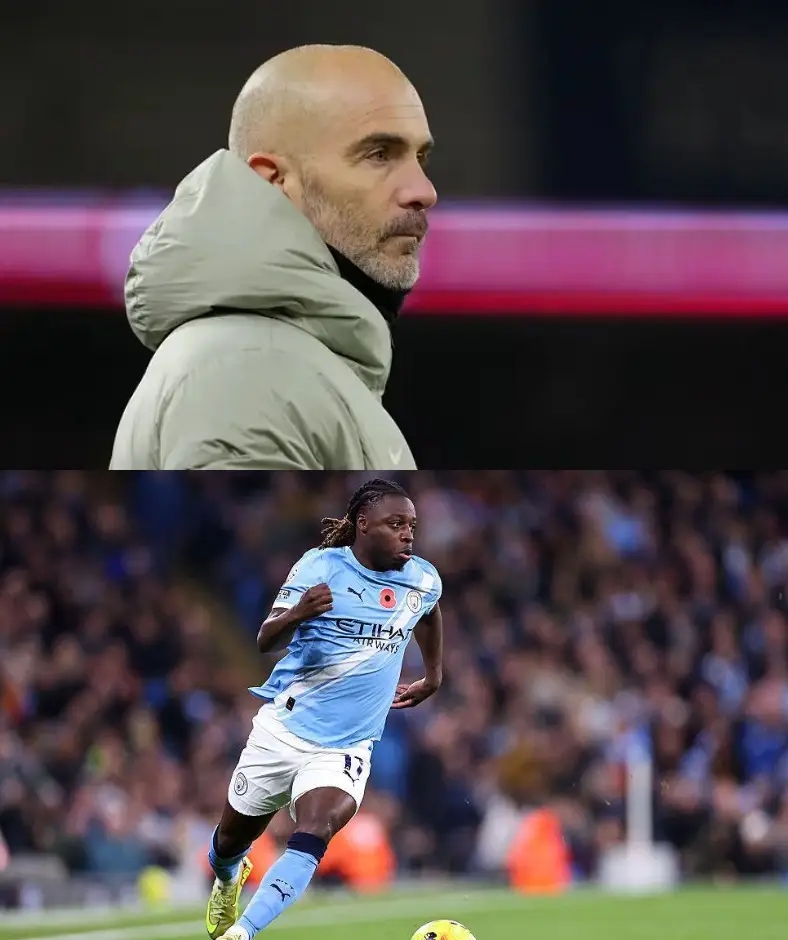
At the centre of the storm is a shocking claim involving Enzo Maresca and Belgian winger Jérémy Doku. Reports and whispers suggest that Maresca, who has been closely linked with tactical discussions and internal evaluations at the club, allegedly pointed toward Doku as a key figure in the moments where City’s Premier League title push began to fall apart. The claim has not been officially confirmed, but it has already spread rapidly through fan circles, media debates, and online football communities.
For a club like Manchester City, where perfection is often the standard and anything less than a title challenge is treated like a failure, even the slightest suggestion of internal blame creates a massive reaction. And this time, the reaction has been explosive.
To understand why this situation has become so sensitive, it is important to go back to the expectations placed on this squad from the beginning of the season. Manchester City entered the campaign as defending champions, once again expected to control the league with their usual combination of tactical discipline, possession dominance, and attacking precision. The squad depth was praised, the manager’s system was feared, and the players were believed to be ready for another historic run.
But football rarely follows scripts, even for the best teams in the world.
As the season unfolded, small cracks began to appear. Matches that City would normally control comfortably started to feel tighter. Possession was still dominant, but the final product was not always as sharp. Goals were harder to come by in key moments, and opponents began to find more confidence when facing them. Slowly, the aura of invincibility started to fade, even if only slightly.
It is in this context that the focus on Jérémy Doku began to grow.
Doku, known for his explosive pace, fearless dribbling, and unpredictable attacking style, has often been seen as one of the most exciting wide players in Europe. When he is at his best, he can dismantle defensive structures on his own, turning tight games into open chances with a single burst of speed. But that same unpredictability can also lead to frustration, especially in systems that rely heavily on structure, timing, and decision-making in the final third.
This tension between freedom and structure is where the current debate seems to sit.
According to the swirling reports, Maresca’s alleged criticism was not about Doku’s talent, which is widely respected, but about his decision-making in crucial phases of matches during the title run-in. In games where control was needed, there is a belief among some internal voices that certain attacking moves broke rhythm, slowed efficiency, or led to missed opportunities that could have changed results.
Whether fair or unfair, that type of analysis is what often happens behind the scenes in elite football environments. Every action is reviewed, every decision is studied, and every player is measured not just on moments of brilliance, but on consistency and tactical discipline.
However, once such evaluations enter the public space, even indirectly, they take on a life of their own.
Inside the dressing room at Manchester City, unity has always been one of the strongest foundations of their success. Players are expected to trust each other completely, even when mistakes happen. The system depends on confidence, not blame. That is why any suggestion of internal finger-pointing can feel dangerous, especially during periods of disappointment.
Fans were quick to react as soon as the Maresca-Doku narrative surfaced. Some supporters defended Doku strongly, arguing that his creativity is exactly what makes City unpredictable and dangerous. Without players willing to take risks, they say, the team becomes too predictable and easier to defend against.
Others, however, saw the situation differently. They pointed out that in tight title races, discipline and efficiency often matter more than flair. In their view, moments of over-dribbling, rushed decisions, or lost possession in key areas can shift momentum in ways that cost championships.
This split in opinion has only intensified the debate.
What makes the situation even more complex is the emotional weight attached to Manchester City’s recent dominance. Over the past years, the club has set extremely high standards, winning trophies, breaking records, and redefining consistency in modern football. When a team operates at that level, even small drops in performance are magnified.
So when the title challenge slipped away, naturally questions began to surface. Was it tactical? Was it physical fatigue? Was it squad rotation? Or was it individual moments that made the difference?
In elite football, the answer is rarely simple, and it is almost never about one player alone.
Still, narratives in football often look for a focal point, someone or something to explain disappointment. And in this case, the narrative has landed heavily on Doku.
Inside training ground discussions, as reported by various voices close to the situation, the focus has been more balanced than the public reaction suggests. Coaches and analysts are said to have reviewed entire phases of play rather than isolating one player. In those reviews, patterns are studied: transitions, spacing, pressing structure, and final-third execution.
Doku’s involvement in those phases is naturally part of the analysis, but so are the actions of every attacking and midfield player involved in those moments.
Yet football is emotional, and once a name becomes attached to a narrative, it is difficult to separate fact from perception.
For Maresca, the situation is also complicated. As a coach known for tactical discipline and structured attacking systems, his perspective naturally leans toward control and efficiency. That does not mean he dismisses creativity, but it does mean he values decision-making in high-pressure moments as a defining factor in success.
From that angle, it is easy to see how discussions about attacking risks could become misinterpreted as criticism of individual players, even if the intention was broader tactical reflection.
Doku, meanwhile, remains one of the most watched and discussed young attackers in Europe. His performances are often analysed frame by frame, with fans and pundits debating every dribble, pass, and final decision. That level of attention comes with both admiration and pressure.
At Manchester City, where every match is expected to be controlled and won, that pressure increases even further.
The Premier League title race itself added another layer of intensity. In close competitions, every dropped point feels like a turning point. A missed chance in October can feel as important as a missed chance in April. That constant pressure creates an environment where emotions run high and analysis becomes sharper.
As the season reached its decisive stages, City’s margin for error disappeared. Matches that could have been routine wins turned into tactical battles. Opponents raised their intensity, defensive blocks became deeper, and space became harder to find. In those conditions, wide players like Doku often face the toughest challenges, because breaking down compact defenses requires perfect timing and decision-making.
It is in those moments that criticism usually emerges, fairly or unfairly.
Supporters who defend Doku argue that his role inherently involves risk. Without risk, there is no breakthrough. Without individual brilliance, there is no way to unlock deep defensive systems. In their view, blaming him for title disappointment ignores the collective nature of football.
They also point out that Manchester City’s style relies on repeated attacking patterns, and when those patterns are disrupted, it is rarely because of one player alone. It is a breakdown in timing, movement, and support from multiple positions.
On the other hand, critics argue that elite football is decided by small details. A single decision to pass instead of dribble, or to shoot instead of recycle possession, can determine whether a title is won or lost. In that argument, accountability becomes a key theme, even if it feels harsh.
What makes this debate even louder is the silence from the club itself. Manchester City have not officially responded to the claims, and Maresca has not publicly elaborated on the reports. That silence leaves space for interpretation, speculation, and growing tension among supporters.
Inside football, silence is often misunderstood. Sometimes it is simply a sign that internal matters are being handled privately. Other times, it is a way to avoid escalating unnecessary controversy. But in the modern media landscape, silence can also fuel rumors.
As the story continues to circulate, one thing remains clear: Manchester City are at a moment where reflection is unavoidable. Whether or not the Maresca-Doku narrative is accurate in its reported form, the broader conversation about performance, decision-making, and consistency is real.
Every elite team goes through moments like this. Success brings scrutiny. Failure brings questions. And sometimes, individuals become symbols of larger tactical discussions that involve the whole squad.
For Doku, this moment could become part of his growth. Many great players have faced criticism early in their careers, only to use it as motivation to improve decision-making and refine their game. The transition from exciting talent to complete player often involves exactly this kind of scrutiny.
For Maresca, the situation highlights how easily tactical analysis can become public controversy. In modern football, even internal conversations can be interpreted in multiple ways once they leave the coaching room.
And for Manchester City, the bigger picture remains the same: maintain dominance, rebuild momentum, and respond on the pitch.
Because in the end, football always brings the conversation back to performance.
Rumours, debates, and accusations may dominate headlines for a while, but what defines a season is what happens on the grass, under pressure, in the moments that matter most.
And for a club like Manchester City, that is where answers are always expected.