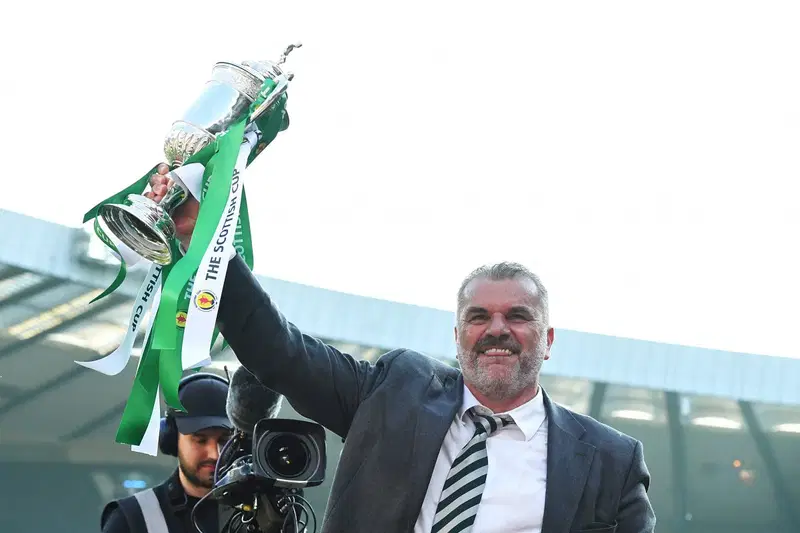
The Scotland managerial vacancy has thrown up plenty of names since Steve Clarke’s emotional departure, but none have generated quite as much excitement among the Tartan Army as Ange Postecoglou. As a Celtic supporter, I’ll admit there’s a part of me that lights up at the thought of the Aussie taking charge of our national side. But having looked closely at the situation, I can say with real confidence: it simply isn’t going to happen.
Let’s be honest about why this speculation has taken off in the first place. Ange Postecoglou isn’t just any name being thrown around by pundits trying to fill column inches. This is a manager who delivered silverware at Celtic Park, who won over the Celtic support with attacking, fearless football, and who memorably played a central role in disrupting Rangers during a period when the Ibrox club had started to believe dominance was theirs by right. For Celtic fans in particular, those memories are still fresh, still fond, and still capable of stirring up genuine excitement at the idea of him returning to manage on a bigger stage — this time, the national team itself.
Add into the mix that Ange has been out of work since being sacked by Nottingham Forest last October, just a month after taking the job at the City Ground, and it’s understandable why some supporters have started joining the dots and wondering whether the timing might finally be right for a Scotland reunion. He’s available, he has history with Scottish football, and he’s spoken openly about wanting his next role to come with the benefit of a full pre-season to properly work with a new group of players. On paper, it all sounds plausible enough.
But scratch beneath the surface, and the reality looks very different.
Since his Forest exit, Postecoglou’s focus has been firmly fixed on returning to club football at the elite level, ideally within one of Europe’s top five leagues. That’s been clear from his own comments and from how he’s conducted himself during his time out of work. Even when speculation linked him with a potential Celtic return at various points last season — speculation that, again, plenty of supporters would have welcomed with open arms — Ange was quick to shut it down and make clear that wasn’t the direction he saw his career heading.
That tells you everything you need to know about his mindset right now. This isn’t a manager looking for sentimental reunions or nostalgic homecomings. This is someone actively positioning himself for another crack at the very top end of the game, the level he reached with Tottenham when he lifted the Europa League and competed regularly in the Premier League.
You can never say never in football — stranger things have happened, and managerial appointments have a habit of catching everyone off guard. But based on everything Postecoglou has said and done since leaving Forest, the Scotland job simply doesn’t fit into his current ambitions. He’s aiming considerably higher than a part-time international post, however much romantic value that post might carry for those of us who watched him work wonders at Celtic Park.
Beyond the football side of things, there’s a far more practical obstacle standing in the way: money. The Scotland job comes with a salary in the region of £750,000 per year. Compare that to what Postecoglou was earning during his time at Nottingham Forest — around £3 million annually — and the gulf becomes immediately obvious. Go back further to his Tottenham days, and he was on closer to £5 million a year.
Given that history, it stands to reason that whatever club Ange ends up joining next, he’ll be expecting a salary somewhere in that same bracket, not a fraction of it. The Scotland job, attractive as it might be in terms of prestige and national pride, simply can’t compete financially with what he’s grown accustomed to earning at the level he’s been operating at in recent years.
It’s not just about the pay packet either. There’s also the question of reputation. Taking charge of the Scottish national team is hardly viewed across the wider football world as a glamorous or career-enhancing move, particularly for a manager who has already proven himself capable of winning trophies in two of Europe’s bigger leagues. The resources available to an international manager working with Scotland are limited compared to what he’s had at his disposal during recent club jobs, and that’s before you even consider the structural differences between club and international football — limited contact time, infrequent camps, and a squad he’d only get to work with for a handful of days at a time around the football calendar.
Here’s where I have to be brutally honest, even as someone who’d love nothing more than to see Postecoglou back involved in Scottish football in some capacity. Sure, Ange would have Scotland playing terrific, expansive, attacking football — that much is virtually guaranteed given his footballing philosophy and track record. But even a manager as gifted as he is can’t perform miracles with the raw materials currently available to him.
He’s not going to turn Lawrence Shankland, Lyndon Dykes, or Che Adams into the kind of clinical, prolific strikers capable of consistently finding the net at major tournament level. In exactly the same way, he’s not going to transform Scott McKenna or Grant Hanley into the next Franco Baresi or Paolo Maldini at the back. Those are simply not the calibre of defenders Scotland currently has at its disposal, however hard any manager might work with them.
And that’s precisely the problem with Ange’s footballing philosophy when applied to the international stage. His approach is built around attacking with intent at every opportunity, committing players forward, and trusting the system to create chances. That works brilliantly when you’ve got the squad depth and individual quality to back it up defensively, the way he did at Celtic and, for periods, at Tottenham. But with a backline built around the likes of Grant Hanley, Scott McKenna, and you could throw John Souttar into that mix too, Scotland would continue to be hugely exposed at the very top level, no matter how entertaining the football looked going forward.
It would be unfair and inaccurate to suggest Scotland’s squad is without quality entirely. There’s a decent core group for any incoming manager to work with, Ange or otherwise. Players like Kieran Tierney, Andy Robertson, Billy Gilmour, Scott McTominay, and John McGinn represent genuine top-level talent, players who have competed at the highest reaches of European club football and who bring real experience and ability to the international set-up.
But even with that core in place, the honest assessment is that any incoming manager — Postecoglou included — would still find it incredibly difficult to deliver the kind of success Scotland fans are really craving. We’re not just talking about qualifying for major tournaments anymore, something Steve Clarke’s tenure helped re-establish as a realistic, regular expectation rather than a distant dream. The next step is advancing beyond the group stages, finally breaking that long-standing pattern of tournament participation without progression.
Complicating matters further is the simple reality of squad age. A number of Scotland’s most important players are edging toward the latter stages of their careers, and realistically, some of the current squad won’t even still be playing by the time the next World Cup cycle comes around. Whoever takes this job on isn’t just inheriting a talented but limited group — they’re inheriting one that’s also approaching something of a generational shift, which adds another layer of difficulty to the rebuilding job ahead.
At Celtic and at Tottenham, Postecoglou had genuinely excellent talent to work with throughout his squad, not just in isolated pockets. That’s a completely different proposition compared to what’s on offer with the Scottish national team. It’s worth remembering that this isn’t a problem unique to Ange either — even managers operating at the very pinnacle of the profession, names like Jose Mourinho or Carlo Ancelotti, would find themselves up against it trying to meaningfully improve Scotland’s fortunes given the current resources and player pool available.
That’s not a knock on Scottish football or the players who represent the country with real pride and effort. It’s simply an acknowledgment of where Scotland currently sits in the broader footballing hierarchy compared to the genuine superpowers of the international game. And to give credit where it’s due, Steve Clarke did improve this team significantly during his time in charge. He took Scotland from a side that hadn’t qualified for a major tournament in over two decades to one that became a regular fixture at World Cups and European Championships. That’s no small achievement, and it deserves proper recognition rather than being dismissed simply because the team ultimately fell short of progressing beyond the group stages.
But even with that genuine progress under Clarke, it still wasn’t enough to take the final step. And if a manager with Clarke’s pedigree and deep understanding of the Scottish game couldn’t get the team over that particular hurdle, it’s difficult to see exactly how Postecoglou — arriving with a very different tactical approach and without the same long-term familiarity with this specific group of players — would suddenly crack a problem that’s eluded Scottish football for the entirety of its history.
Putting it all together — the financial mismatch, the reputational risk of taking on a part-time post with such limited resources, and the genuine footballing challenges that come with trying to apply an attacking, possession-based philosophy to a squad with defensive limitations — I’m confident in saying that, for both financial and footballing reasons, this would be a straight “no thanks, mate” from Big Ange if the Scottish FA came calling.
It’s not a knock on Postecoglou, and it’s certainly not meant as a criticism of Scotland’s prospects either. It’s simply a realistic read of where his career is currently heading versus what the Scotland job can realistically offer him at this moment in time. He’s a manager building toward another opportunity in elite club football, not one looking to step back into a part-time international role with significantly reduced resources and a fraction of the salary he’s grown used to.
If Postecoglou is off the table — and I think the evidence overwhelmingly suggests he is — then the conversation naturally turns to who the Scottish FA should actually be sounding out for the role. There’s been chatter about David Moyes as an early frontrunner, and given his extensive experience across English and Scottish football, he’s certainly a credible option worth serious consideration.
But here’s an alternative idea worth throwing into the mix: what about Brendan Rodgers? He’s a manager with genuine pedigree, having delivered considerable success during his time at Celtic, and he’s someone who clearly understands Scottish football inside and out from his time managing at the highest level domestically. Given his current circumstances and the trajectory of his career, there’s a reasonable chance he might actually fancy the challenge of taking the national team forward, in a way that simply isn’t realistic for someone like Postecoglou right now.
Rodgers has the kind of tactical pragmatism that could complement Scotland’s current squad profile far more effectively than an all-out attacking system might. He’s shown throughout his career that he can adapt his approach depending on the players and resources available to him, which strikes me as exactly the kind of flexibility Scotland’s next manager is going to need given the defensive question marks within the current squad.
## A Reality Check Worth Having
There’s always a temptation, particularly in the immediate aftermath of a managerial departure, to dream big and throw out the most exciting names possible, regardless of how realistic those appointments actually are. Postecoglou’s name carries genuine weight and romance within Scottish football circles, particularly among Celtic supporters who watched him transform the club during his time in Glasgow. It’s entirely natural that his name would surface as soon as the Scotland vacancy opened up.
But football, at the end of the day, often comes down to far less romantic considerations than club allegiance or nostalgic attachment. Salary expectations, career trajectory, personal ambition, and the practical realities of what a job actually offers in terms of resources and prestige all play a significant role in determining who actually ends up in the dugout. On every single one of those measures, the Scotland job simply doesn’t stack up against where Postecoglou currently sees his career heading.
So while I’d happily join the chorus of Scottish football fans cheering him on if, against all odds, he did end up taking the reins, I think the smart move now is to manage expectations and focus attention on candidates who are genuinely realistic, like Moyes or potentially Rodgers. The Scottish FA has a tight timeline to work with before the Nations League campaign begins in September 2026, and chasing a name that’s almost certainly out of reach risks wasting valuable time during an already compressed search process.
For now, Ange Postecoglou’s focus remains exactly where it’s been since his Forest departure: aiming for a return to elite club football, ideally in one of Europe’s top five leagues, on wages that reflect his standing within the game. The Scotland job, for all its national pride and historic significance, just doesn’t fit into that picture right now. And as much as it pains me to say it as someone who’ll always have a soft spot for what he achieved at Celtic Park, I think it’s time Scottish football supporters accepted that particular dream isn’t coming true this time around.