If it hasn’t been established that the penalty was “clear” or that Rangers were “robbed,” it’s better not to state those as facts. Here’s a high-engagement version that attributes the controversy rather than asserting it: 🚨 OUTRAGE! Rangers Fans Furious After Nick Walsh Rejects Huge Penalty Appeal at Tannadice – VAR Footage Sparks Massive Debate! 😱💙 The controversial decision has Rangers supporters demanding answers after a dramatic moment that could have changed the match

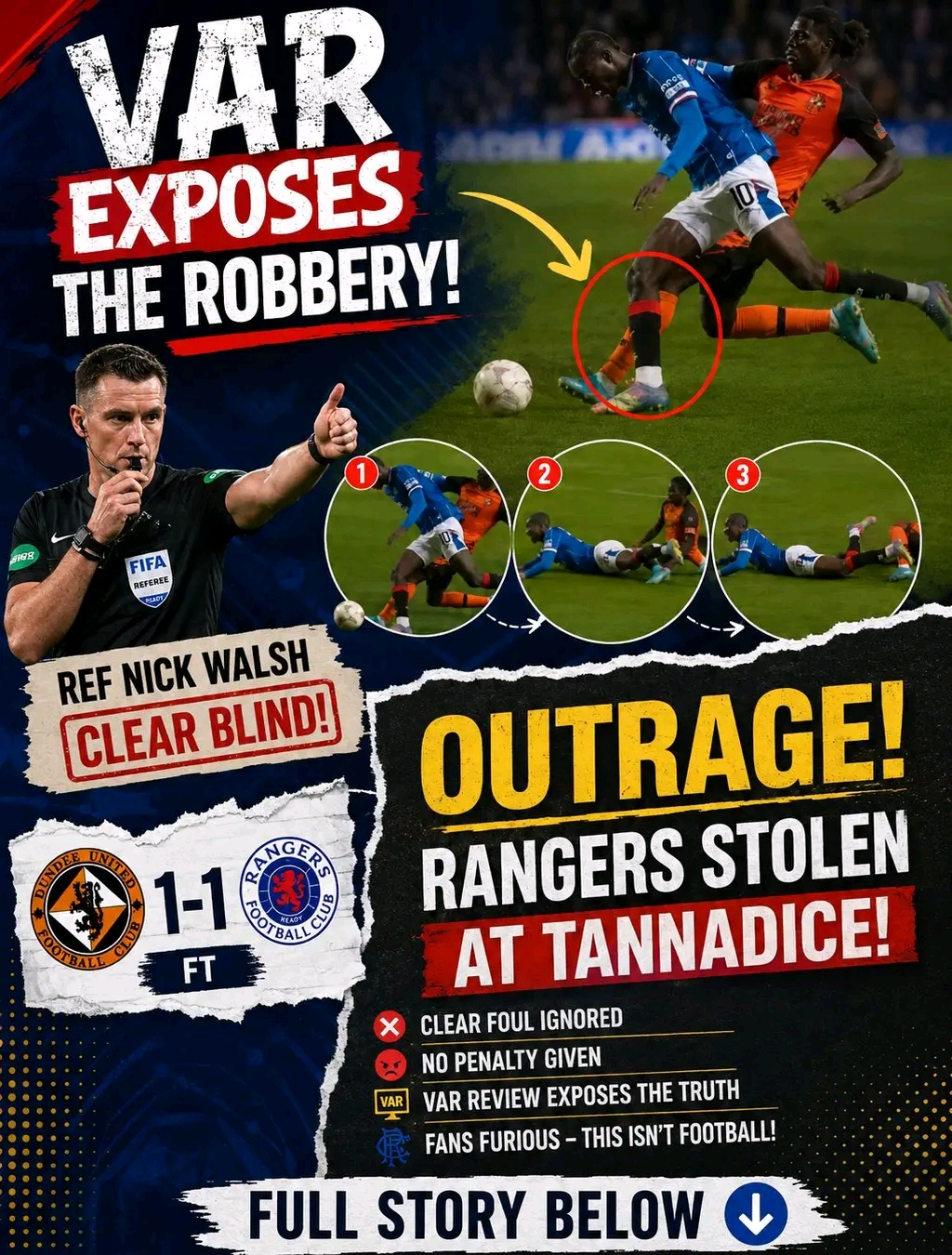
Rangers were left frustrated during their Scottish Premiership clash with Dundee United after a controversial penalty appeal involving referee Nick Walsh became one of the biggest talking points of the match. The incident has generated widespread discussion among supporters, pundits and football fans, with many questioning whether Rangers should have been awarded a spot-kick while others believe the officials made the correct decision.
The moment occurred during an intense encounter at Tannadice, where both sides were battling for a crucial result. Rangers had created several promising attacks and were looking to take control of the game when a challenge inside the Dundee United penalty area led to loud appeals from the visiting players and supporters.
Rangers players immediately surrounded referee Nick Walsh, convinced that the challenge warranted a penalty. The Ibrox side believed there had been sufficient contact to justify a spot-kick, while the home players insisted the challenge was fair. As the appeals grew louder, all eyes turned to the referee to see whether he would point to the penalty spot.
Walsh, however, was unmoved. After a brief pause, he signalled for play to continue, indicating that he did not believe a foul had been committed. The decision instantly sparked frustration among Rangers players, coaching staff and travelling supporters, many of whom felt their side had been denied a valuable opportunity.
Attention quickly shifted to the Video Assistant Referee (VAR). Supporters watching inside the stadium and at home expected the incident to receive careful review, hoping that another look at the footage might change the on-field decision.
Following the review, there was no recommendation for an on-field review, meaning Nick Walsh’s original decision stood. The match continued, but the incident immediately became one of the most discussed moments of the afternoon.
As television replays circulated and clips appeared across social media, debate intensified. Many Rangers supporters argued that the challenge involved enough contact to justify a penalty, while others questioned whether the available camera angles provided enough evidence to overturn the referee’s original decision.
Former players, football analysts and supporters all offered differing opinions. Some believed Rangers were unfortunate not to receive a penalty, while others argued that the referee’s decision was understandable based on what he saw in real time. The split in opinion only added to the controversy.
Social media platforms quickly filled with reactions from Rangers fans. Many expressed disappointment with the decision, arguing that similar incidents have resulted in penalties elsewhere. Others questioned why VAR did not advise an on-field review, believing the incident deserved a second look.
On the other hand, some neutral observers felt the officials followed the VAR protocol correctly. Under the current laws, VAR is only expected to intervene when there is a “clear and obvious error.” If the video officials believed the incident did not meet that threshold, they would allow the referee’s original decision to remain in place.
That explanation, however, did little to calm the frustration among many Rangers supporters. For them, the incident represented another controversial officiating decision in Scottish football, a topic that has frequently dominated headlines in recent seasons.
The timing of the appeal also increased its significance. In tightly contested matches, a single penalty decision can dramatically influence the final result. Had Rangers been awarded a spot-kick and converted it, the momentum of the game could have shifted completely.
Rangers manager Derek McInnes remained focused on his team’s overall performance after the match but acknowledged that controversial decisions often become defining moments in closely fought encounters. Like many managers, he stressed the importance of consistency in refereeing decisions throughout the season.
Nick Walsh is among Scotland’s most experienced referees and has officiated numerous high-profile domestic fixtures. While referees inevitably face criticism after controversial moments, every decision is assessed under significant pressure, often within seconds.
The introduction of VAR was intended to reduce major officiating errors and improve decision-making. However, incidents like this demonstrate why the technology continues to divide opinion. While some supporters believe VAR increases fairness, others argue it has simply created new controversies about interpretation.
Football’s laws leave many decisions open to interpretation, especially those involving physical contact inside the penalty area. What one official considers sufficient contact may not be viewed the same way by another, making debates like this almost inevitable.
The discussion surrounding the Tannadice incident is therefore unlikely to disappear quickly. Television replays, slow-motion footage and expert analysis will continue to be examined by supporters searching for answers.
Despite the controversy, Rangers know they must quickly turn their attention to upcoming fixtures. The season remains long, and every point will be crucial as they pursue success in both domestic and European competitions.
Supporters will undoubtedly continue discussing the penalty appeal for days to come, with many hoping for greater clarity and consistency in future refereeing decisions. Whether one believes Rangers should have been awarded a penalty or agrees with Nick Walsh’s decision, the incident has become one of the defining talking points of the match.
Ultimately, only the match officials know exactly what they saw in real time and what was communicated during the VAR review. Without an official explanation stating that an error was made, it cannot be concluded that Rangers were wrongly denied a penalty. What can be said with certainty is that the decision sparked a major debate among supporters and ensured that the match at Tannadice will be remembered for more than just the final score.