There are wins that settle nerves gently, and there are wins that arrive like a exhale after minutes of held breath. Rangers’ 1-0 victory over Aberdeen at Pittodrie on Sunday belonged firmly in the second category — not because of the quality on display, which by most honest assessments remained modest at best, but because of everything riding on it for Derek McInnes and his players heading into the fixture. Three days after a chastening Conference League exit to Czech side Jablonec left the manager describing himself as mortified, and with his job security having become an open, uncomfortable subject of debate across Scottish football media, Rangers travelled to Pittodrie needing a response. They found one, however unconvincing the manner, and left the north-east with a first Premiership win of the season safely secured.
The buildup to this fixture had been unusually fraught even by the standards of a club that seems to generate crisis narratives at a near-weekly rate. McInnes had won only two of his first seven matches in charge since replacing Danny Rohl over the summer, a return that would concern any club but looked especially alarming set against Rangers’ size and historical expectations. The Jablonec defeat, a 4-3 penalty shoot-out loss that eliminated Rangers from Europe entirely for the season, had been described by former players including Andy Halliday as belonging alongside the club’s most notorious continental humiliations — Kaunas, Progres Niederkorn — and had prompted explicit warnings that McInnes’s position could come under genuine threat if results didn’t turn around quickly. Sky Sports pundit Kris Boyd had gone as far as saying he feared for the manager’s future specifically if Rangers failed to beat Aberdeen, even while stressing he still believed McInnes had been the right appointment. That’s the emotional and competitive backdrop against which this match needs to be understood: not simply three league points, but a genuine referendum, in the court of public and media opinion if nowhere more formal, on whether McInnes’s rebuild at Ibrox was heading in a workable direction.
McInnes responded to that pressure not by overhauling his entire approach, but by making four changes to the side that had capitulated in the Czech Republic — a deliberate swing back toward experience and familiarity after a heavily rotated Jablonec lineup had been widely criticized as disjointed and short on know-how. Two of those changes carried particular significance given McInnes’s own history: Cammy Devlin and Lawrence Shankland both arrived at Ibrox with the manager from Hearts, and both were recalled to provide the kind of trusted, battle-tested presence McInnes clearly felt his side had lacked three days earlier. Findlay Curtis also came into the side, and — in the change that generated the most anticipation among supporters — Kim Min-su was given his first Rangers start, just days after completing his £8.5 million move from Girona.
Rangers set up in a 4-2-3-1 formation. Ivor Pandur continued in goal, with a back four of Dujon Sterling, Emmanuel Fernandez, Olwethu Makhanya and James Penrice ahead of him. Devlin and Dan Neil formed the double pivot in central midfield — Neil’s inclusion notable given he’d been Rangers’ captain for the Jablonec tie and had been substituted at half-time in what was read at the time as one of the more damning individual moments of that European exit, making his recall here something of a quiet vote of continued confidence from his manager. Ahead of them, Curtis, Min-su and Djeidi Gassama were tasked with supporting Shankland, restored to the side after finding himself surprisingly sidelined for both the Jagiellonia Bialystok defeat and the League Cup win over St Mirren despite holding the club captaincy.
Aberdeen, by contrast, arrived at Pittodrie in considerably better form and with considerably less to prove. Stephen Robinson’s side had won six of their first seven matches across all competitions, including a perfect return from their League Cup group campaign, and Kevin Nisbet had been in outstanding individual form, having scored nine goals in his previous seven appearances. Robinson kept faith with the side that had been performing well, setting up in a 3-4-1-2 shape with Nisbet partnered by Yogane up front, and captain duties resting with Nisbet himself given his importance to the team’s attacking output.
The match itself started in a manner that will have done little to settle any Rangers nerves. Aberdeen were the sharper, more purposeful side in the opening minutes, and might easily have taken an early lead. Inside the first two minutes, Dan Happe narrowly failed to make the necessary contact with a dangerous Connor Ronan free-kick, a moment that would have sent an already febrile home crowd into raptures had the connection been slightly cleaner. Shortly after, Mitchy Ntelo found himself with a genuine sight of goal but shot straight at Pandur when a more composed finish might have tested the goalkeeper more seriously. It was the kind of start that will have felt uncomfortably familiar to Rangers supporters who’d watched their side concede first in both of their opening two Premiership fixtures of the season, against Dundee United and Hibernian, and who had every reason to fear a similarly disjointed opening against a confident, in-form Aberdeen side playing at home.
But Rangers gradually found their footing, and the source of that improvement was unmistakable: Kim Min-su. The South Korean winger, thrown into arguably the most pressurized full debut imaginable given the circumstances surrounding his new club, responded with a performance that every subsequent match report singled out as the standout individual contribution of the afternoon. Inside eight minutes, he’d already tested Aberdeen goalkeeper Marius Müller with a shot that forced a save — an early statement of intent from a player who, by his own public comments on signing, had spoken of wanting to bring a “winning mentality” and face challenges “head-on.” That early promise was reinforced significantly around the half-hour mark, when Min-su unleashed a thunderous strike from roughly thirty yards out that required a genuinely outstanding piece of goalkeeping from Müller, tipped over the crossbar at full stretch to preserve parity. It was the kind of moment that电 generates its own momentum — not just for the player himself, but for a crowd of travelling Rangers supporters desperate for some tangible reason to believe their club’s frantic, expensive summer rebuild might actually be bearing fruit.
Min-su wasn’t operating in isolation either. Djeidi Gassama produced a driving, purposeful run from deep in the 38th minute that carried Rangers up the pitch and created a chance for his fellow winger, adding to the sense that Rangers’ attacking players, whatever the collective side’s broader defensive and structural issues, were at least finding pockets of genuine quality and directness in the final third — a marked improvement on the toothless, disjointed picture painted by the Jablonec performance just days earlier, where Rangers had been widely described as never offering anything meaningful going forward.
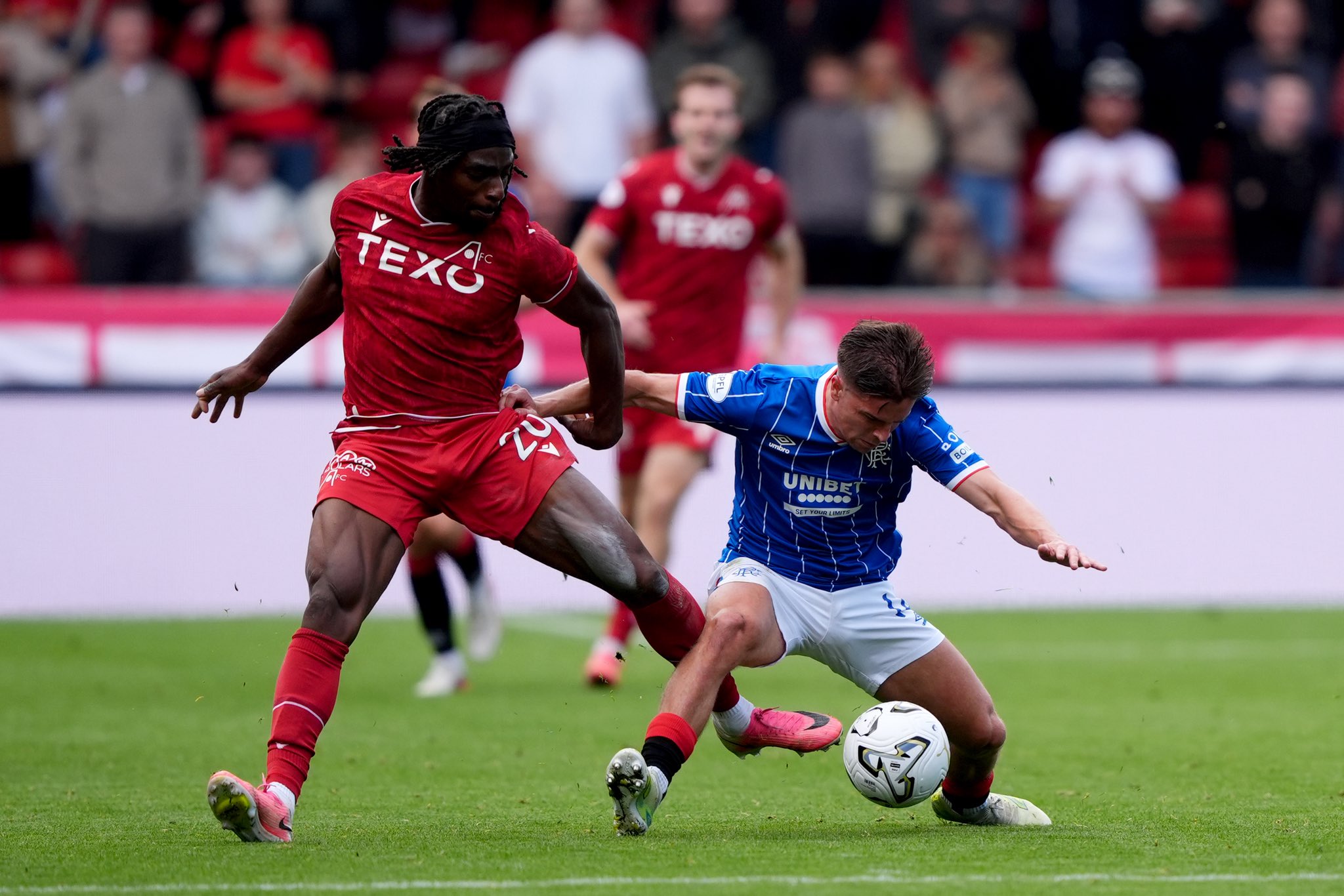
The goal that ultimately separated the two sides arrived in the 69th minute, and its buildup illustrated exactly the kind of understated, unglamorous team contribution that so often decides tight, tense matches. Min-su’s shot from the edge of the box was blocked by the alert Müller, but rather than the danger being fully cleared, the loose ball fell into space where Lawrence Shankland was lurking. Aberdeen’s Afeez Aremu did manage to eventually complete a clearance, forcing the danger behind for a corner — but the resulting set piece proved decisive. In the ensuing goalmouth scramble, with Gassama again involved in the buildup, Shankland was adjudged to have been fouled inside the penalty area, and referee Matthew MacDermid pointed to the spot.
What followed was a moment of real significance, both for the match and for the broader narrative swirling around Rangers’ season. Shankland, whose own start to life at Ibrox had been unexpectedly complicated — arriving as a headline, manager-backed signing and instant captain, only to find himself repeatedly overlooked for a starting berth in favour of alternatives like Ryan Naderi and Youssef Chermiti — stepped up to take the penalty himself. He sent Müller the wrong way with genuine composure, tucking the ball home to record his first goal in a Rangers shirt. Given everything riding on the fixture — his manager’s mounting scrutiny, his own uncertain place in the side, a club desperate for any sign of momentum after a torrid European week — it’s difficult to imagine a more perfectly timed contribution. McInnes himself would later single out both Shankland and Min-su for particular praise in his post-match comments, “purring” over the pair’s performances in a manner that reflected genuine relief as much as tactical satisfaction.
Rangers’ lead, though, was far from comfortable, and the closing stages produced the match’s most contentious and dramatic passage of play. Aberdeen threw everything at their visitors in search of an equalizer, and Pandur found himself required to earn his afternoon’s wages in a way he hadn’t for much of the preceding hour, producing crucial saves to deny both Kevin Nisbet and substitute Ayoub Mouloua as Aberdeen pressed with increasing desperation. For a period, it looked as though the home side’s persistence would be rewarded: in the 83rd minute, Nisbet rose to convert a close-range header that sent Pittodrie into brief, roaring celebration, appearing to have salvaged a deserved point for a team that had, in fairness, competed with real intensity throughout.
That celebration proved short-lived. Following a VAR review, the goal was disallowed — the officials determining that Nisbet had pushed Rangers full-back Dujon Sterling in the build-up to his header, an infringement sufficient to nullify the goal under the laws governing offences in the build-up to a scoring opportunity. It was a moment that carried a certain symmetry given how Rangers’ own goal had arrived via a converted penalty, and Aberdeen’s sense of injustice was sharpened considerably by what had happened just two minutes earlier: in the 81st minute, Aberdeen had themselves appealed for a penalty when Sterling appeared to impede Nisbet’s run toward a cross, only for referee MacDermid to wave the appeal away without any VAR intervention. Taken together — a stonewall-looking shout turned down, followed swiftly by a VAR call chalking off what would have been a deserved equalizer — Aberdeen finished the match with real, understandable grounds for frustration, even if the disallowed-goal decision itself, hinging on a clear push in the build-up, was one that most neutral observers would regard as a correct and fair application of the letter of the law rather than a marginal or controversial call open to genuine dispute.
Beyond the specific flashpoints, the broader shape of the match reflected two teams in genuinely different circumstances collides awkwardly rather than producing free-flowing, high-quality football. Aberdeen, buoyed by their strong start to the season, pushed and probed with real intent, particularly once they’d fallen behind, committing men forward and testing Rangers’ defensive resolve repeatedly in the final twenty minutes. Rangers, for their part, showed a degree of resilience and organisational discipline that had been conspicuously absent in the Czech Republic days earlier — Fernandez and Makhanya held firm at the heart of the defence without any individual errors flagged across the available reporting, Devlin and Neil did the unglamorous defensive-midfield work of screening and protecting a lead rather than chasing further goals, and Pandur, when finally called upon in earnest, delivered exactly the saves his side needed. It amounted, collectively, to a performance most match reports were careful to describe honestly rather than generously: an improvement on Jablonec, certainly, but a low bar to clear, and a result built more on resilience, a clinical penalty conversion, and a slice of fortune from VAR than on any sustained tactical or technical superiority over ninety minutes.
The significance of the result, though, extends well beyond the specifics of the performance itself. For McInnes, this represented his first Premiership win of the season, arriving after a start that had seen Rangers draw at Dundee United and lose to Hibernian in their opening two league fixtures, all wrapped around the club’s chastening exits from both the Europa League and Conference League qualifying rounds. The scale of external pressure that had built around him in the days immediately preceding this fixture was genuinely significant — former players publicly questioning his suitability for the role, pundits speculating openly about his job security, and renewed fan campaigns calling for a Steven Gerrard return gathering momentum across supporter channels. A defeat or even another underwhelming draw at Pittodrie, against the club where McInnes had built his own managerial reputation across nearly eight years in charge, would have compounded that pressure considerably, quite possibly to a genuinely critical level. Instead, McInnes got exactly what he needed: a result, however unconvincing the underlying performance, that offers him breathing room heading into the September international break rather than facing a fortnight of speculation and scrutiny with no positive result to point toward.
For Rangers’ broader squad-building project this summer, the match also offered genuinely encouraging individual data points amid an otherwise turbulent context. Min-su’s promising full debut suggests the club’s significant investment in bringing him from Girona may prove shrewd, even on the evidence of a single match against Premiership opposition rather than the kind of continental competition he’ll face down the line. With Kevin Kelsy’s move from Portland Timbers still edging toward completion — reportedly in the region of £9 million, and set to make him the second most expensive signing in the club’s history — Rangers’ attacking options should only continue to strengthen in the days ahead, offering McInnes further resources to address the specific hole left by Youssef Chermiti’s serious knee injury against Hibernian back in early August.
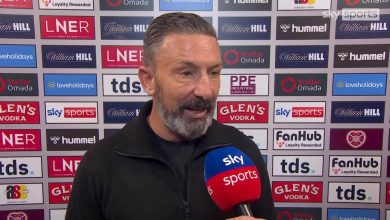
Postmatch, McInnes used his media duties to address several other strands of the club’s ongoing business. He confirmed there had been no offers for midfielder Nicolas Raskin, who was once again absent from the matchday squad amid continued speculation linking him with clubs across England, Italy and Spain, while cautioning that the closing days of the transfer window typically bring a significant acceleration in activity that Rangers need to be prepared for. He also pushed back against any suggestion that delays in completing incoming transfer business reflected poorly on the club’s recruitment operation, framing the timeline as a natural consequence of a complex, fast-moving market rather than any lack of urgency internally.
What this result ultimately buys Derek McInnes, more than anything else, is time — a increasingly valuable commodity for any manager navigating a difficult opening stretch at a club with Rangers’ expectations and history of managerial churn. The underlying concerns that fuelled a week of intense scrutiny haven’t vanished simply because Rangers found a way to grind out a narrow win at Pittodrie: questions remain about playing style, about defensive solidity, about whether a squad assembled at such pace and volume this summer can develop genuine cohesion quickly enough to sustain a serious campaign across multiple competitions. But football, and football punditry in particular, tends to reward results over process in the immediate aftermath of any given match, and a first league win of the season — built on a debutant’s genuine sparkle and a beleaguered captain’s ice-cool finishing under real pressure — gives McInnes something concrete to build from as Rangers head into the international break, rather than facing a fortnight of enforced downtime under the kind of existential, job-threatening pressure that had defined the preceding several days at Ibrox.