I Can’t Control Decisions” — Robinson Frustrated as Chris Sutton Blasts His “Nonsense” Reaction to Rangers Defeat

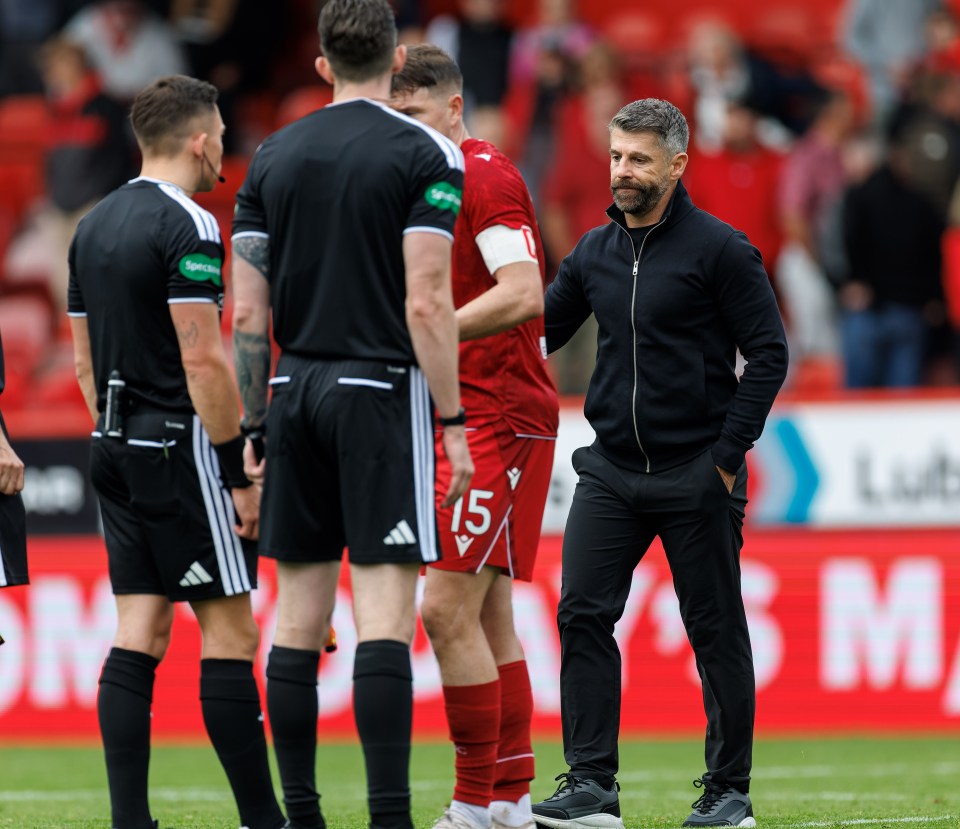
Stephen Robinson left Pittodrie a frustrated man after Aberdeen’s 1-0 defeat to Rangers, pointing to two contentious refereeing calls that went against his side — but his post-match comments have since been picked apart by pundits, with Chris Sutton dismissing his complaints as “absolute nonsense.
Aberdeen fell to Lawrence Shankland’s 69th-minute penalty, awarded after Dan Happe fouled Djeidi Gassama in the box — a decision even Rangers-supporting pundit Kris Boyd, working for Sky Sports, described as “a stone-waller.” It was what happened either side of that goal that left Robinson aggrieved. Two minutes before Nisbet’s disallowed effort, Aberdeen had their own penalty appeal turned down after a tussle between Nisbet and Rangers defender Dujon Sterling in the box. Then, in the 83rd minute, Nisbet thought he’d equalised with a close-range header, only for referee Matthew MacDermid to be sent to the pitchside monitor by VAR official Andrew Dallas. On review, MacDermid ruled the goal out, judging that Nisbet had used both hands to push Sterling in the back during the build-up. Replays also appeared to show Nisbet was in an offside position in any case — meaning that even had the push not been given, the goal likely wouldn’t have stood on a second phase of review.
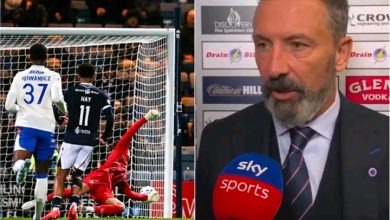
Speaking to Sky Sports afterward, Robinson was careful with his words but couldn’t hide his frustration. “I can’t control decisions,” he said. “I can’t control what VAR sees as too much force, and not enough force. I can’t control it. I can control that we defend better for the goal.” He returned to the theme when pressed further, saying: “If I could give my thoughts, but the authorities make sure we don’t give our thoughts. You all saw the game and the only thing I can comment on is I don’t know who judges the amount of force. There wasn’t enough for Kevin to get a penalty and there was enough to disallow the goal. Someone has made that decision rightly or wrongly and it certainly affects the game. They seemed quite similar to me but I’m not a referee. I can only control the things that I can in terms of our performance. There were lots of good stuff with battling qualities and real desire and determination.”
Asked whether he’d approached MacDermid after the final whistle, Robinson said he hadn’t: “No. I don’t go anywhere the man. I want to be in the dugout and want to help the players and the staff and the players.” It’s that reluctance to speak to officials directly, combined with pointed comments about the “authorities” restricting what managers are allowed to say publicly, that appears to be the source of the “I’d get a six-game ban” framing — Robinson’s way of indicating he felt more strongly about the decisions than he was able to express without risking SFA disciplinary action for improper conduct or criticism of match officials.
Robinson did use the same set of comments to address Rangers’ interest in his own players, offering a “very doubtful” outlook on the club being able to keep hold of certain individuals amid transfer speculation, and he was notably keen to steer discussion back toward performance rather than officiating, praising his side’s “battling qualities and real desire and determination” throughout the game.
Adding to the sense of a bad-tempered, feisty affair, referee MacDermid brandished nine yellow cards across the ninety-plus minutes — a high number for what was, by most independent assessments, a competitive but not especially unruly or ill-disciplined contest. That statistic alone suggests an official who was perhaps erring toward stricter interpretations of contact and conduct throughout, context that arguably supports Robinson’s broader sense that fine margins were being adjudicated tightly in both directions rather than loosely in Rangers’ favour specifically.
Robinson’s comments didn’t go unchallenged. Former Celtic striker and pundit Chris Sutton, working for the Daily Record, was scathing in his assessment of the Aberdeen manager’s complaints. “Key moments went against Aberdeen? Absolute nonsense, absolute rubbish,” Sutton said. “They took the game to Rangers – did they? When? I’ll have to watch the game back, because I didn’t see it. They are lucky to have three points on the board because they were lucky against Hearts in the first game.”
Kris Boyd offered a similarly blunt rebuttal specifically on the penalty award, dismissing any suggestion Rangers’ spot-kick was soft: “He might want to come out and talk about decisions, but the penalty is a penalty kick. It’s a stone-waller, on Gassama.” On the disallowed Nisbet goal, Boyd’s read was equally unambiguous: “The other two — I don’t see it. You don’t need to look for a penalty. The goal, for me it’s a push — but if you move it on he is offside anyway, so it’s irrelevant.”
Sutton went further still when discussing Robinson’s broader framing of the game, rejecting the idea that Aberdeen had been the dominant or unlucky side: “I think any Aberdeen fan watching that would think, ‘What are you talking about? Was that the same game which we watched?’
The reaction among Aberdeen’s own supporters, reflected on forums like FollowFollow, has been notably divided rather than uniformly sympathetic to their manager’s complaints. One post argued Robinson “should be able to voice his opinions on decisions,” but added a pointed caveat: “However I’d do it on a day where actual decisions went against you that were in any way controversial. Rangers must’ve won.” Another was more blunt still: “Both decisions were clearly correct. Barely any contact for their penalty shout and their ‘goal’ was a shove and then an offside.” A further comment predicted the media narrative would harden regardless of the facts: “You just know there will become an accepted truth in the media that Aberdeen were robbed even though both of those incidents were 100% correct decisions.”
For Derek McInnes, the controversy over the officiating has, if anything, worked in his favour by shifting post-match discussion away from the underlying quality of his side’s performance and onto a debate over Robinson’s conduct and complaints instead. McInnes himself left Pittodrie delighted with both the result and what he saw as genuine signs of improvement, with his side securing a first Premiership win of the season at a hugely significant moment for his own managerial position.
For Robinson, the defeat — and the reaction to his response to it — adds a frustrating coda to what had otherwise been a promising start to Aberdeen’s season, having won six of their previous seven matches across all competitions before this loss. With pundits largely united in dismissing his complaints as unfounded, and with Aberdeen now facing a run of fixtures that Robinson himself has previously described in the context of a “scrap” for results, the manager will likely be keen to move the conversation on quickly, back toward the “battling qualities and real desire and determination” he pointed to as the more meaningful takeaway from his side’s afternoon at Pittodrie.