Deadline day brings a departure and a defiant stand at Ibrox, as McInnes braces for the window to finally close
Rangers’ transfer window closed with one departure confirmed and one significant bid knocked back, as Thelo Aasgaard sealed a season-long loan move to Anderlecht while the Ibrox club rebuffed an approach from Besiktas for Belgium international Nicolas Raskin. The two situations, arriving within hours of each other as the clock ran down towards Thursday’s 17:00 BST deadline, offered a neat illustration of where Derek McInnes’s rebuilding project stands: prepared to let a squad player go and get game time elsewhere, but unwilling to be strong-armed into losing a first-team leader mid-season.
For Aasgaard, the move to Belgium brings to an end a difficult and frustrating opening 18 months in Scotland. For Raskin, it is merely the latest chapter in a saga that has rumbled on for the best part of two transfer windows, and one that appears — for now, at least — to have ended in Rangers’ favour.
A quiet exit for Aasgaard
Thelo Aasgaard’s departure was not a surprise to anyone who has watched Rangers closely since the turn of the season. The 24-year-old Norway international completed a £1m loan move to Anderlecht, with the Belgian club having been given the option to sign him permanently for a further £5m next summer. It is a structure common to modern deadline-day business: a modest loan fee now, a route to a bigger permanent fee later, and an escape valve for a player who has fallen out of the picture at his parent club.
Aasgaard’s numbers this season tell their own story. One goal in five appearances is a modest return for a player signed with genuine ambition attached to him, and it reflects a player who started the campaign with promise before finding himself squeezed out of contention. He scored on the opening day of the season against Dundee United, returning early from his summer commitments with Norway to get a head start on the campaign, and for a spell it looked as though he might build on the mixed debut season he had endured under Russell Martin and, later, improved form under a different head coach. McInnes himself praised Aasgaard in pre-season, suggesting the midfielder had shown the attributes to kick on.
But the emergence of a rival for his position proved decisive. The arrival of Minsu Kim, who operates in the same advanced attacking-midfield role that Aasgaard prefers, squeezed his opportunities significantly, and a difficult evening in the Europa League proved to be something of a watershed moment. Aasgaard was substituted at half-time during Rangers’ 1-1 draw with Jagiellonia at Ibrox, a result that ended the club’s European campaign for the season, and he has not started regularly since. Once it became clear that regaining a starting berth ahead of Kim was unlikely, both player and club appear to have quietly agreed that a loan exit was the sensible route for all parties.
Anderlecht moved with intent once talks opened. Belgium’s domestic transfer window shut a day ahead of the UK deadline, and because the Brussels club remain involved in the Europa League this season, the deal needed to be completed in time to satisfy UEFA’s squad-registration rules — adding a layer of urgency to what had, by most accounts, been a fairly straightforward negotiation between the two clubs. Aasgaard travelled with the Rangers squad on Wednesday before the move was finalised, with McInnes later explaining that the situation developed quickly once the two clubs found an agreement.
There is a personal dimension to the move, too. At Anderlecht, Aasgaard reunites with Oliver Antman, his former Rangers team-mate, who made a similar switch to Belgium previously. For a player who has struggled to force his way into a settled Ibrox side, the prospect of regular football in the Belgian top flight — where Anderlecht remain one of the country’s traditional heavyweights and are competing in Europe this season — represents a clear chance to rebuild momentum in his career.
Aasgaard’s path to Ibrox was itself a relatively rapid rise. Born in Liverpool and of Norwegian descent through his father, he came through the youth ranks at Liverpool before a switch to Wigan Athletic, where he established himself as an attacking talent good enough to earn full Norway recognition. A move to Luton Town in January 2025 preceded his switch to Rangers that summer, arriving at Ibrox for an initial fee in the region of £3.5m and signing a contract that, on paper, still runs until 2029. That contract length underlines why this is being treated as a loan rather than an outright sale for now: Rangers retain a stake in his long-term value, and if Anderlecht’s option is exercised next summer, the Ibrox club stand to bank a healthy profit on a player who never quite established himself domestically.
For Rangers, the calculation is straightforward business logic. Aasgaard was a talented squad option who had become a luxury the club could not accommodate once Kim’s form demanded regular starts. Rather than let him stagnate on the bench for the rest of the campaign, the club have moved him on with a mechanism to recoup value later, while easing the wage burden and squad congestion in the process. It is the kind of tidy, low-drama piece of business clubs like to complete on deadline day, even if the surrounding noise around Ibrox’s transfer business this summer has been anything but calm.
Raskin stands firm amid Besiktas interest
If Aasgaard’s exit was a story of a player easing his own path out of a congested squad, the situation surrounding Nicolas Raskin has been the polar opposite: a sustained, high-profile tug-of-war over a player Rangers have been desperate to keep.
Besiktas’s loan approach for the Belgian midfielder was turned down, extending a pattern of transfer interest in Raskin that has run through the best part of this year. The 25-year-old has been strongly linked with a move away from Glasgow ever since his performances for Belgium at this summer’s World Cup elevated his profile considerably, and reports throughout the current window have connected him with clubs well beyond Turkey. Spanish sides have previously been credited with interest, an eye-catching valuation in the region of £17m was attached to reported talks with a La Liga club earlier in the year, and an offer from a Premier League newcomer was said to have fallen short of Rangers’ valuation. Besiktas’s move is simply the latest suitor to test Ibrox’s resolve — and, like those before it, to be knocked back.
Raskin’s stock has risen sharply since he first arrived at Ibrox from Standard Liège in a deadline-day deal back in January 2023, a transfer that itself came together at pace after a long-running pursuit. He has gone on to make well over 140 appearances for the club, developing into one of the most reliable and technically accomplished midfielders in the Scottish Premiership, capable of dictating tempo from deep or driving forward into more advanced areas. His performances for Belgium at the World Cup — helping the Red Devils reach the latter stages of the tournament — only sharpened suitors’ interest, and speculation over his Ibrox future has been a fixture of the football conversation in Glasgow for months.
That speculation has occasionally spilled over into how Raskin has been used on the pitch. The player missed Rangers’ past two matches amid the ongoing transfer noise, a decision that would ordinarily raise questions about a rift between player and manager. McInnes, though, was quick to head off any suggestion of discord, insisting that Raskin’s conduct throughout the uncertainty has been exemplary. “I’m just glad I’m able to choose him tonight,” the Rangers manager said, addressing Raskin’s inclusion after the transfer interest became public. “We can do with his experience in there. I thought he got better in the second half. Obviously delighted if we manage to hold on to him and it looks like we will.”
The manager’s phrasing — “good as gold” — was a deliberate attempt to reassure supporters that the midfielder’s head has not been turned despite the swirl of transfer talk surrounding him, and that professionalism, not sulking, has characterised his response to speculation he has openly acknowledged he cannot fully control. It is the kind of endorsement managers reserve for players they consider central to their plans, and it chimes with the message Rangers have sent through their conduct in the market: interest in Raskin is welcome as validation of his development, but it is not for sale, certainly not on loan, and certainly not this close to the business end of a Scottish Premiership campaign in which every point matters.
Raskin’s response on the pitch spoke just as loudly as any words from his manager. Restored to the Rangers midfield in Wednesday’s win at Falkirk, he not only started but was afforded the captain’s armband in the closing stages of the match — a gesture from the Ibrox coaching staff that could hardly have sent a clearer signal about where he sits in the pecking order, and about the trust placed in him regardless of the noise around his future. For a player who had been left out of the previous two matchday squads, that armband represented as pointed a statement of intent as any transfer rejection.
McInnes counts down to a quieter dressing room
Taken together, the two situations leave Derek McInnes with a squad that looks, for now, settled in its most important areas even as fringe players continue to be moved on. The Rangers manager has made little secret of his relief that the window is finally drawing to a close, describing it as one of the most protracted and eventful transfer periods he can recall.
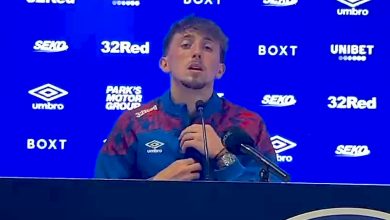
“It seems to have been the longest window I can remember — so much going on,” McInnes said. “For us now, it will do everybody good if we can get the window shut and work with what we’ve got. Players always settle a wee bit more.”
That comment captures something of the mood around Ibrox this summer and into the early weeks of the season: a squad in a near-constant state of flux, with headline arrivals, high-profile departures and persistent speculation over key men like Raskin combining to create an unsettled backdrop for a manager trying to build cohesion on the pitch. McInnes’s point about players settling once speculation dies down is a familiar refrain among managers navigating transfer windows, but it carries particular weight this time given how frequently Rangers’ business has dominated the agenda in recent months.
The broader picture at Ibrox this year has been one of considerable squad turnover as McInnes and the club’s recruitment team have worked to reshape the group. Significant incoming business has included the additions of Minsu Kim — whose form has been directly responsible for pushing Aasgaard towards the exit — along with a host of other new faces brought in across the summer window as part of a wider squad rebuild. On the outgoing side, in addition to Aasgaard’s exit, Rangers have already sanctioned departures for players surplus to requirements as the manager looks to trim a bloated squad down to a more manageable, competitive size.
Raskin’s situation, by contrast, illustrates the flip side of that rebuilding process: identifying which players are genuinely core to the project and drawing a clear line under their availability, regardless of the fees or profile of interested clubs. Besiktas’s approach, like those that preceded it from elsewhere in Europe, was always likely to be difficult to accept midway through a domestic campaign, not least because a loan deal — as opposed to a permanent sale — would have offered Rangers little in the way of long-term financial certainty in exchange for losing one of their most influential players for the rest of the season.
What it means for Rangers going forward
With the loan window now closed on Aasgaard’s departure and Raskin’s future seemingly secured for the immediate term, McInnes can turn his full attention to matches rather than speculation — something he made clear he was looking forward to. The manager’s comment about wanting “to get the window shut and work with what we’ve got” suggests a coaching staff eager to draw a line under the uncertainty and focus purely on results, starting with the platform provided by the win over Falkirk.
For Aasgaard, the move to Anderlecht offers a genuine opportunity to rebuild his career away from the intense scrutiny of the Old Firm rivalry, in a league where he may find more regular opportunities to show the qualities that persuaded Rangers to sign him from Luton in the first place. Should he impress in Belgium, the £5m option Anderlecht hold would represent a reasonable return for Rangers on a player who, for all his talent, never quite forced his way into a settled position at Ibrox. Should the loan not work out, Rangers retain him on a contract until 2029, giving them the flexibility to reassess in twelve months’ time.
For Raskin, the immediate future now looks to be at Ibrox, at least until the next transfer window opens. His restoration to the starting eleven at Falkirk, capped by the captain’s armband, suggests a player and manager on the same page about his role in the side, whatever noise continues around him externally. Whether that interest resurfaces in January, when Raskin will have entered the final 18 months of his contract cycle relative to any future window calculations, remains to be seen — but for now, Rangers have made their position emphatically clear: their Belgian international is not for sale, on loan or otherwise, mid-season.
As the transfer window finally shuts on what McInnes has called the longest he can remember, Rangers move forward with a slightly leaner squad, a key midfielder reaffirmed as untouchable, and a manager visibly relieved to be able to focus solely on results rather than speculation for the remainder of the autumn.