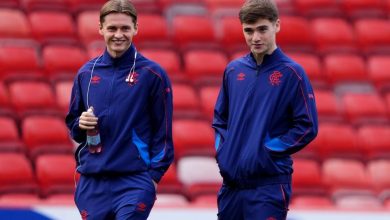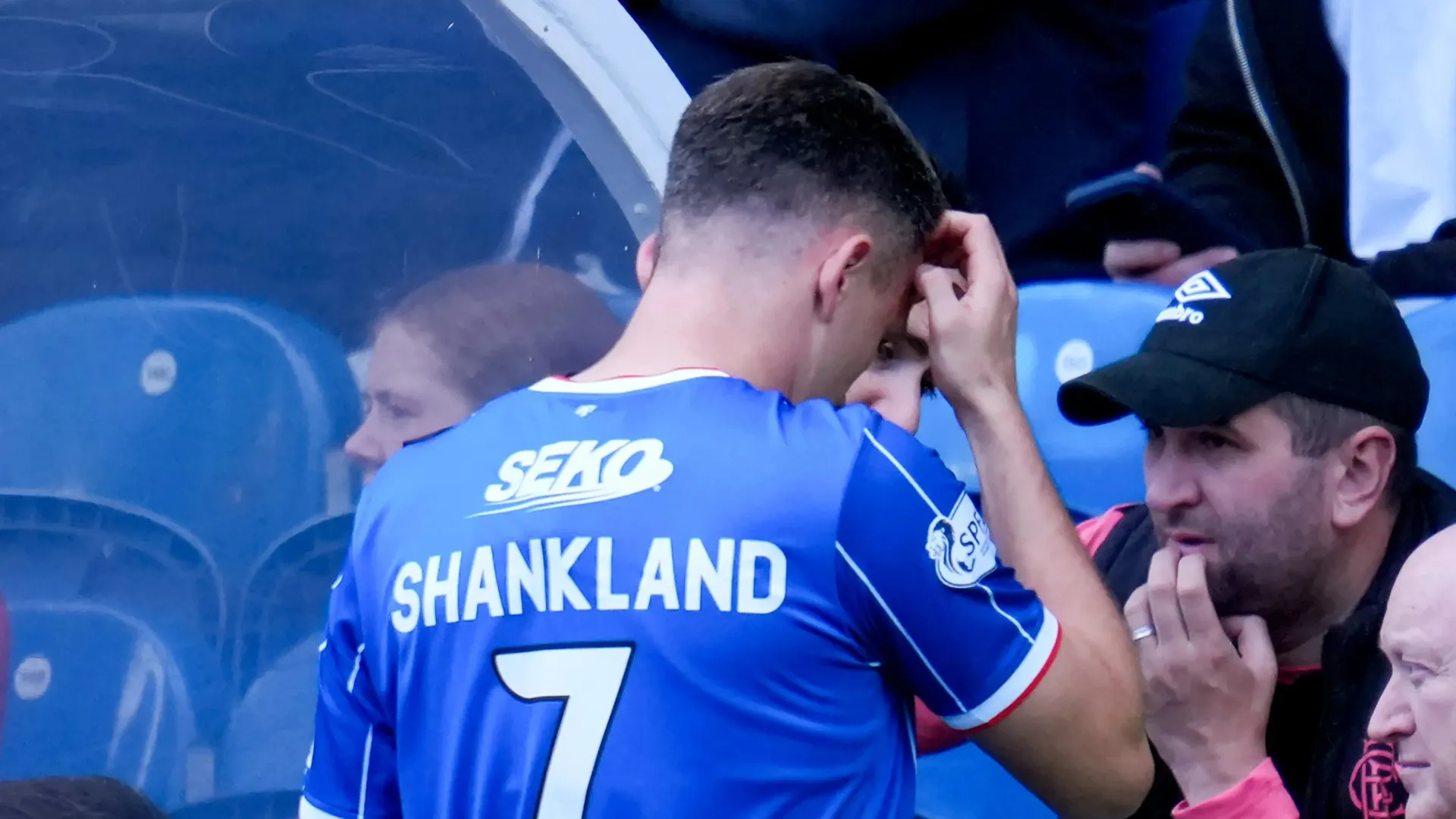
Rangers have been dealt a significant blow with confirmation that captain Lawrence Shankland faces up to three months on the sidelines after suffering a hamstring injury during Saturday’s 1-0 win over Motherwell at Ibrox. The 31-year-old was forced off inside the opening eight minutes of the match, and while his side went on to secure a third consecutive Premiership victory without him, the extent of the injury has cast a considerable shadow over what should otherwise have been a thoroughly positive weekend for Derek McInnes and his players
The injury struck early and with little obvious warning. Shankland pulled up just eight minutes into the match against Motherwell, forced off the pitch and replaced by Ryan Naderi — who would go on to score the only goal of the game just four minutes after coming on, securing the points for Rangers despite the loss of their captain. It was, in that narrow sense, a fortunate outcome for Rangers on the day: the team found a way to win regardless of the setback, with Naderi’s impact off the bench proving the difference between two points dropped and a job done.
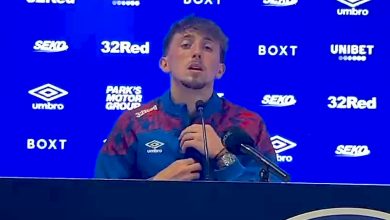
But the broader picture emerging in the days since has made clear that the cost of the injury itself is likely to be felt far beyond a single afternoon at Ibrox. Speaking to Rangers TV after the match, Derek McInnes did not attempt to downplay his concerns, describing the issue as a hamstring injury and immediately drawing an ominous comparison to a similar problem Shankland suffered during his time at Hearts, which kept him out of action for roughly three months.
McInnes said that it was an injury he believed Shankland had experienced before at Hearts, during a spell that saw him sidelined for around three months, and he expressed hope that the situation wouldn’t prove to be quite as serious this time around, while acknowledging the affected area of the body appeared to be similar. He noted that Shankland was, understandably, feeling low given the circumstances, and that the club would need to establish the specifics before drawing firm conclusions.
Rangers confirmed that Shankland would undergo scanning on the Monday following the Motherwell match to establish the full extent of the damage. In the time since, reporting from multiple outlets covering the club has converged on a fairly consistent picture: the Scotland international is now expected to be sidelined for around 12 weeks, effectively confirming McInnes’s worst fears in the immediate aftermath of the injury.
That timeline places Shankland’s expected return somewhere in early December, assuming a straightforward recovery without setbacks — though hamstring injuries, by their nature, don’t always follow predictable recovery curves, and Rangers will likely want to build in a cautious buffer before reintroducing their captain to first-team action, given the recurrence risk associated with this type of muscular injury, particularly given that this appears to be a repeat problem in a similar area to a previous, lengthy layoff.
McInnes offered further insight into the context surrounding the injury, explaining that Shankland’s workload had been notably high in the match immediately prior to the Motherwell game — a midweek fixture against Falkirk played on an artificial pitch. He suggested that the switch from a synthetic surface back to grass so soon afterward may have left the player somewhat more vulnerable to this kind of muscular issue, while also noting that Shankland had reported feeling fine heading into the Motherwell match and couldn’t point to any specific moment or action that caused the problem — he simply felt it pull as the game got underway.
What makes this injury particularly frustrating, both for Shankland personally and for Rangers as a club, is the timing. Far from being a player who was already struggling for form or fitness, Shankland had just begun to show genuine signs of settling into life at Ibrox and delivering the kind of end product that persuaded the club to pursue his signature in the first place.
In the two matches immediately preceding the injury, Shankland had scored three goals — converting from the penalty spot in a win over Aberdeen before following that up with a double in a victory over Falkirk. That represented precisely the sort of scoring burst that suggested he was beginning to build real momentum, both individually and in terms of forging productive attacking relationships with teammates around him, including the likes of Kim Min-Su, Djeidi Gassama, and Findlay Curtis in the forward areas.
McInnes was explicit in lamenting this element of the situation, describing it as a real shame for Shankland given that he’d only just started to get himself moving, enjoying the attacking threat the team had been building over recent matches — momentum McInnes admitted the club had been waiting a long time to see materialise. Having arrived at Rangers over the summer after finally securing the move he’d long wanted, and having represented Scotland at the World Cup during the close season, albeit with limited playing time there, Shankland appeared to be entering exactly the sort of purple patch that could have defined the early part of his Ibrox career. Instead, that momentum has been abruptly halted just as it was building
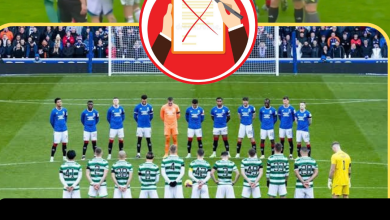
The scale of what Rangers stand to lose during Shankland’s absence becomes clearer when considering the specific fixtures he’s now set to miss. Most significantly, the captain will be unavailable for what promises to be one of the biggest stretches of the season: an Old Firm double-header against Celtic, contested across both the Premier Sports Cup and the Premiership. Missing out on fixtures of that magnitude, particularly as captain and one of the team’s most reliable goal threats, represents a considerable loss for McInnes as he plans his approach to the club’s most high-profile matches of the campaign.
Beyond the Celtic fixtures, Rangers also face a trip against St Mirren in the more immediate term, a match that will need to be navigated without their captain leading the line. Further down the road, the length of Shankland’s absence means he could realistically miss a significant portion of the season’s autumn schedule, depending on exactly how his recovery progresses.
There is, however, one mitigating factor that may work slightly in Rangers’ favour. With an extended international break on the calendar and the club having already exited European competition this season, the actual number of fixtures Rangers will play during the likely three-month window of Shankland’s absence is somewhat reduced compared to a season featuring a run in continental competition. That’s obviously a fairly modest silver lining given the club would surely have preferred European football and a fit captain over the alternative, but it does mean the practical impact in terms of total missed matches may be somewhat less severe than the raw three-month timeline might initially suggest
Shankland’s injury doesn’t arrive in isolation. It compounds an already difficult run of fitness news for Rangers’ forward line, coming on the back of a serious injury suffered earlier in the season by Youssef Chermiti, another of the club’s attacking options. With two significant injuries now affecting Rangers’ striking department within a relatively short window, the depth and adaptability of the club’s forward options have been tested far sooner and more severely than anyone at Ibrox would have anticipated at the start of the campaign.
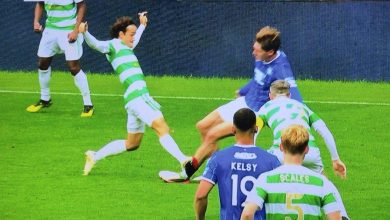
That context adds considerable weight to the timing of Rangers’ deadline-day acquisition of Kevin Kelsy from Portland Timbers for a reported £9million fee. When asked directly after the Motherwell match whether Shankland’s injury made Kelsy’s arrival all the more significant, McInnes was unequivocal in his response, confirming that it did — a fairly blunt acknowledgement that the club’s newest and most expensive signing is now likely to be required to shoulder far more responsibility, far sooner, than originally planned.
With Shankland sidelined, McInnes’s remaining striking options for the upcoming fixture against St Mirren and beyond include Naderi, whose match-winning cameo against Motherwell will surely have strengthened his claim for regular involvement, Bojan Miovski, whose own future at the club has been the subject of separate speculation in recent weeks, and Kelsy himself, now facing an accelerated introduction to Scottish football following his big-money
There’s also a wider dimension to this injury beyond its direct impact on Rangers. Shankland’s absence comes at a notably inconvenient moment from an international perspective as well. With competition for places in the Scotland squad an ongoing consideration for any player hoping to remain part of the national team picture, dropping out of contention due to a lengthy injury layoff is far from an ideal position to find oneself in, particularly for a player who had only recently featured for his country at a major tournament.
Extended absences of this nature can allow other forwards to establish themselves more firmly within a national setup, and a player returning from three months out will typically need time to rebuild match sharpness and form before being able to press a compelling case for international recall. For a 31-year-old forward, missing an extended stretch of the domestic season also raises broader questions about form, fitness, and squad standing heading into the next round of Scotland fixtures, even if none of that diminishes the quality or the goalscoring instincts that made him such a wanted man over the summer transfer window in the first place.
The comparison McInnes drew to Shankland’s previous hamstring problem at Hearts is worth dwelling on a little further, given how directly it appears to have shaped the club’s expectations around this latest setback. That prior injury, sustained during Hearts’ title challenge last season, kept Shankland out of action for a similar period and caused him to miss eight matches at what was, at the time, a pivotal stage of the campaign for his former club.
The fact that Rangers’ medical staff and McInnes himself immediately recognised the similarity between the two injuries — both in terms of the specific muscle group affected and the area of the hamstring involved — suggests this may be a recurring vulnerability for the player, rather than an entirely isolated incident. That’s a consideration that will likely factor into how carefully Rangers manage his rehabilitation and eventual return to full training and match action, given the elevated risk of re-injury that typically comes with any muscle problem that has previously proven troublesome for a player.
Whether this pattern also influences Rangers’ broader squad management and rotation policy going forward — for instance, being more cautious about how frequently Shankland is asked to switch between different playing surfaces, given McInnes’s own suggestion that the transition from an artificial pitch back to grass may have played some role in this latest injury — remains to be seen. It’s certainly the kind of detail that will likely factor into conversations between the club’s medical and coaching staff as they plan his eventual reintegration into the side.
For Derek McInnes, the timing of Shankland’s injury adds yet another layer of difficulty to an already challenging managerial assignment. Rangers had built up a genuinely positive run of results heading into the international break, with three consecutive Premiership victories offering a sense of momentum and stability that had, at times, felt in short supply earlier in his tenure. Losing his captain and most in-form attacking player for an extended period, right at the moment that momentum was building, represents precisely the kind of disruption McInnes could have done without.
The upcoming fixture list only heightens the stakes. A home match against St Mirren offers a relatively straightforward opportunity to continue the winning run without Shankland available, but the subsequent Old Firm double-header against Celtic represents an altogether different proposition — the kind of high-pressure, high-profile fixtures where having your most reliable goalscorer and captain unavailable could prove genuinely costly, both in terms of results on the pitch and the broader narrative around McInnes’s own position at the club.
With reports continuing to suggest that McInnes is working to secure his long-term future in the Ibrox dugout, the ability of his remaining attacking options — Naderi, Miovski, and now Kelsy — to deliver consistent goals and performances across this extended period without their captain will likely play a significant role in shaping perceptions of his management over the coming months. A settled, productive spell without Shankland could help reinforce the idea that Rangers have genuine depth and are not overly reliant on any single player. A difficult run of results and goalscoring struggles, by contrast, would only intensify the pressure already building around the manager’s position.
For now, all focus at Ibrox will turn toward managing Shankland’s rehabilitation carefully and ensuring the club’s remaining attacking options are given every opportunity to fill the void left by his absence. The captain himself, by all accounts feeling understandably low in the immediate aftermath of the injury, faces a lengthy period on the sidelines watching from a distance as his teammates navigate one of the most significant stretches of Rangers’ season without him, including the Old Firm fixtures that will have been circled on his calendar as some of the biggest of his career since making the move to Ibrox.
The hope, both for Shankland and for Rangers more broadly, will be that the eventual recovery timeline proves shorter than the roughly three-month estimate currently being floated, and that whatever rust accumulates during his time out can be shaken off quickly once he does return to full training and match fitness. In the meantime, McInnes will be relying heavily on the likes of Naderi, Miovski, and particularly the newly arrived Kelsy to ensure Rangers’ promising early-season form doesn’t unravel in their captain’s absence — with the club’s Champions League ambitions, and quite possibly McInnes’s own managerial future, resting at least in part on how successfully that transition is managed over the coming weeks and months.