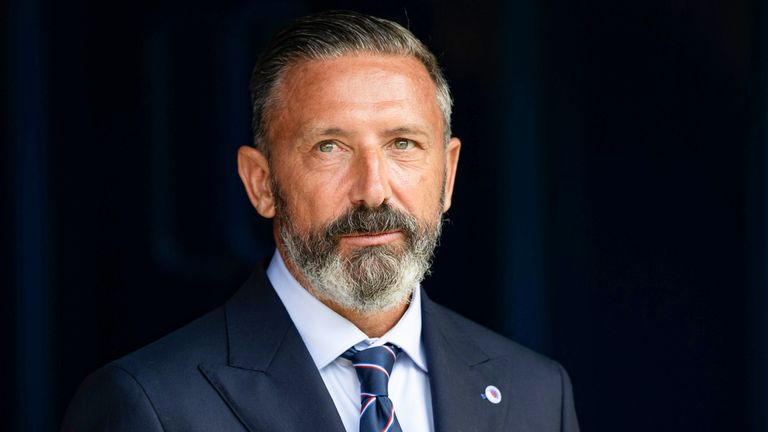
Derek McInnes has laid down a stark challenge to his Rangers squad ahead of Sunday’s Premier Sports Cup quarter-final against Celtic, declaring that everyone at the club, players and staff alike, carries a shared responsibility to deliver silverware, and that anyone who fails to do so simply will not last long in the job. The comments, delivered in the build-up to one of the biggest fixtures of the season so far, underline just how clearly McInnes understands the terms of his own employment at Ibrox, and just how directly his own future is likely to be tied to the trophies, or lack of them, that Rangers manage to accumulate under his stewardship.
Speaking to reporters ahead of Sunday’s Old Firm derby, McInnes was blunt in his assessment of what is required of anyone who takes charge of Rangers. He explained that he fully understands the nature of the business, adding that everyone who signs up for a role at the club does so with their eyes open to what is expected. He went further still, stating plainly that players and staff share a collective responsibility to deliver silverware, and that falling short of that standard means simply not sticking around at Ibrox for very long.
That kind of candour reflects a manager who has clearly reflected deeply on the demands of the role before accepting it. McInnes inherited a club he says has not been sufficiently relevant domestically in recent years, pointing to what he described as a run of sporadic cup wins and just a single league title, a record he clearly views as falling well short of what a club of Rangers’ size and history should be delivering on a regular basis. For McInnes, addressing that shortfall, and doing so quickly, appears to be at the very top of his list of priorities since taking permanent charge of the team.
The numbers McInnes has been working with tell their own story. Since he took permanent charge, sections of the Scottish football media have pointed out that Rangers have won just one league title and two domestic cups across the past 15 years, a stark contrast to the club’s historic dominance of Scottish football before their financial collapse and subsequent rebuild through the lower leagues. That drought has coincided with a period of sustained success for arch-rivals Celtic, who have used Rangers’ struggles to establish a period of relative dominance domestically, adding extra symbolic weight to any fixture between the two clubs, and to the quarter-final meeting at Ibrox in particular.
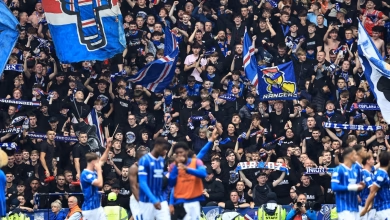
Given that context, McInnes has been explicit that ending Rangers’ days of being viewed as also-rans in Scottish football starts with fixtures exactly like Sunday’s. He has urged his players to see the visit of Celtic, even with Martin O’Neill’s side unable to bring any travelling support to Ibrox due to the SPFL’s decision to bar away fans from all Old Firm fixtures this season, as a golden opportunity to take a meaningful step toward silverware. McInnes has been keen to stress that a raucous, entirely one-sided home crowd represents an advantage his players must fully exploit rather than something to be taken for granted.
For McInnes personally, the message he has delivered publicly to his squad mirrors a philosophy he has voiced throughout his managerial career. Reflecting on his own approach to the job, he has made clear that his job satisfaction, and by extension his prospects of remaining in the role over the long term, will ultimately be judged by how many trophies he is able to deliver rather than by any other measure of progress or improvement. That is a demanding, uncompromising standard to set for himself, but one that McInnes appears to have fully embraced as simply part of what comes with managing a club of Rangers’ stature and history
That focus on silverware as the defining measure of success is not a new theme in McInnes’s career. During his time in charge of Aberdeen, he was similarly candid about viewing further trophies as unfinished business, admitting on more than one occasion that he would happily trade a string of respectable league finishes for the guarantee of lifting a cup. That consistency of outlook suggests McInnes’s comments ahead of Sunday’s derby are not simply calculated words for the media, but reflect a genuinely held conviction about what actually matters in a results-driven industry, particularly at a club with the history and expectation that Rangers carries.
Beyond the broader question of silverware, McInnes has also acknowledged that his own head-to-head record in derby fixtures is likely to weigh heavily on how supporters and pundits judge his tenure. Drawing on his own experience at Hearts, where he won three of his four Edinburgh derbies against Hibernian last season, McInnes has openly accepted that similar scrutiny now awaits him in Glasgow, on a far bigger stage. He has been candid in admitting that Hearts managers who fail to win derbies against Hibs do not tend to survive long in the role, and has drawn a direct parallel to the situation he now finds himself in at Rangers, acknowledging that the fixture against Celtic carries even greater significance and an even brighter spotlight than anything he experienced in Edinburgh.
That willingness to confront the pressure of derby scrutiny head-on, rather than downplay it, again speaks to a manager who appears to have a clear-eyed understanding of exactly what is required of him in his new post. Rather than treating Sunday’s quarter-final as just another fixture on a long list of games to be negotiated through the season, McInnes has framed it as a significant early opportunity to build credibility with supporters, both by delivering a result against Rangers’ fiercest rivals and by taking a tangible step toward the kind of silverware he insists the club, and his own tenure, will ultimately be judged on.
McInnes’s message about the importance of trophies has come at a particularly relevant moment in the Rangers season. The club endured a difficult opening block of fixtures, exiting Europe at the qualifying stage in defeats to both Jagiellonia and Jablonec, before opening their league campaign with a draw and a defeat. That rocky start prompted McInnes to hold a private team meeting aimed at refocusing his squad’s mentality, using the setback in Europe as motivation rather than a source of lingering negativity.
According to defender Emmanuel Fernandez, who spoke about the meeting afterwards, McInnes was open with the squad about the disappointment of that poor start before redirecting their focus toward the three domestic trophies still available to be won across the season: the Scottish Premiership title, the Premier Sports Cup, and the Scottish Cup. Fernandez explained that the players came away from that meeting with renewed belief in their ability to mount a serious domestic challenge, and credited the intervention with helping to improve the squad’s overall sense of togetherness heading into a run of fixtures that has since brought three straight Premiership wins over Aberdeen, Falkirk and Motherwell, lifting Rangers up to fourth in the table ahead of Sunday’s derby.
That upturn in form offers some early evidence that McInnes’s message is beginning to resonate with his players, even if there remains room for improvement, with those three league victories all coming by a single goal and Rangers still showing periods of wastefulness and defensive uncertainty along the way. Even so, the shift in mentality McInnes has sought to instil, framing the season not around the disappointment of an early European exit but around the trophies still very much in play, appears to have provided a platform of confidence heading into Sunday’s much bigger test against Celtic.
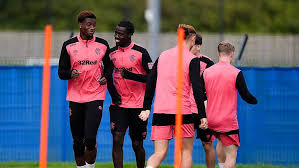
Given the magnitude of Sunday’s quarter-final and the possibility of the tie going all the way to penalties, McInnes has also made clear that his side have been working specifically on spot-kicks in training, conscious of how many of Rangers’ recent cup and European fixtures have been decided by fine margins. He has described practising penalties as simply professional preparation, pointing out that in light of recent results, narrow margins have played a significant role in determining outcomes, and stressing the importance of ensuring his players are as prepared as possible for whatever way the match unfolds.
That attention to detail reflects the broader seriousness with which McInnes appears to be approaching Sunday’s fixture, treating it not merely as another step in a long domestic campaign but as a genuine opportunity to deliver an early marker of progress in his tenure. Given his own repeated insistence that trophies, and performances against Celtic specifically, will ultimately define how his time in charge is remembered, leaving no stone unturned in preparation for a fixture that could go to penalties appears to be a natural extension of that mindset.
Taken together, McInnes’s comments paint the picture of a manager who has walked into one of the most demanding jobs in Scottish football fully aware of what is required of him, and who has chosen to communicate that reality directly and honestly to both his players and the watching public, rather than attempt to manage expectations downward. His insistence that failing to deliver silverware simply means a manager, or indeed a player, will not last long at Ibrox reflects both an acceptance of the unique pressures that come with managing Rangers and a determination to meet those pressures head-on rather than shy away from them.
Whether that approach ultimately proves successful will depend heavily on results over the coming months, starting with Sunday’s derby against Celtic. A positive outcome against O’Neill’s side, in front of an Ibrox crowd unaccompanied by any travelling support and roaring McInnes’s team on, would represent exactly the kind of step toward silverware and derby credibility that the manager has spoken about so directly in the build-up. Anything less, given the explicit standard McInnes has set for himself and his squad, would only intensify the scrutiny he has already acknowledged awaits him, both in terms of his overall trophy record and his personal head-to-head history against Rangers’ fiercest rivals.
Ultimately, McInnes’s message speaks to a wider truth about what it means to manage a club of Rangers’ size and history. Trophies, rather than league position, style of play or general progress, remain the ultimate currency by which managers at Ibrox are judged, a reality that previous incumbents in the role have echoed throughout the years. For McInnes, having already experienced life managing under significant pressure and scrutiny during his time at both Aberdeen and Hearts, there appears to be little illusion about what awaits him at Rangers. Instead, he has chosen to confront that pressure openly, framing Sunday’s derby against Celtic as an opportunity rather than a burden, and setting out clearly for both his players and Rangers supporters exactly what standard he intends to hold himself, and his squad, to as his tenure at Ibrox continues to take shape.