Ibrox View: Three decisions referee Nick Walsh got wrong as Rangers take Old Firm spoils vs Celtic

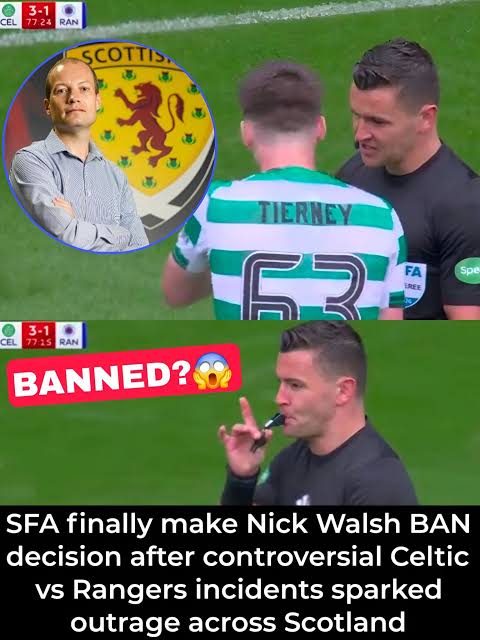
Rangers emphatically took the spoils in the first Old Firm derby of the season, brushing Celtic aside 3-0 at Ibrox to book their place in the semi-finals of the Premier Sports Cup. Goals from Dan Neil, twice, and Kevin Kelsy secured a comprehensive win for Derek McInnes’s side, one that leaves little room for genuine debate about which team deserved to progress. But even in a match as one-sided as this, referee Nick Walsh still found ways to leave Ibrox unhappy with his performance, with three key moments standing out as calls he simply got wrong.
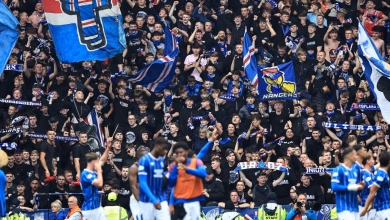
There is no getting around how comfortable Rangers’ win ultimately was. By full time, Celtic had rarely threatened, and McInnes’s side controlled long spells of the contest in front of a stadium that, for the first time this season under the SPFL’s away-fan ban, contained only home supporters. Yet even amid such a one-sided scoreline, Nick Walsh’s afternoon in the middle drew plenty of scrutiny, with several flashpoints throughout the game leaving Rangers supporters with genuine cause for frustration, even in victory.
Working alongside VAR official Andrew Dallas and assistant Steven McLean, Walsh was always going to face an unenviable task overseeing a fixture as combustible as an Old Firm derby, and to his credit, several of his bigger calls, including two separate VAR reviews for offside, were ultimately adjudged to have been correctly handled. But it is the moments that fell outside of clear video review, the ones left to his own on-field judgement, where the frustration for Rangers supporters truly lies.
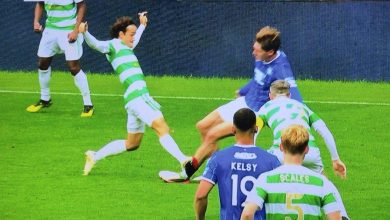
Chief among the complaints from an Ibrox perspective was the leniency shown toward Celtic defender Colby Donovan, who was fortunate to still be on the pitch come the final whistle. Donovan was shown a yellow card as early as the 27th minute for a foul on Djeidi Gassama, and from that point onward, his afternoon should arguably have been played on a knife edge. Instead, the Celtic defender continued to fly into challenges with little apparent consequence, including a foul on Ryan Naderi later in the match that many felt should have resulted in a second caution and an early bath.
Even outside pundits reviewing the game afterwards acknowledged just how close Donovan came to seeing red, with one assessment suggesting he had pushed his luck to within a fraction of a percent of being sent off before the final whistle arrived. For a Rangers side that was already cutting through Celtic’s defence at will, the failure to reduce the visitors to ten men through a fully merited second booking represents a clear missed opportunity for Walsh to have taken control of a game that, by rights, should have been an even more emphatic afternoon for the hosts. Given how blatant several of Donovan’s later fouls appeared, allowing him to see out the full 90 minutes stands as one of the clearest examples of Walsh’s inconsistency on the day.
The second major gripe from an Ibrox perspective centres on an incident midway through the second half, when Ryan Naderi appeared to slip inside the Celtic half, only for Mika Baur to catch him on the ankle as the Rangers midfielder attempted to regain his footing. Replays of the incident showed clearly that it was Baur who made contact with Naderi first, yet rather than awarding the free-kick in Rangers’ favour, Walsh instead pointed the other way, giving the decision to Celtic.
It was a moment that summed up the frustrations of an afternoon in which several fifty-fifty calls simply did not fall Rangers’ way, even as the scoreline continued to tilt overwhelmingly in the home side’s favour. While the mistake itself did not lead to any direct consequence for Rangers given their dominance elsewhere on the pitch, it remains a clear example of an official getting an on-field decision wrong in real time, with no VAR intervention available to correct it given that such marginal fouls typically fall outside the scope of video review.
Perhaps the most contentious moment of the entire afternoon arrived when Celtic substitute Haissem Hassan, having just come off the bench and immediately begun causing problems down the Rangers left, was hauled down by Dujon Sterling in a challenge that was, in isolation, a fairly straightforward yellow card. Yet in the confusion that followed, with Hassan left fuming on the ground, it was James Penrice who ended up walking away with a caution, after the ball he was attempting to clear struck the grounded Celtic winger and sparked a furious confrontation involving players from both sides.
The issue for many Rangers supporters is not necessarily that a card was shown following the flashpoint, but that Sterling, whose original foul on Hassan was described by pundits reviewing the incident afterwards as the clear and obvious point at which a booking should have been issued, escaped completely unpunished, while Penrice, whose only real crime was inadvertently kicking the ball in Hassan’s direction while trying to win back possession, was the one left with his name in the book. Had Walsh dealt with Sterling’s foul more promptly, the argument goes, the subsequent confrontation, and Penrice’s involvement in it, might never have occurred at all. Instead, the Rangers full-back was left to see out the remainder of the match effectively walking a disciplinary tightrope for an incident that was as much a product of Walsh’s delayed reaction as anything Penrice himself did wrong.
For all the frustration generated by those three moments, it would be wrong to suggest that Walsh’s performance had any meaningful bearing on the eventual outcome. Rangers were the superior side for almost the entirety of the 90 minutes, with Neil’s brace either side of Kelsy’s first goal for the club since his £9 million move from MLS reflecting a level of attacking quality that Celtic simply had no answer for on the day. Even the goal that was correctly disallowed for offside, Emmanuel Fernandez’s header from a Penrice free-kick, chalked off after Nicolas Raskin was found to have strayed offside and interfered with play, was a decision that most neutral observers agreed Walsh and his VAR team got right.
That is precisely what makes the three errors outlined above so frustrating from an Ibrox perspective: they occurred not in a tight, marginal contest where every decision could have swung the balance of the game, but in a match Rangers were winning comfortably regardless. In some ways, that makes the inconsistency even more galling. A team playing as well as Rangers did on Sunday deserves an officiating performance that matches the calibre of the occasion, rather than one littered with the kind of individual errors of judgement that continue to fuel debate about the standard of refereeing in Scottish football’s biggest fixtures.
Sunday’s performance also adds to what has become a lengthy and closely scrutinised history for Walsh whenever he takes charge of matches between Rangers and Celtic. Previous derbies overseen by the official have similarly generated debate from both sides of the divide, whether over red-card incidents that were not upgraded on review, marginal penalty decisions, or bookings that supporters on one side or the other felt were harsh or inconsistent. That pattern of controversy, regardless of which side ultimately wins the match in question, has led some observers to suggest that if both sets of supporters consistently distrust the same official, it may say more about the standard of officiating on display than it does about the neutrality of the man in the middle.
For Rangers supporters specifically, Sunday’s derby will likely be remembered as a joyous occasion regardless of the refereeing gripes, given the manner of the win and its significance in sending McInnes’s side through to a Hampden semi-final. But the frustrations over Donovan’s failure to be shown a deserved second yellow card, the wrongly awarded free-kick against Naderi, and the confusion that led to Penrice rather than Sterling being booked following the Hassan flashpoint, will nonetheless add fuel to an ongoing debate about consistency in Scottish officiating, one that shows little sign of abating regardless of how comfortably matches are ultimately settled on the pitch.
With Rangers now safely through to the last four of the Premier Sports Cup, and a return trip to Celtic Park in the Scottish Premiership already on the horizon just a week later, McInnes and his players will be keen to move on quickly from any lingering officiating debates and focus on building further momentum during what has become an increasingly promising run of form. For Nick Walsh, meanwhile, Sunday’s derby is unlikely to be the last time his performance comes under this kind of scrutiny, given his now well-established history of contentious involvement in fixtures between these two clubs.
Whatever the rights and wrongs of the three decisions picked out above, none of them ultimately prevented Rangers from delivering a statement result against their fiercest rivals. But for a support that has grown accustomed to holding officials to the highest possible standard in matches of this magnitude, Sunday’s derby offered a reminder that even in the most one-sided of victories, there is rarely a shortage of refereeing talking points to keep the debate simmering long after the final whistle has blown.