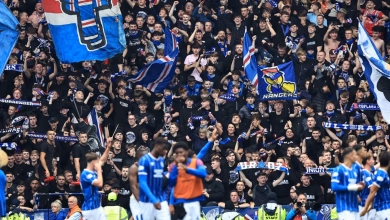
Rangers’ 3-0 demolition of Celtic in Sunday’s Premier Sports Cup quarter-final should, by any normal measure, have been remembered purely as a footballing story. Dan Neil’s brace, Kevin Kelsy’s first goal for the club, Derek McInnes’ first Old Firm win as manager — all the ingredients were there for a straightforward celebration inside Ibrox. Instead, within hours of the final whistle, the conversation around the match had partly shifted away from what happened on the pitch and onto what greeted players and supporters before a ball was even kicked: a pre-match tifo displayed in the Copland Road stand that has now prompted a former top-level referee to call for the Scottish Football Association to intervene.
The image itself needs little decoration to explain why it has caused unease. Unfurled by supporters in the section behind one of Ibrox’s goals, the banner recreated a well-known flashpoint from Old Firm history — former Rangers midfielder Ian Ferguson aggressively grabbing the shirt of ex-Hearts player Mike Galloway during a heated on-field confrontation from a previous era. The choice of imagery would likely have generated some debate in any circumstances, given its violent framing. What has sharpened the criticism considerably is timing: Galloway passed away earlier this year, meaning supporters chose to recreate an aggressive physical confrontation involving a man who is no longer alive to have any say in how that moment from his career is remembered or repurposed by a crowd of thousands.
It’s this combination — the aggressive nature of the depicted incident, and the fact that it involves a recently deceased former player — that has drawn the strongest reaction so far, from someone whose career gives his opinion on stadium conduct real institutional weight.
The most prominent voice criticising the tifo publicly is Keith Hackett, the former Premier League referee who went on to serve as general manager of the Professional Game Match Officials Board, the body that oversees refereeing standards in English football. Hackett is not a neutral pundit reaching for a hot take; he built a long career around officiating standards, conduct around the game, and disciplinary process, which gives his intervention here more institutional credibility than the average post-match reaction.
Speaking to Ibrox News, Hackett was blunt in his assessment, describing the display as completely unacceptable and arguing that the SFA has a responsibility to contact Rangers and make clear that this kind of imagery has no place inside the stadium again. His central point was less about punishing Rangers after the fact and more about the governing body drawing a clear line for the future — flagging the incident, warning the club, and setting an expectation that it should not be repeated. That is a notably measured position; Hackett is not calling for points deductions, stadium closures, or hefty fines. He is calling for a warning, delivered clearly enough that there is no ambiguity about what is and isn’t acceptable in the stands going forward.
Whether the SFA takes up that suggestion remains to be seen. Scottish football’s governing bodies have not always moved quickly or decisively on banner and tifo controversies in the past, and the organisation has a well-documented history of applying disciplinary scrutiny unevenly across different types of matchday incidents — pitch invasions and crowd violence tend to attract hearings and sanctions relatively promptly, while banner and chant controversies have sometimes been left to UEFA, police investigations, or simply public criticism rather than formal domestic censure. That inconsistency is itself part of the backdrop against which this latest incident is playing out.
What makes the timing of this controversy particularly awkward for Rangers is the state of the relationship between both Old Firm clubs and Scottish football’s governing bodies heading into this season. Sunday’s Ibrox derby was played entirely without away supporters — neither Celtic fans at Ibrox for this match, nor will Rangers fans be present at Celtic Park for next Sunday’s Premiership return fixture. That arrangement did not come about by accident or ticketing dispute alone; it followed a genuinely serious episode of crowd disorder earlier this year.
Back in March, a Scottish Cup quarter-final between the two clubs at Ibrox ended in chaos after Celtic won on penalties. Celtic supporters who had been given a rare, larger allocation of tickets — the first sizeable away contingent at an Old Firm fixture in almost a decade — poured onto the pitch to celebrate, prompting hundreds of Rangers fans to invade in response. What followed was described by an independent review as scenes in which crushing and life-threatening violence were only narrowly avoided, as fans from both sides clashed, missiles and pyrotechnics were thrown, and police and stewards were forced to construct a physical barrier across the pitch to separate the two groups. Dozens of arrests followed.
The fallout from that night has shaped much of the disciplinary landscape both clubs are now operating under. Both Rangers and Celtic were charged by the SFA with failing to prevent unacceptable conduct, and both admitted the charges at a disciplinary hearing held at Hampden in August. The punishment handed down required each club to play their next home Scottish Cup fixture behind closed doors, with a further ruling that any repeat of crowd trouble in that competition over the following two seasons would trigger another closed-doors punishment. Celtic pushed back publicly on the severity of that sanction, issuing a statement describing it as a disproportionate response to what they characterised as a relatively contained incursion driven by a moment of emotional celebration, while stressing that the club has never defended fans encroaching onto the pitch and has taken action whenever it has occurred.
It is against that backdrop — closed-doors punishments, admitted disciplinary charges, and a defensive posture from both clubs about how harshly they are being treated — that Sunday’s tifo has landed. Any suggestion of further disciplinary trouble for either Old Firm club right now carries extra weight, precisely because the governing body has already demonstrated this year that it is willing to impose real sporting consequences, not just warnings, when supporter conduct crosses a line it considers serious.
Sunday’s banner is also not an isolated event when it comes to Rangers supporters and pre-match displays that have drawn scrutiny. The club’s more vocal sections have a recent track record of tifos that have generated controversy well beyond footballing circles, and that history is part of why this latest incident is being treated as more than a one-off.
Last year, a Rangers tifo depicting Graeme Souness — the club’s former player and manager — pointing what appeared to be a shotgun, accompanied by the phrase “Take aim against the rebel scum,” prompted a police investigation. Rangers publicly condemned the display at the time, distancing the club from the imagery and language involved. Police ultimately concluded that no criminal offence had been committed, and the SFA did not pursue any formal disciplinary response of its own. That outcome — public condemnation from the club, a police look but no charges, and no governing-body sanction — set something of a template for how these incidents have typically been resolved in the recent past: strongly worded statements, but limited concrete consequence.
Earlier that same year, in March, Rangers found themselves fined by UEFA rather than a domestic body, after supporters displayed a banner during a European fixture reading “Keep woke foreign ideologies out. Defend Europe.” That episode is a useful point of comparison because it shows the split jurisdiction at play here: UEFA has been willing to fine the club directly for supporter conduct in European competition, while domestic authorities have generally taken a lighter touch on banner and tifo issues specifically, reserving harsher sanctions for physical crowd disorder like the pitch invasions in March.
Taken together, this pattern — a shotgun-themed tifo referencing violence against opposition, a UEFA fine for exclusionary political language, and now a tifo recreating a violent physical confrontation involving a supporter who has since died — suggests a recurring tension between how a section of the Ibrox support wants to express derby rivalry and where the boundaries of acceptable matchday conduct actually sit. It also raises a fair question about whether previous responses — club condemnation without meaningful sanction — have done enough to discourage displays of this kind, or whether the absence of firm consequences has, intentionally or not, signalled that there is limited real cost to testing those boundaries.
It’s worth dwelling on why this particular tifo has cut through in a way that some other pre-match banners might not have. Old Firm football has never been short of confrontational imagery, aggressive chanting, or references to notorious flashpoints from decades of fixtures between the two clubs — that, for better or worse, has long been part of the culture surrounding the derby. What separates Sunday’s display is the combination of two specific factors working against each other: the violence depicted, and the fact that one of the two men shown in that moment is no longer alive to respond to how his career and character are being used.7
Recreating a genuine altercation between two footballers from a different era inevitably invites the question of consent and dignity — whether it’s appropriate for a deceased former player’s likeness to be used in a display glorifying an aggressive physical confrontation, regardless of how much water has passed since the original incident occurred on the pitch. Supporters who created and displayed the tifo may well see it purely as a celebration of a combative, uncompromising moment from Rangers’ history, with no intention of causing distress. But intent and impact are not always the same thing, and Hackett’s criticism focused squarely on the second of those — the unacceptability of the image itself, irrespective of what supporters meant by putting it up.
There is also a broader question here about how football clubs, and the supporter groups operating semi-independently within them, navigate matchday visual culture in an era where every banner, chant, and pyro display is filmed, shared, and scrutinised almost instantly. What might once have been a display seen only by those inside the stadium, and perhaps described briefly in a matchday report, is now dissected by pundits, former officials, and rival supporters within hours, occasionally becoming a bigger story than the match it accompanied. Sunday’s derby is a clear example of that dynamic in action.
At the time of writing, there is no indication that the SFA has issued a formal response to the tifo, either confirming that contact has been made with Rangers or outlining any disciplinary process. Hackett’s comments represent a call for action from a respected voice in refereeing and matchday conduct circles, not confirmation that the governing body has already decided to act. Given the SFA’s track record with similar incidents — condemnation without sanction for last year’s Souness banner, a UEFA fine rather than a domestic one for the “woke foreign ideologies” banner — there is a reasonable chance this episode follows a familiar pattern: public criticism, perhaps a private word from the governing body to the club, but no formal charge or sporting sanction.
That said, the surrounding context makes this a slightly different environment for the SFA to be operating in. With both Old Firm clubs already sitting under a suspended sanction relating to crowd conduct in the Scottish Cup, and with away support banned from Old Firm fixtures entirely this season because of the fallout from March’s pitch-invasion chaos, the governing body may feel less inclined to let a fresh controversy pass with only informal disapproval. Any perception that Rangers or Celtic are testing the patience of a body that has already demonstrated a willingness to impose closed-doors punishments could invite closer scrutiny than a similar incident might have received in a less fraught season.7
For Rangers, the practical stakes of the coming days are considerable regardless of how the tifo situation develops. The club is already dealing with the operational reality of the away-fan ban extending into any home Scottish Cup fixture this season, and Derek McInnes’ side will want the story of the week to remain about Dan Neil’s derby-winning brace, Kevin Kelsy’s breakthrough goal, and a first Old Firm win for their new manager — not about a banner controversy dragging in questions of taste, respect for the deceased, and the club’s disciplinary standing with the national governing body. How Rangers choose to respond publicly, whether with a statement distancing the club from the specific supporters responsible, silence, or some other approach, will likely shape how much further this story runs before attention turns fully to next Sunday’s Premiership rematch at Celtic Park.
It would be easy to file Sunday’s tifo controversy away as a minor sideshow to a genuinely significant footballing result — Rangers’ first Old Firm win of any description under Derek McInnes, secured with a level of dominance that few inside Ibrox expected. In isolation, a single banner criticised by one former referee might not amount to much. But viewed alongside March’s pitch-invasion violence, the closed-doors punishments handed down in August, last year’s shotgun-themed Souness tifo, and the UEFA fine for exclusionary banner language, Sunday’s display fits into a longer-running pattern that Scottish football’s authorities have struggled to fully get a handle on: a fixture whose intensity regularly produces displays and behaviour that sit somewhere between passionate rivalry and something considerably more troubling.
Whether the SFA heeds Keith Hackett’s call and formally contacts Rangers remains to be seen. What is already clear is that the governing body, both clubs, and their supporters are heading into an increasingly charged run of fixtures — a Premiership derby at Celtic Park next Sunday, a League Cup semi-final still to come, and the ever-present possibility of another Scottish Cup meeting later this season — with the question of where matchday conduct crosses a line still very much unresolved. Sunday’s tifo may fade from the headlines by the time the two sides meet again next weekend. The underlying tension it represents almost certainly will not.