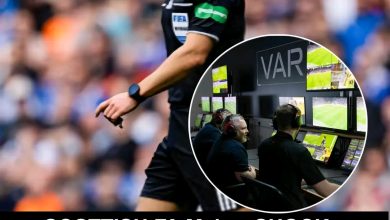
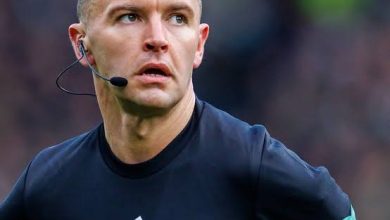
Rangers vs Celtic Oversight Causes ‘Surprise’ as Ex-FIFA Referee Finds Reason to Fume

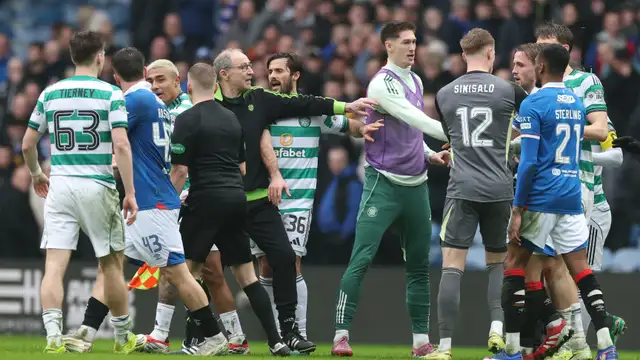
Derek McInnes will not care one bit, and nor will the vast majority of the Ibrox support, but Rangers’ emphatic 3-0 Premier Sports Cup quarter-final victory over Celtic on Sunday was not without its share of contentious officiating moments. Referee Nick Walsh found himself at the centre of several significant calls throughout the afternoon, and while the vast majority of neutral observers agree the better side won comfortably regardless, at least one decision has since drawn pointed criticism from a highly credentialed source — a former FIFA official who believes Celtic were unfairly denied a clear penalty.
The Best Result Yet of McInnes’s Ibrox Reign
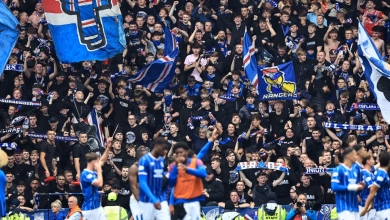
Before turning to the officiating talking points, it is worth restating just how significant Sunday’s result was for a Rangers side and manager who had endured a considerably more difficult start to the season than the eventual scoreline suggested was possible. Dan Neil scored twice, either side of a well-taken Kevin Kelsy strike, to secure a 3-0 win that extended Rangers’ winning run to five matches in all competitions and delivered comfortably the best result and performance of McInnes’s tenure so far. By full-time, even Martin O’Neill was gracious enough to accept that his Celtic side had been thoroughly dominated at a raucous, sold-out Ibrox — a rare and telling admission from an experienced manager well used to finding positives even in the heaviest of defeats.
Rangers might, in truth, have won by an even wider margin. Emmanuel Fernandez thought he had added a fourth goal shortly after the hour mark, only for the offside flag to cut short the celebrations, while Kelsy’s own second-half strike required a VAR check of its own before it was allowed to stand. That the game’s marginal calls appeared to work in Rangers’ favour on balance will not have gone unnoticed by a watching Celtic support already frustrated by their side’s toothless overall performance — but it was one particular non-decision, rather than either of those close offside calls, that has generated the most significant post-match debate.
The Makhanya Incident
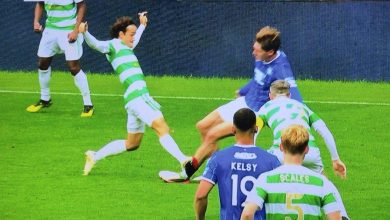
The moment in question arrived in the first half, with the score still goalless, when Rangers defender Olwethu Makhanya became tangled with Celtic striker Kasper Hogh inside the penalty area. Replays appeared to show Makhanya climbing onto Hogh’s back before swinging the Danish forward down to the turf, in what many observers felt was a fairly clear foul committed inside the box. Despite the nature of the coming-together, Walsh waved play on without hesitation, and — perhaps more strikingly — there was no indication that the incident was subjected to any meaningful VAR review at the time, despite penalty decisions being precisely the sort of subjective on-field call that video assistant referees are typically tasked with double-checking for clear and obvious errors.
The incident received relatively little attention in the immediate aftermath of the final whistle, a fact that in itself speaks to how comprehensively Rangers’ performance overshadowed almost every other talking point from the afternoon. Even Premier Sports’ live broadcast team made comparatively little of the moment as the game moved on, with the broadcast’s focus quickly shifting back to Rangers’ growing dominance in the middle of the pitch rather than dwelling on a shout that, at the time, appeared to be a fairly standard forgotten penalty appeal in the context of a match already trending heavily toward the home side.
Keith Hackett’s Verdict
That relative lack of scrutiny changed once former FIFA-listed referee Keith Hackett was asked for his expert assessment of the incident. Speaking exclusively to Ibrox News, Hackett did not hold back in his verdict, expressing genuine surprise that video officials had not intervened to overturn what he clearly felt should have been given as a clear penalty to Celtic. “With the referee not awarding a penalty kick then looking at this clip I am surprised that there was no VAR intervention,” Hackett said. “Celtic have every right to be disappointed that a penalty kick was not awarded.”
Hackett’s credentials lend particular weight to that assessment. A veteran of the FIFA international refereeing list during his officiating career and a long-serving figure within English refereeing administration since retiring from the pitch, he has become one of the most widely consulted independent voices on contentious refereeing incidents across British football, regularly called upon by media outlets north and south of the border to offer expert analysis on decisions that have sparked controversy or debate. When a figure of Hackett’s standing describes himself as surprised that a video review did not take place, it carries considerably more weight than the usual chorus of aggrieved fan reaction that follows almost every contentious call in a fixture as emotionally charged as an Old Firm derby.
For Rangers supporters, there will nonetheless be a certain wry satisfaction in seeing a contentious refereeing call finally go their way in this fixture, given the frequency with which decisions in recent Old Firm meetings have been scrutinised in the opposite direction. Whatever the rights and wrongs of the specific incident, most inside Ibrox will simply be relieved that, for once, a marginal call did not end up costing their side in a fixture of this magnitude.
Walsh’s Afternoon in Full
The Makhanya incident was far from the only significant call Nick Walsh had to make across the ninety minutes, and a fuller assessment of his overall performance suggests a genuinely mixed bag from an officiating perspective, regardless of which way individual marginal decisions ultimately fell. Beyond the disputed penalty shout, Walsh also had to deal with a foul on Rangers midfielder Ryan Naderi that some observers felt merited more serious sanction than was ultimately shown, with suggestions in the aftermath that a poor challenge on the German-Bulgarian forward could easily have resulted in a red card rather than the lesser punishment that was dished out on the day.
There was further controversy, this time working in Celtic’s favour from a Rangers perspective, when Emmanuel Fernandez appeared to escape punishment for what many felt was a clear foul committed during the first half. Speaking on BBC Radio Scotland’s live coverage of the match, Celtic legend Pat Bonner could barely contain his disbelief when Walsh opted not to blow his whistle for the challenge, exclaiming “oh my word” as the incident unfolded. Fellow summariser Peter Lovenkrands went even further in his assessment, stating unequivocally that the challenge should have resulted in a free-kick, telling listeners: “That’s 100 per cent a free kick.” That Fernandez went on to have what would have been a fourth Rangers goal chalked off for offside later in the same half will offer Celtic fans little consolation for what they will view as a missed opportunity to punish the Argentine defender earlier in the contest.
Taken together, these various flashpoints paint a picture of an officiating performance that both sets of supporters could reasonably point to when arguing they were hard done by at various points during the ninety minutes. Rangers fans were frustrated by Fernandez’s disallowed effort and the earlier non-punishment of the challenge on Naderi going unpunished to Celtic’s benefit; Celtic fans, meanwhile, have the Makhanya penalty shout and the earlier missed foul on Fernandez to point to as evidence that the officiating did not consistently favour their opponents throughout. It is, in many respects, a fairly typical Old Firm officiating post-mortem — plenty of contentious moments to debate, with reasonable arguments available to supporters of both clubs depending on which incidents they choose to emphasise.
The VAR Question Persists
The broader question raised by the Makhanya incident is one that has dogged Scottish football’s video assistant referee system since its introduction — namely, the apparent inconsistency in which incidents receive a meaningful review and which do not. Unlike several other European leagues, where the threshold for VAR intervention in penalty claims has become increasingly well understood by supporters and pundits alike, Scottish football’s implementation has repeatedly drawn criticism for what many perceive as unpredictable standards regarding which incidents warrant a pitch-side monitor review and which are allowed to pass without any visible checking process at all.
Hackett’s intervention adds an authoritative voice to that ongoing debate, suggesting that even to an experienced, independent former official with no connection to either Glasgow club, the standard being applied by video officials in matches of this magnitude remains difficult to predict with any consistency. For a fixture as significant and closely scrutinised as an Old Firm derby, that lack of clarity around VAR’s decision-making thresholds is likely to continue generating exactly this kind of post-match debate for as long as the underlying inconsistency remains unaddressed by the game’s governing bodies in Scotland.
Walsh’s Long and Controversial Old Firm History
Sunday’s fixture was far from Nick Walsh’s first taste of Old Firm controversy, and understanding that broader history helps explain why Sunday’s various flashpoints have generated as much debate as they have. Walsh’s first appointment to this fixture came back in 2021, when he took charge of a 4-1 Rangers win at Ibrox, and he has remained one of the SFA’s most regularly used officials for the country’s biggest games in the years since, despite a lengthy list of contentious moments attached to his name from both sides of the Old Firm divide.
Rangers in particular have found plenty to be aggrieved about in previous Walsh-officiated derbies. During a Premier Sports Cup semi-final loss to Celtic, the club issued a strongly worded statement condemning what it described as an “unacceptable level of refereeing” after Walsh sent off Rangers midfielder Thelo Aasgaard while showing only a yellow card to Celtic’s Auston Trusty for an off-the-ball incident involving goalkeeper Jack Butland, a decision that prompted the Ibrox club to demand an urgent meeting with the SFA. More recently, at May’s Old Firm derby, Walsh opted against sending off Alistair Johnston for a heavy challenge on Mikey Moore, a call that left Rangers supporters furious and one that continued to be cited as an example of perceived inconsistency when Walsh’s name appeared on the officiating team sheet for subsequent Rangers fixtures. Celtic, for their part, have had their own grievances with Walsh over the years, including a disallowed Rangers goal at the 2024 Scottish Cup final that prompted criticism from the Ibrox dugout, and a widely scrutinised decision not to send off Celtic’s Reo Hatate for a dangerous challenge against Kilmarnock, which a subsequent review found had been incorrect.
That pattern of contentious calls stretching across seasons and involving both halves of Glasgow’s football divide helps contextualise why Sunday’s various flashpoints attracted the scrutiny they did, even amid a result as one-sided as a 3-0 away win. Whatever the specific rights and wrongs of Sunday’s individual incidents, Walsh’s reputation as a referee capable of making decisions that generate genuine debate — rather than passing largely unremarked upon, as the best officiating performances often do — meant post-match scrutiny of his display was always likely to follow, regardless of how comprehensively either side had won or lost.
Further Flashpoints Beyond the Penalty Shout
Beyond the headline Makhanya incident, subsequent detailed review of Walsh’s overall performance identified further moments worth scrutinising. In the 65th minute, Rangers’ Ryan Naderi was involved in what appeared to be a fairly innocuous passage of play in which he slipped near the touchline, only for Celtic’s Mika Baur to make contact with his ankle as both players competed for the loose ball. Despite replays suggesting Baur had made the initial contact, the resulting free-kick was awarded in Celtic’s favour rather than Rangers’ — a decision that left James Penrice, the Rangers player left to deal with the resulting delivery, in a difficult defensive position moments later. It was a relatively minor moment in the context of a game Rangers were already controlling comfortably, but it added to the sense that Walsh’s overall reading of marginal contact incidents throughout the afternoon was, at best, inconsistent in both directions.
The Numbers Behind Rangers’ Dominance
Whatever debate continues to surround the various contentious calls, the underlying statistics from Sunday’s contest leave little room for argument about which side deserved victory on the balance of overall play. Rangers registered 15 shots across the ninety minutes compared to Celtic’s seven — more than double their opponents’ output — and were considerably more clinical in front of goal too, managing eight shots on target compared to a solitary effort on target from O’Neill’s side across the entire afternoon. Possession told a similarly one-sided story, with Rangers enjoying 53 per cent of the ball, a modest but meaningful edge that, combined with their vastly superior shot output, painted the picture of a team that dictated territory and tempo for the majority of the contest.
Ultimately, of course, the only statistic that mattered by full-time was the scoreline itself, and Rangers made excellent use of the chances their overall dominance created, converting three of their eight shots on target into goals — a conversion rate that speaks to the quality of finishing produced by Neil and Kelsy in particular, rather than a fortunate afternoon built on profligate opposition finishing gone unpunished. Even accounting for the various contentious officiating moments discussed above, it is difficult to construct a credible argument that Rangers’ victory was anything other than thoroughly deserved on the balance of play across the full ninety minutes.
Why Refereeing Scrutiny Still Dominates the Discourse
The intensity of debate generated by Sunday’s officiating flashpoints, even amid such a comprehensive Rangers victory, says something broader about the current state of trust between Scottish football’s supporters and its refereeing establishment. Both Old Firm clubs have, at various points over recent seasons, publicly voiced frustration with decisions made in matches involving Nick Walsh specifically, creating a dynamic in which almost any contentious call involving either side is liable to be interpreted through the lens of accumulated grievance rather than assessed purely on its individual merits. That dynamic makes it considerably harder for any single refereeing performance, however good or bad in isolation, to be received calmly by either fanbase.
Social media reaction in the hours following Sunday’s final whistle reflected exactly that pattern, with clips of the Makhanya incident circulating widely among Celtic supporters as evidence of a missed penalty, while Rangers fans pointed just as readily to the earlier non-award against Fernandez and Naderi’s uninvestigated poor challenge as proof that any complaints from Parkhead ought to be viewed in the context of decisions that, on another day, could easily have gone the other way. Untangling genuine refereeing error from the confirmation bias that inevitably colours fan reaction to any Old Firm officiating display remains one of the more difficult tasks facing neutral analysts of Scottish football, and Sunday’s fixture offered a fairly representative example of just how quickly that untangling process can become genuinely complicated.
What Comes Next for Officiating Scrutiny
With both clubs already scheduled to meet again in the Scottish Premiership the following Sunday, the identity of the officials appointed for that reverse fixture will itself become a talking point in the build-up, given the history outlined above and the fresh grievances generated by Sunday’s quarter-final. Whether the SFA opts to reappoint Walsh for that fixture, or selects an alternative official in an attempt to draw a line under the growing list of contentious incidents attached to his recent Old Firm appointments, remains to be seen. What is clear is that, regardless of who takes charge, the scrutiny applied to every marginal decision in this fixture shows no sign of relenting anytime soon — a reality that officials tasked with the unenviable job of overseeing Scottish football’s biggest and most emotionally charged occasion will simply have to continue navigating as best they can.
For now, though, the definitive outcome of Sunday’s contest leaves little room for genuine dispute. Rangers were the better side by a considerable distance, McInnes has the platform-building result his young tenure had been searching for, and whatever debate continues to swirl around Nick Walsh’s individual calls, nobody inside Ibrox will be losing much sleep over a controversy that, ultimately, had no meaningful bearing on the final outcome of the biggest fixture of the Scottish football calendar so far this season.
O’Neill’s Rare Concession
It is worth dwelling for a moment on the significance of Martin O’Neill’s own post-match assessment, given how unusual it is for a manager on the losing side of an Old Firm derby to concede quite so readily that his side were comprehensively second best. O’Neill, an experienced operator well versed in the art of finding silver linings even in the darkest of results, offered no such spin in the aftermath of Sunday’s defeat, accepting plainly that Celtic had been dominated throughout at a hostile, capacity Ibrox. That level of candour from an experienced Old Firm campaigner underlines just how one-sided the underlying performance data suggests the contest genuinely was, officiating quirks notwithstanding.
For Celtic, the challenge now is to move on quickly from a result that has raised uncomfortable questions about squad depth and tactical set-up, with a rearranged Premiership meeting against the same opponents looming at Celtic Park the following weekend. For Rangers and McInnes, meanwhile, Sunday’s win — contentious refereeing moments and all — represents exactly the kind of statement result capable of transforming the mood around a previously scrutinised managerial reign, and few inside Ibrox will spend much time dwelling on Keith Hackett’s post-match intervention when there is a genuine sense that the corner may finally have been turned under their new manager.