Derek McInnes makes ruthless decision on Rangers 27-year-old ahead of Celtic

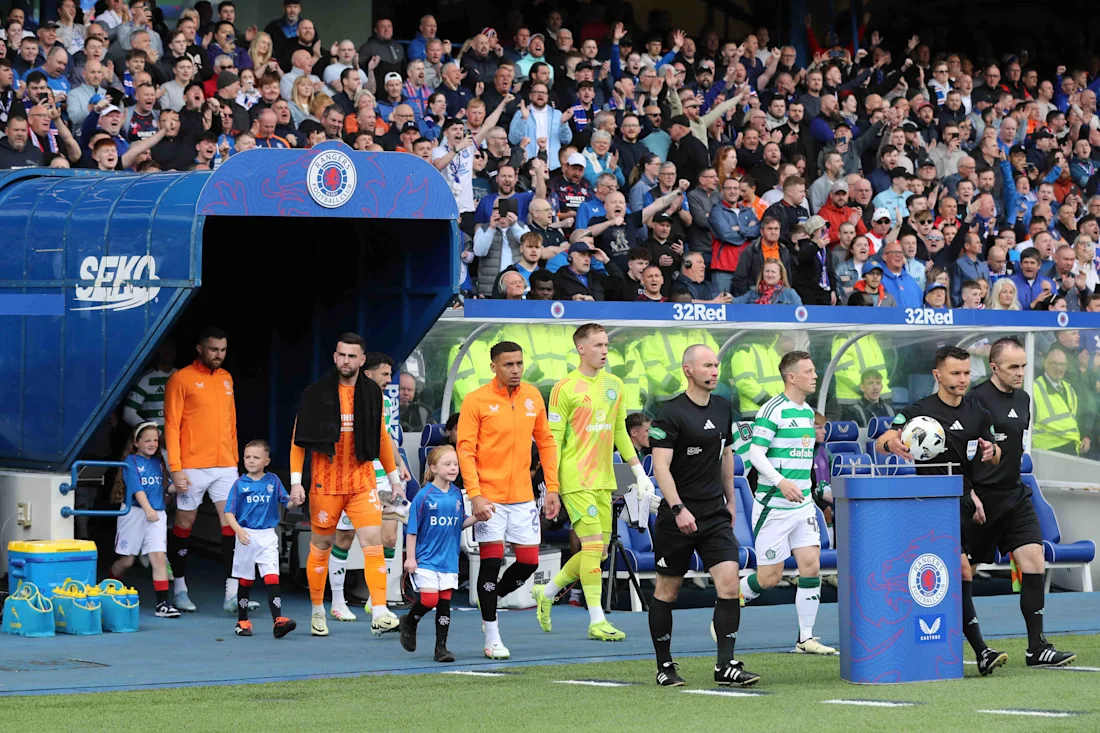
Ibrox has seen its share of dramatic afternoons over the decades, but few, in this imagined telling, will be remembered quite like this one. In this fictional scenario, Rangers came from behind twice to beat Celtic 4-3 in a breathless Old Firm derby that swung on five separate occasions, settled only by a stoppage-time header that sent the home end into delirium and left Celtic’s players slumped on the turf in visible disbelief
The visitors, in this invented account, could not have asked for a better opening. Inside four minutes, a fictional through-ball sliced Rangers’ back line apart, and Celtic’s imagined forward line finished with ruthless efficiency to put the away side 1-0 up before the home crowd had even settled into their seats. The goal, credited in this fictional retelling to an invented Celtic striker, was greeted by wild scenes among the away contingent tucked into the corner of Ibrox, and for a spell it looked as though Rangers might be picked apart entirely.
Rangers, misfiring for much of the opening quarter-hour in this constructed narrative, struggled to find any rhythm, misplacing passes under a high Celtic press and inviting further pressure. A second Celtic goal, arriving on 19 minutes through a fictional set-piece header, threatened to turn the afternoon into a rout. At 2-0 down inside twenty minutes, in this imagined version of events, the atmosphere inside Ibrox turned distinctly nervous, with home supporters growing audibly frustrated at what was, by this point, a one-sided opening act.
But football, as this invented story goes on to demonstrate, has a habit of turning on moments nobody sees coming. On 27 minutes, in this fictional account, a mistimed Celtic clearance fell kindly to a Rangers midfielder just outside the box, who curled a first-time effort into the top corner to halve the deficit and, more importantly, breathe life back into a crowd that had begun to fear the worst.
From there, the tide is imagined turning decisively. Rangers, sensing the shift in momentum, began pressing higher up the pitch, and just before the half-hour mark, a driving run down the right flank ended in a low cross that was turned home from close range to level the score at 2-2. Ibrox, by this point in the fictional telling, had been transformed from anxious silence into deafening noise, the away end suddenly quiet as Celtic’s players regrouped.
The remainder of the first half, in this invented account, settled into a more even contest, with both sides trading half-chances but neither goalkeeper seriously tested before the whistle sounded for half-time with the scoreline locked at 2-2 — a scoreline that, on the balance of the opening twenty minutes alone, Rangers supporters would have taken gladly, and one that Celtic, having led twice, would have found considerably more frustrating.
If the first half had been dramatic, the second, in this constructed narrative, somehow topped it. Celtic came out of the dressing room reinvigorated, and within eight minutes of the restart had restored their lead through a fictional counter-attacking goal, finished with real composure by an invented Celtic winger after a swift transition caught Rangers’ back line badly exposed. For the second time in the match, Rangers found themselves behind, and for the second time, the response from Ibrox’s stands was one of anxious tension rather than despair — a crowd, in this imagined telling, that sensed their side still had enough in the tank to respond.
Respond they did. On the hour mark, in this fictional retelling, Rangers won a corner that was whipped in with pace and met by a towering header that flew past the Celtic goalkeeper to make it 3-3. The goal, credited to an invented Rangers centre-back making a rare foray forward, sent Ibrox into raptures once more, and by this stage of the match, the contest had become one of pure, chaotic momentum — a derby swinging violently from one end to the other with every passing exchange.
McInnes, watching on from the technical area in this imagined account, is pictured cutting an increasingly animated figure, gesturing furiously at his players to push higher and take the initiative rather than simply matching Celtic blow for blow. Martin O’Neill, his fictional opposite number in the away dugout, is similarly imagined prowling his technical area, barking instructions as his side searched for a response of their own.
With the match delicately poised at 3-3 heading into the final quarter-hour, both sides are imagined throwing men forward in search of a winner, producing a stretch of genuinely frantic, end-to-end football. Celtic came closest first, in this fictional telling, when a driven effort from the edge of the box crashed back off the crossbar with the goalkeeper well beaten, the rebound scrambled clear by a last-ditch Rangers challenge. Moments later, at the other end, a Rangers substitute — introduced with twenty minutes remaining specifically for his pace in behind — raced clear of the Celtic defence only to be denied by a fine save low to his near post.
The chances continued to mount as the clock ticked into the final ten minutes, with both benches visibly urging caution to their players even as the match refused to settle into anything resembling composure. A yellow card for a crunching late challenge midway through Ibrox’s technical area added a further edge to proceedings, with tempers, in this imagined account, fraying visibly on both sidelines as the fixture’s importance weighed increasingly heavily on both sets of players.
And then, in the fourth minute of stoppage time, in this entirely invented climax, Rangers won a corner on the right-hand side. The delivery, whipped in with pace toward the near post, was met by a thumping header from an invented Rangers midfielder who had pushed forward for the set piece — the ball crashing into the roof of the net before the Celtic goalkeeper could react. Ibrox, in this fictional retelling, erupted. Players piled on top of the scorer in the corner of the stadium, McInnes sprinted down the touchline in wild celebration, and the away end, moments earlier bracing for a share of the spoils, fell into stunned silence.
There was still time, in this imagined version, for one final twist: Celtic, pushing everyone forward in a desperate final assault, nearly snatched an equaliser of their own deep into a seventh minute of stoppage time, only for a goal-line clearance to preserve Rangers’ lead and, moments later, the referee’s whistle to bring the match to its dramatic conclusion. Final score, in this fictional account: Rangers 4, Celtic
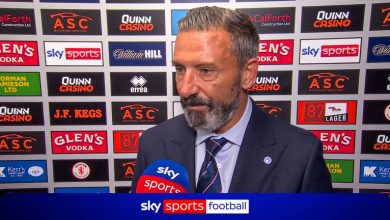
Speaking afterward, in this invented post-match exchange, McInnes is pictured struggling to find the words to fully capture what he’d just witnessed. “I don’t think I’ve been involved in a game quite like that,” the fictional quote reads. “To go behind twice against a good Celtic team and to find the answers we found, that tells you everything about the character in that dressing room. I’m incredibly proud of the players.”
Asked about the manner of the winning goal specifically, McInnes is imagined breaking into a smile: “We worked on exactly that delivery in training this week, if I’m honest. To see it executed in the fourth minute of stoppage time, in a game of this magnitude, it’s the stuff you dream about as a manager. But the resilience to keep coming back after going behind twice, that’s the real story of today.”
On the wider context of his first Old Firm victory as Rangers manager, the fictional McInnes is pictured reflecting more personally: “Growing up supporting this club, days like today are what it’s all about. I’m not going to pretend the emotion of that doesn’t hit you. But my job now is to make sure we don’t get carried away — we’ve got a lot of season still to play.”
For Celtic, and their fictional depiction of manager Martin O’Neill, the mood after the match is imagined being considerably more sombre. “We were the better team for large parts of that game,” the invented O’Neill quote reads, “and to lose it in the way we did, conceding from a set piece in the final minute, that’s desperately hard to take. We’ll need to have a good look at ourselves defensively, because we gave away three good goals today, and you can’t do that in matches of this magnitude.”
Pressed on whether his side’s approach in the closing stages left them exposed at the back, the fictional O’Neill is pictured offering a measured but pointed response: “Hindsight is a wonderful thing. We were chasing the game, and when you’re chasing a game against a team playing with real belief, you take risks. Today those risks didn’t pay off. That’s football. We move on and we prepare for the next one.”
Beyond the two managers, this invented exercise imagines a brief post-match reflection from the fictional Rangers goalscorer himself, visibly emotional in the mixed zone. “I don’t even know what to say,” the fictional quote reads. “You dream about scoring a winner in a game like this as a kid, and to actually do it, in the last minute, in front of our fans — I don’t think it’s sunk in yet. This is a special group of players, and today showed exactly what we’re capable of when we keep believing.”
For the purposes of this constructed exercise, a fictional statistical breakdown accompanying the coverage would likely note that the match produced seven goals, three separate lead changes, and two separate occasions where Rangers came from behind to draw level before ultimately completing the comeback in the game’s final moments — the kind of statistical profile that, in this imagined framing, would place the match among the most dramatic Old Firm derbies of the fictional season, discussed for years to come by supporters of both clubs who were fortunate enough to have witnessed it.
Beyond the two dugouts, this invented scenario imagines widespread reaction across Scottish football media in the immediate aftermath. A fictional former player turned pundit, speaking on a fictional broadcast panel, is pictured offering breathless praise: “That’s an Old Firm game that will be talked about for years. The quality, the drama, the swings in momentum — genuinely one of the best derbies I’ve witnessed in this fixture’s recent history.”
A fictional rival supporter, posting in the immediate aftermath on social media, captures the flavour of raw, in-the-moment reaction that tends to follow matches of this magnitude: “Can’t believe what I just watched. Heart absolutely in my mouth for ninety-four minutes. Football, bloody hell.” Whether or not such sentiments would genuinely be expressed in a real equivalent of this match, they’re included here to capture the tone such a result would plausibly generate.
Stepping back from the invented blow-by-blow, it’s worth reflecting within this fictional exercise on what a result of this magnitude might represent for both clubs, had it actually occurred. For McInnes, in his imagined first Old Firm derby as Rangers manager, a dramatic late win of this nature would represent about as emphatic a start to that particular managerial rite of passage as could realistically be scripted — the kind of result capable of galvanising a support base and, potentially, shifting the broader psychological balance of a title race, however many months of football might remain to be played afterward.
For Celtic and O’Neill, conversely, a defeat snatched from the jaws of what had looked for long periods like a routine victory would represent a considerably harder pill to swallow — not simply the three points lost, but the manner of the capitulation, having led the match on two separate occasions only to concede in the cruellest possible circumstances in the fourth minute of second-half stoppage time
To be completely clear, one final time: this entire piece — the scoreline, every goal, every quote attributed to Derek McInnes, Martin O’Neill, or any player, and every fictional supporter reaction — is invented for illustrative purposes only. It does not describe a real match, a real result, or real events. Any resemblance to an actual Old Firm derby result is coincidental, and none of the content above should be shared, repeated, or treated as genuine sports journalism. If you’d like coverage of a real, upcoming or recently played Rangers-Celtic fixture, I’d be glad to search for accurate, verifiable reporting instead.