Rangers captain Lawrence Shankland is sidelined until early December after undergoing corrective surgery for a grade 2c hamstring

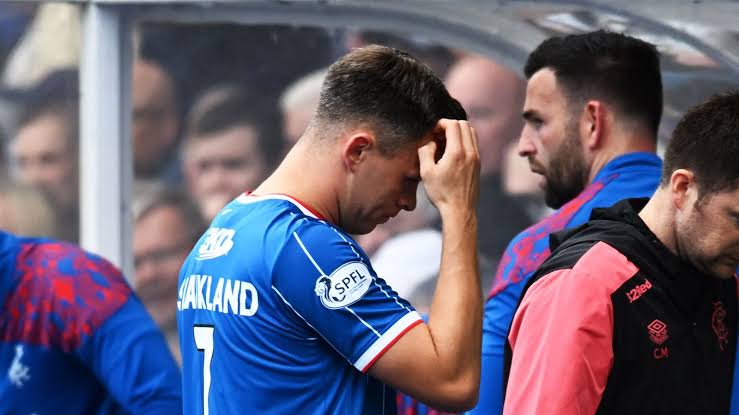
Derek McInnes has been handed fresh clarity, if not much comfort, on the timeline for Lawrence Shankland’s return to action, with reports now suggesting the Rangers captain will not be seen in Light Blue again until early December at the earliest. The confirmation that Shankland has undergone corrective surgery on his grade 2c hamstring tear draws a line under weeks of uncertainty over whether the 31-year-old would need an operation or attempt to let the injury heal naturally, and while the surgical route offers Shankland a reduced chance of the problem recurring, it comes with an extended recovery window that will keep Rangers’ skipper sidelined for a significant chunk of the season.
The injury itself occurred in circumstances that will feel painfully familiar to anyone who followed Shankland’s career at Hearts. The striker was forced off just minutes into what became a 1-0 win over Motherwell at Ibrox, pulling up in the very first sprint of a stop-start afternoon that had been repeatedly interrupted by VAR delays. McInnes revealed afterwards that he had an immediate sense of how serious the issue looked, describing the moment Shankland went down as one where he “knew it was significant,” and that instinct was quickly backed up by scans which confirmed a two-centimetre tear, strikingly similar in both location and severity to the injury that cost Shankland around three months at Hearts in January of last season. The recurrence of an issue in almost the same spot immediately raised questions about whether surgery, rather than a natural healing process, would be the more sensible route this time around, and Rangers wasted little time sending their captain to London for a specialist opinion.
That specialist consultation ultimately settled the debate. McInnes had explained before the follow-up scan that the decision carried a genuine trade-off: opting for surgery would add an estimated three to four extra weeks to the recovery timeline compared with allowing the tear to heal naturally, but it would substantially reduce the risk of the injury recurring for a third time. Given that Shankland had already suffered the issue twice in the same muscle group within the space of a year, the calculation increasingly pointed towards the operating table being the more prudent long-term option, even if it meant a longer spell on the sidelines in the short term. McInnes confirmed that Shankland duly went under the knife in London, undergoing the procedure on the same day as reports first emerged that surgery had been settled upon, a decision the manager framed as one that “minimises the risk” of the hamstring failing again, even if it does push his return further back than fans would like.
With the operation now completed, attention has turned to exactly how long Shankland’s rehabilitation is likely to take. Reports in the days since the surgery have pointed towards a recovery period in the region of twelve to fourteen weeks, a timeframe that, even at its most optimistic end, pushes Shankland’s likely return towards the start of December. That timeline would rule the Rangers captain out of an extraordinary run of fixtures: both remaining Old Firm league meetings this calendar year, any potential involvement in the latter stages of the Premier Sports Cup, a heavy block of European fixtures, and all four of Scotland’s opening Nations League matches under new head coach Sébastien Pocognoli. For a player who had only just begun to look like the talismanic figure Rangers signed him to be, netting in back-to-back away wins at Aberdeen and Falkirk before the Motherwell setback struck, the timing could scarcely be crueller.
The scale of the loss is compounded by the fact that Shankland was not just a peripheral figure in McInnes’ plans but very much the focal point of the team’s attacking approach heading into the campaign’s most demanding stretch. He had scored four goals in ten appearances for the club before the injury, and pundits were quick to point out just how costly his continued presence would have been against Motherwell alone, with former Rangers midfielder Andy Halliday suggesting on BBC Sportsound that Shankland would likely have walked away from that game with a couple of goals to his name had he stayed on the pitch. Losing that end product, combined with the captaincy and leadership Shankland had quickly established in the dressing room since his move to Ibrox, leaves a considerable gap for McInnes to fill, both on the pitch and in the manner his side approaches upcoming fixtures without their on-field figurehead.
It is a blow made heavier still by the fact that Rangers were already contending with the long-term absence of Youssef Chermiti, who has been ruled out for a lengthy period after suffering anterior cruciate ligament damage against Hibernian last month. With Chermiti and now Shankland both unavailable, McInnes has effectively lost his two most senior striking options inside the space of a few weeks, a scenario the manager himself admitted would have felt overwhelming had it been presented to him at the start of the campaign. Speaking about the situation, McInnes acknowledged that if someone had told him on day one that both his leading forwards would be sidelined with significant injuries simultaneously, he would have felt the weight of that immediately, though he has since tried to frame the situation as an opportunity for others in the squad to step forward.
That opportunity has, to Rangers’ credit, been seized fairly emphatically by those deputising in Shankland’s absence. Ryan Naderi came off the bench to replace his captain within seven minutes of the Motherwell game and went on to score the only goal of that match, capitalising on an error from the visiting goalkeeper to slot home from close range. Since then, Bojan Miovski has taken up much of the goalscoring burden, netting a stoppage-time winner against St Mirren in midweek to extend Rangers’ winning run and offer some reassurance that the goals have not dried up entirely in Shankland’s absence. Deadline-day signing Kevin Kelsy, meanwhile, continues to be eased into first-team contention, with McInnes stressing that the £9million forward’s arrival now looks even more important given the depth of the crisis up front, even if his early performances, including in the win over St Mirren, have not yet fully convinced onlookers that he is ready to lead the line alone. Min-su Kim’s introduction to the side has also been credited by McInnes with sharpening the team’s overall attacking threat, giving the manager a genuine, if untested, spread of options to rotate through over the coming months.
The wider consequences of Shankland’s absence stretch well beyond team selection for any single fixture. Rangers now face the prospect of navigating a run that includes further meetings with Celtic, continued European commitments, and the business end of the Premier Sports Cup, all without the physical presence and know-how of a captain who arrived at Ibrox specifically to be the kind of leader capable of dragging the team through difficult moments. McInnes has been at pains to project calm regarding the situation, repeatedly pointing out that his squad possesses good options even in Shankland’s absence, but there is little disguising the fact that losing a player who had just started delivering the kind of performances Ibrox had been waiting to see represents a considerable setback to the rhythm McInnes had been building.
There is also a personal dimension to the story that has not gone unnoticed by supporters and commentators alike. Shankland waited a long time for the chance to join the club he supported as a boy, eventually completing a move to Ibrox and being entrusted with the captaincy almost immediately, a mark of the esteem in which he was held by the club’s hierarchy and coaching staff. Having finally begun to translate that trust into performances on the pitch, with those decisive contributions against Aberdeen and Falkirk suggesting he was finding his feet after an inevitable adjustment period, the timing of this second serious hamstring injury in the space of a year will feel like a cruel twist for a player who has spoken previously about how much the move meant to him. Rangers will be desperately hoping that the specialist’s surgical intervention proves to be the right call and that Shankland can come back from this latest setback as strongly as he did following his recovery from the earlier injury at Hearts, when he returned smoothly enough to still make an impact and ultimately earn a place in Scotland’s World Cup squad.
For now, though, the focus at Ibrox has to shift towards managing without him. McInnes has repeatedly stressed that the club’s summer recruitment, bringing in the likes of Kelsy and continuing to develop players such as Naderi and Kim, was designed precisely to provide the kind of depth needed to absorb setbacks like this one, and the coming months will represent the sternest test yet of whether that squad-building strategy can hold up under sustained pressure. With Chermiti already sidelined for the long term and now Shankland facing a recovery timeline stretching towards early December, Rangers’ forward line for the remainder of the calendar year will look markedly different from the one many supporters envisaged when the transfer window closed. Whether Miovski, Naderi, Kelsy or Kim can collectively fill the void left by two senior strikers may well come to define how successfully Rangers navigate what was already shaping up to be a defining autumn under their new permanent manager.
McInnes, for his part, has tried to strike a balance between honesty about the severity of the situation and confidence that his squad can cope. He has been careful not to use the injuries as an excuse in press conferences, choosing instead to emphasise the quality of the options still available to him, but there is no getting away from the fact that an early December return for his captain means Rangers must navigate the most physically and emotionally demanding period of the season, including further meetings with Celtic, without the player signed specifically to carry that burden. Supporters will now watch closely to see how the makeshift forward line copes under the accumulated weight of expectation, aware that the timeline for Shankland’s return offers at least a concrete date to work towards, even if it is later than anyone at Ibrox would have hoped when the captain first went down against Motherwell just weeks ago.