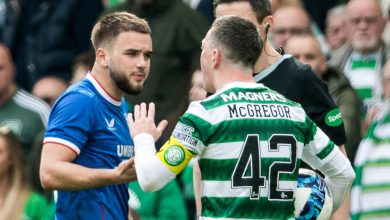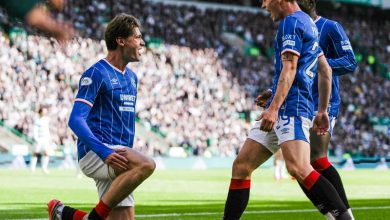
Rangers have gone to the Scottish FA over a challenge from Celtic midfielder Mika Baur on striker Ryan Naderi during Sunday’s Old Firm derby, with manager Derek McInnes admitting he is “not happy” that the incident was never properly reviewed on the day. What should have been a straightforward celebration of a dominant 3-0 win at Ibrox has instead turned into the latest flashpoint in Scottish football’s most combustible fixture, with questions now being asked about refereeing standards, VAR protocols, and the physical toll being placed on one of the league’s most improved young forwards.
The flashpoint arrived in the 64th minute of Sunday’s derby, with Rangers already in control of the contest. Naderi, the German striker whose combative style has made him a fan favourite since his £5million move from third-tier Hansa Rostock in the winter window, went into a fifty-fifty challenge with Celtic’s Mika Baur. Replays of the collision appeared to show something referee Nick Walsh missed in real time: it was actually Naderi who got to the ball first, with Baur then catching him high on the leg in the follow-through. Despite this, the free kick was awarded to Celtic rather than Rangers.
The decision did not sit well inside Ibrox. The award sparked visible outrage among Rangers’ players, their supporters, and Naderi himself, who was withdrawn from the pitch not long after the incident. For a player who has quickly established himself as first-choice in McInnes’s forward line, being forced off in a game of this magnitude was a significant moment — not just for the optics of the decision, but for what it meant physically. McInnes later described Naderi’s lower leg as “a mess” in the aftermath of the game, language that underlined just how alarmed the Rangers camp were by the extent of the damage, even if the initial worry was more about swelling and bruising than a fracture or ligament tear.
Pundits who have reviewed the incident since have been largely sympathetic to Rangers’ complaint, even if they’ve stopped short of calling for a red card. Ex-referee Bobby Madden, working through the Daily Record, said the most obvious frustration for Rangers is that the free kick itself went the wrong way, given the phase of play. Fellow former official Mark Clattenburg, working with GRV Media, backed that view, agreeing a free kick should have gone in Rangers’ favour, while stopping short of arguing for a dismissal. He characterised Baur’s challenge on Naderi as late and reckless, but said it lacked the requisite force and malice for a sending-off. The independent analysts at Ref’s View reached a similar conclusion, with hosts Steve Conroy and Des Roache separately branding the tackle “late and reckless” while suggesting Baur was fortunate to escape without a card at all.
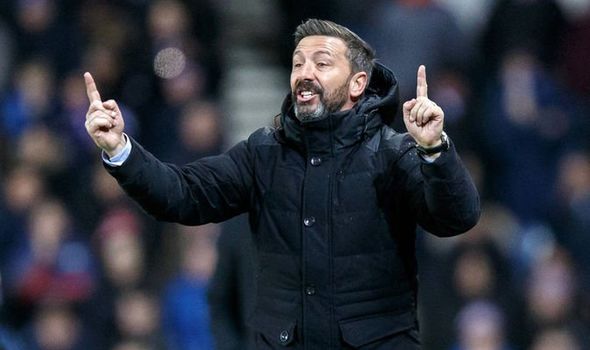
What has elevated the story beyond a standard post-match talking point is Rangers’ decision to formally raise the incident with the game’s governing body. According to reporting from the Rangers Review, chief executive Jim Gillespie has been in direct contact with Willie Collum — the SFA’s head of refereeing operations — specifically over the Baur challenge on Naderi. McInnes confirmed that Gillespie had spoken to both Collum and the wider SFA about the tackle from the previous week’s fixture, stating plainly that he was “not happy” the incident had gone unreviewed and had left Naderi’s ankle in the state it was in
That choice of words — “not happy” — is McInnes putting it mildly by the standards of Old Firm histrionics, but the substance of the complaint is serious: a club effectively arguing that a refereeing failure, compounded by an apparent lack of retrospective review, allowed a genuinely dangerous challenge to go unpunished and leave one of their most important attacking players facing a race against time for the return fixture. Scottish football operates a system in which incidents missed or misjudged by the on-field official can be referred to an independent panel of former referees after the fact, a mechanism that has been used repeatedly in Old Firm contests over the years to review high-profile flashpoints — including, notoriously, incidents involving Kemar Roofe and Albian Ajeti in previous derbies. Rangers’ argument, in essence, is that the Baur-Naderi collision deserved exactly that kind of scrutiny and didn’t get it.
For his part, McInnes was careful in his public comments not to be dragged too far into refereeing debate in the build-up to the next fixture, saying he didn’t want to get bogged down in talk about officials given the scale of the game ahead. That’s a fairly standard managerial deflection technique — publicly downplaying an issue that the club is simultaneously pursuing through more formal channels — and it reflects the tightrope McInnes is walking. He needs Naderi fit and available, he wants a fair hearing on the tackle, but he also doesn’t want to hand Celtic or the media a pre-match narrative to seize on before a trip to Parkhead
The more pressing concern for Rangers in the short term isn’t disciplinary process — it’s fitness. Naderi has been central to McInnes’s approach this season, and losing him for a trip to Celtic Park would represent a real blow. McInnes has confirmed that the striker is “a wee bit of a doubt” for Sunday’s return derby, alongside one other unnamed player, and has been candid that there isn’t a direct alternative in the squad who offers the same profile. Rangers do have other attacking options — the likes of Bojan Miovski, Youssef Chermiti and Rabbi Matondo among them — but McInnes was clear that none of them replicate exactly what Naderi brings physically to the side, meaning any enforced absence would likely force a rethink of approach rather than a simple swap.
That’s a meaningful admission from a manager who has, by most accounts, found some rare consistency and momentum after a difficult start to life in the Ibrox hot seat. Rangers’ 3-0 win over Celtic was widely seen as one of the club’s most complete derby performances in years, with pundits — including former Celtic goalkeeper Pat Bonner — expressing shock at how comprehensively Celtic were beaten. Losing the game’s best individual performer to what amounts to a refereeing failure would be a bitter pill regardless of the outcome of any SFA process, and it’s easy to see why Rangers are pushing the issue as hard as they are: even if no retrospective ban is issued to Baur, establishing that the challenge was mishandled matters for setting precedent ahead of a fixture congestion period that will see the two clubs meet again soon.
None of this is happening in a vacuum. Contentious tackles, contested penalties, and disputed red cards have been a recurring feature of Rangers-Celtic fixtures for years, and the SFA’s compliance and review process has repeatedly been drawn into the aftermath. Historically, incidents such as Kemar Roofe’s studs-up challenge on a Hamilton defender, Albian Ajeti’s disputed penalty award, and Jon Flanagan’s elbow on Scott Brown have all gone through some version of the same process Rangers are now hoping to trigger over the Baur-Naderi incident: an initial on-field decision, followed by public complaint from the aggrieved club, followed (in some cases) by a retrospective panel review, and occasionally an independent disciplinary hearing.
What makes each of these cases politically charged is the perception — voiced by both clubs at various points over the years — that the SFA’s disciplinary machinery isn’t applied evenly. Celtic have previously accused the association of clearing Rangers players too easily, most notably in the Flanagan case, branding one such decision “a huge embarrassment for Scottish football.” Rangers, for their part, have historically pushed back against what they see as an erosion of referees’ on-field authority whenever decisions are overturned retrospectively. The current Naderi situation inverts the usual roles slightly, with Rangers this time the ones pushing for retrospective action against a Celtic player, but the broader dynamic — mutual suspicion of the review process, amplified by whichever side feels aggrieved in the moment — remains exactly the same.
It’s also worth noting that VAR’s role in Scottish football has itself been a subject of near-constant debate since its introduction, with pundits and managers on both sides of the divide regularly questioning why certain incidents are or aren’t referred to the video assistant. In this case, the fact that referee Nick Walsh’s original decision — awarding the free kick to Celtic rather than Rangers — was not corrected either in-game or through a video review has become as much a part of the story as the tackle itself. Rangers’ argument to the SFA isn’t only about Baur’s specific action; it’s about a wider frustration with a review system that, in their eyes, let both a bad decision and a physically damaging challenge slide b
In practical terms, there are two separate threads to watch. The first is disciplinary: will the SFA’s compliance officer refer the Baur incident to the independent panel of former referees for retrospective review, as has happened with comparable incidents in the past? If the panel unanimously agrees the original decision should have gone the other way, or that the challenge constituted a more serious offence than the game state suggested at the time, Celtic could yet find themselves facing a fast-track hearing similar to those seen in previous derby controversies.
The second, more immediate thread is simply whether Naderi is fit enough to face Celtic again this weekend, at Parkhead, in what promises to be an even more heated occasion given the result of the first meeting and the row that has followed it. McInnes has been non-committal, saying only that there is “positivity” around the squad and that a repeat of the energy and performance levels from the first derby will be required regardless of who is available. Rangers have shown they can win big without unnecessary changes to their approach, but doing so at Celtic Park, in a red-hot atmosphere, without their most physically dominant forward, would be an entirely different challenge.
For now, the situation sits in that familiar Old Firm limbo: a genuine grievance, a formal complaint lodged with the governing body, pundits broadly sympathetic to the aggrieved side without going as far as demanding retrospective punishment, and a fixture just days away that will be shaped as much by fitness updates as by any disciplinary ruling. Whatever the SFA eventually decides about Mika Baur’s challenge, the damage — to Naderi’s ankle, and to the temperature of an already feverish rivalry — has already been done