Shankland reportedly back from injury and set to START tomorrow! 😱🔵 Rangers fans have just received a huge boost ahead of the big clash!

Rangers have confirmed their captain, Lawrence Shankland, will undergo surgery to repair a torn hamstring, an operation that will keep him sidelined for up to four months and rule him out of both Old Firm fixtures against Celtic this month, along with a chunk of the season beyond
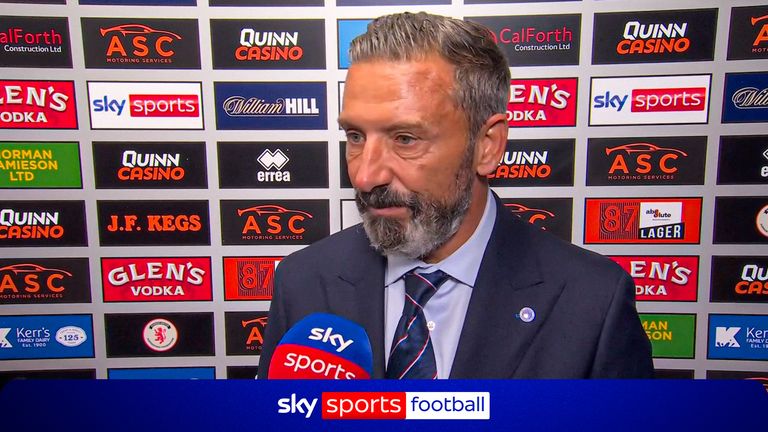
Shankland lasted just six minutes of Rangers’ 1-0 win over Motherwell before pulling up and clutching the back of his leg. He was replaced by Ryan Naderi, who went on to score the game’s only goal after capitalising on a mistake from Motherwell goalkeeper Alex Paulsen. The early signs weren’t encouraging: manager Derek McInnes told reporters afterwards that his captain feared the injury felt similar to the one that had previously sidelined him for two months while at Hearts, and that alarm bell proved accurate once scans confirmed the full extent of the damage.
Speaking ahead of Rangers’ subsequent match against St Mirren, McInnes confirmed the injury as a 2C hamstring tear — the same grading, he noted, as the one Shankland suffered at Hearts the previous January. He explained that Shankland had travelled to London for a follow-up ultrasound scan with a specialist, who would help determine whether surgery was the right course of action or whether, as with the previous injury, it would be better managed by allowing it to heal naturally. McInnes set out the likely timeline in blunt terms: a best-case scenario of around three months out, with four months representing the more pessimistic estimate, and any surgical intervention adding a further three to four weeks on top of that.
That decision has since been made. McInnes confirmed that Shankland will indeed have surgery, performed by a specialist in London — the same surgeon also due to operate on winger Daisuke Yokota’s separate groin injury. Explaining the reasoning, McInnes said the recurring nature of the injury made surgery the more sensible option, framing it as a way of minimising the risk of the problem resurfacing again down the line, while acknowledging that a further recurrence could never be entirely ruled out. He accepted that the procedure would likely add an extra three to four weeks to the recovery timeline compared with letting the injury heal naturally, but argued the trade-off was worth it for the added long-term security it offered both player and club.
The most immediate and painful consequence for Rangers supporters is the timing. Shankland’s injury rules him out of the entire Old Firm double-header against Celtic — first the Premier Sports Cup quarter-final at Ibrox, and then the Premiership meeting at Parkhead just seven days later. For a club captain to miss both fixtures against Rangers’ fiercest rivals in the space of a single, hugely significant week represents about as unfortunate a piece of timing as football can produce, particularly given how central Shankland had become to Rangers’ attacking play in the weeks immediately before the injury struck.
The wider consequences stretch beyond domestic football, too. Shankland’s spell on the sidelines will also rule him out of Scotland’s upcoming Nations League campaign, denying him the opportunity to make an early impression on new national team boss Sebastien Pocognoli during the Belgian’s first matches in interim charge — a particularly frustrating blow given that Shankland was part of Scotland’s squad at the recent World Cup and would otherwise have been well placed to continue that international involvement.
What makes the injury especially painful is the timing relative to Shankland’s form. He had scored in back-to-back Premiership victories against Aberdeen and Falkirk immediately before the Motherwell game, having netted Rangers’ previous three goals across those matches to help secure the club’s first two league wins under McInnes. McInnes didn’t hide his disappointment at losing a player who had only just found his rhythm, describing it as a real shame given that Shankland had been moving well and contributing to an attacking spark Rangers had been waiting a long time to see. He added, somewhat ruefully, that had he been told at the very start of his time in the job that both Youssef Chermiti and Shankland would suffer significant injuries before the season was very old, he’d have felt the weight of that news immediately.
Notably, McInnes offered a theory as to what might have contributed to the injury, pointing to Rangers’ fixture just days earlier at Falkirk, played on an artificial 4G surface, and suggesting that switching between different pitch types — from synthetic turf back to grass — can sometimes leave players a little more vulnerable to this kind of soft-tissue injury. He was careful to frame this as speculation rather than a definitive explanation, but it’s a detail that speaks to the increasingly common conversation in Scottish football around player welfare and the physical toll of switching between artificial and natural surfaces during a congested fixture schedule.
Shankland’s injury compounds a forward-line crisis that had already been building at Ibrox before he was even hurt. Youssef Chermiti, another key attacking option, remains ruled out for the rest of the season after suffering anterior cruciate ligament damage in an earlier match against Hibernian. That injury alone had already forced Rangers into the transfer market mid-season, resulting in a reported £9million move for Venezuelan international Kevin Kelsy from Portland Timbers, brought in specifically to offset the loss of Chermiti’s goal threat.
Kelsy made his Rangers debut off the bench in the same Motherwell win that saw Shankland forced off, partnering Naderi up front after coming on, though he missed a good early chance to mark the occasion with a goal. McInnes was full of praise for the business done to bring Kelsy to the club given the timing, describing the signing as excellent business by the club given the circumstances, and highlighting his physical attributes and mobility as qualities well suited to carrying more of the goalscoring burden in the coming weeks. With Shankland now also sidelined, however, that burden looks set to fall on Kelsy far sooner and far more heavily than would ideally have been the case for a player still adapting to a new country, league, and set of teammates.
Compounding matters further, winger Daisuke Yokota will also require surgery, on a separate groin injury, which is expected to keep him out for two to three months — meaning Rangers face an extended period without three separate attacking options across their squad, at almost exactly the moment when momentum had begun building under McInnes following a difficult start to his tenure.
Some analysis of the situation has framed Shankland’s injury as a genuine test of Derek McInnes’s credentials as Rangers manager — an opportunity, however unwelcome, to demonstrate the squad depth and tactical flexibility he’s been building since taking over. Despite losing his captain and leading source of recent goals, Rangers still found a way to beat St Mirren 1-0 in the very next match, with substitute Bojan Miovski scoring a last-gasp winner at Ibrox — a result that will have offered McInnes some reassurance that his side isn’t solely reliant on any single player, even one as influential as Shankland had recently become.
That said, the manager was clear-eyed about the scale of the challenge still ahead. Losing a captain and senior professional for a period that could stretch to four months, right in the middle of a season that includes continued participation in cup competition, continental football, and a title race that has tightened considerably since Rangers’ rocky start, represents a genuine test of squad depth rather than a one-off inconvenience to be absorbed and forgotten.
It’s worth setting Shankland’s importance in a wider context to properly understand why this injury has generated such significant coverage. His move to Rangers over the summer, alongside former Hearts manager McInnes and fellow ex-Hearts player Cammy Devlin, had been viewed as a genuinely significant piece of business — a proven, prolific domestic goalscorer arriving with a track record of decisive contributions in big matches, brought in to address exactly the kind of finishing problem that had periodically dogged Rangers in recent seasons.
Shankland’s own injury history adds an extra layer of poignancy to the current situation. He had previously missed more than two months of action during his time at Hearts after suffering a hamstring injury in January, an issue that ultimately cost Hearts dearly in their own title challenge that season — at the time of that injury, Hearts sat top of the table and chasing a first non-Old Firm championship since Aberdeen’s famous title win in 1985, only for Shankland’s absence to coincide with the club’s form dropping away at a crucial stage. The fact that his current Rangers injury has been described by McInnes as feeling similar, and carrying the same 2C grading, will inevitably raise uncomfortable questions among Rangers supporters about whether history might be about to repeat itself, this time affecting Rangers’ own title ambitions rather than Hearts’.
In practical terms, McInnes now faces a genuinely difficult stretch of squad management. With Shankland sidelined for what could be as long as four months, and Chermiti out for the season entirely, Rangers are relying heavily on Kelsy’s continued development, along with contributions from the likes of Naderi and Miovski, to sustain their goalscoring output through a demanding run of fixtures. The confirmed timeline suggests Shankland’s return is unlikely before December at the earliest, and potentially not until the turn of the new year if recovery runs toward the more pessimistic end of the estimated range — a period that will encompass not only both Old Firm league and cup meetings with Celtic, but a heavy block of Premiership and European fixtures besides.
There’s also a broader squad-building question likely to occupy Rangers’ hierarchy in the coming months: with two senior strikers now sidelined for extended periods, does the club look to bolster its attacking options further when the January transfer window opens, assuming suitable targets and financial flexibility allow? Given how swiftly Rangers moved to sign Kelsy following Chermiti’s injury, it wouldn’t be a surprise if a similar sense of urgency applies here, particularly if Kelsy’s early performances in an expanded role suggest the position still needs further reinforcement rather than simply patience while injured players recover.
For a Rangers side that had begun to show real signs of finding its feet under McInnes after a rocky opening spell, the Shankland injury represents perhaps the sternest examination yet of how genuine that improvement really is. The 1-0 win over St Mirren immediately after Shankland’s injury was confirmed offers early encouragement that the squad can cope in his absence, but sustaining that form across four months without a captain who had only just rediscovered his scoring touch — and doing so through a period that includes both Old Firm derbies — will require considerably more than a single positive response.
What’s clear in the immediate aftermath of the news is that this is a significant, multi-layered setback rather than a routine inconvenience. A club captain, a full Scotland international, and — by his recent form — arguably Rangers’ most reliable source of goals will now miss a period stretching deep into the season’s most consequential run of fixtures, missing both meetings with Celtic in the process. How McInnes and his squad respond to that gap, and whether Kelsy in particular can shoulder the increased burden being placed on him far earlier than anyone at Ibrox would have preferred, may end up shaping the entire complexion of Rangers’ campaign long before Shankland is fit enough to return to the pitch.