
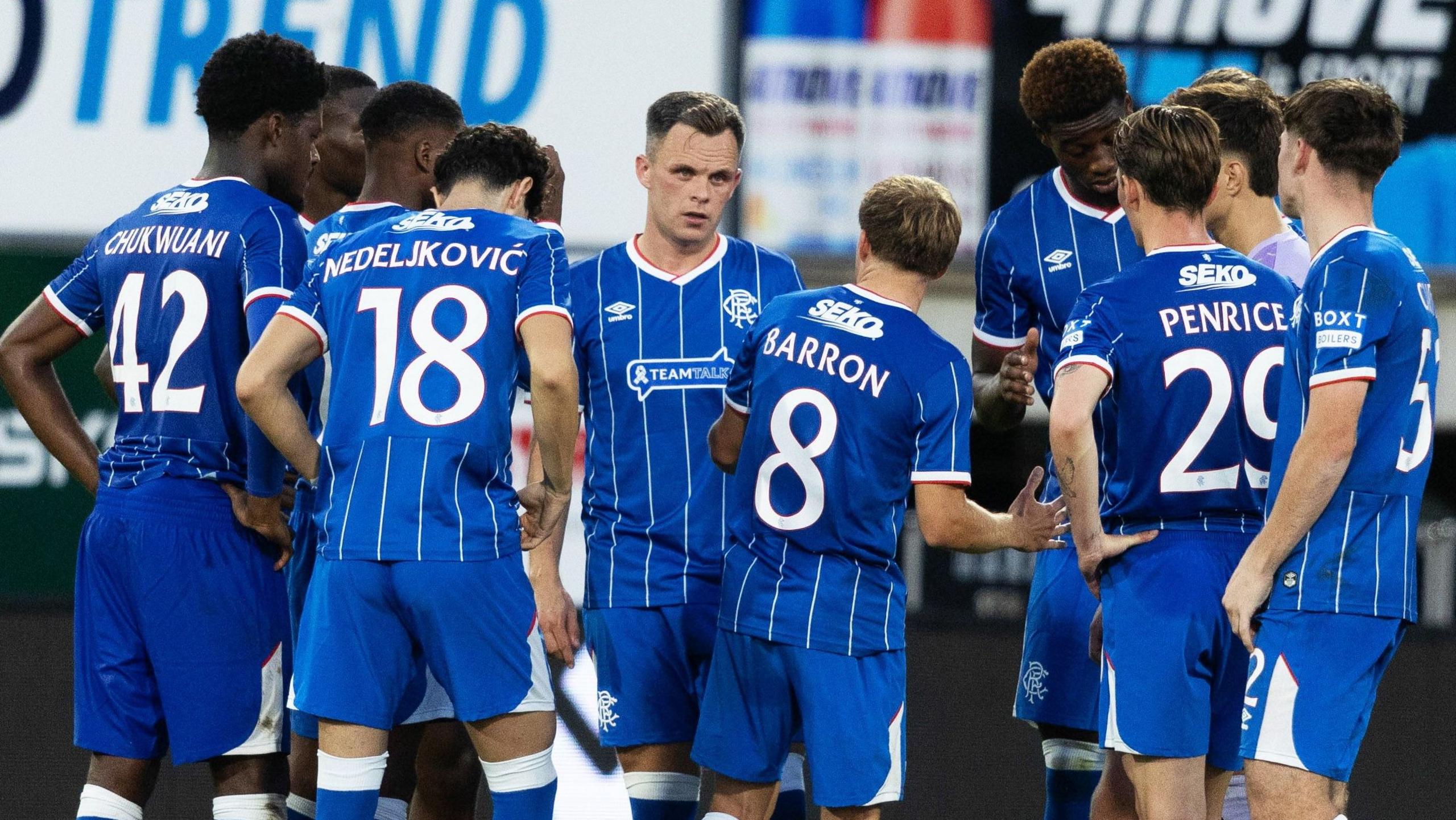
Whatever the exact wording, the sentiment fits what Rangers supporters have watched since the end of August. Derek McInnes did not inherit a settled squad this summer. He inherited a club that had finished third in the Scottish Premiership, ten points behind Celtic, a managerial vacancy created when Danny Rohl agreed to join RB Salzburg, and a recruitment brief that demanded quality in the wide areas. The man he chose to answer that brief, more than any other, was a 20-year-old from Gyeonggi Province by way of Cataloni
Appointed as Rohl’s successor, McInnes spent the early weeks of the window working through a long list. Lawrence Shankland, a Scotland striker, arrived first from Hearts. Ross McCrorie returned to Ibrox as a former academy product, and Ben Godfrey came on loan from Atalanta. Ivor Pandur arrived in goal from Hull City for a reported £6million, and Dan Neil joined after his Sunderland contract expired. Cammy Devlin, another former Hearts man, reunited with McInnes on a free transfer. Further names followed: Vanja Dragojevic from Partizan Belgrade, Olwethu Makhanya from Philadelphia Union, Daisuke Yokota from Hannover for a reported £2.75million and Badredine Bouanani on loan from Stuttgart.
McInnes was open about his philosophy. He said he wanted ready-made players capable of meeting the demands of the job, with a mix of those familiar with Scottish football and others arriving for the first time. He also acknowledged that Rangers might need to be patient at times.
But one position stood out as a persistent concern. Reports throughout the summer said McInnes had repeatedly spoken about the need to add quality in the wide areas. Gassama and Findlay Curtis were on the left, and Yokota had been added on the right, but the squad still lacked a winger who could take defenders on, play between the lines and offer a genuine threat from the flank. That need was never far from the manager’s mind.
When Rangers triggered Kim’s £8.5million release clause with Girona, he became the club’s 12th summer signing and the third attacking addition after Shankland and Yokota. McInnes described the move as strengthening the forward areas, a real target and focus throughout the window, and said Kim would add another exciting dimension to the squad.
Kim was born on 19 January 2006 in Gwangju, in South Korea’s Gyeonggi Province. In 2016, aged ten, he moved to Spain, joining Penya Blaugrana Cinc Copes. He joined Girona in 2022 and impressed with the B team, and the progress was rapid. He made his La Liga debut in October 2024 and appeared in the Champions League the following month, at an age when many players are still in academy football.
Girona renewed his contract until 2027, but first-team minutes were hard to come by, so the club sent him to FC Andorra in Spain’s second tier. The loan was a success. He scored six goals and provided four assists, giving him the senior experience that Rangers’ recruitment team could point to as evidence he was ready for a step up.
Rangers had also considered other wide targets, with Frosinone’s Fares Ghedjemis and Brighton’s Amario Cozier-Duberry among the names linked. In the end, the club settled on Kim, signing him on an initial four-year deal with the option of a further twelve months. He also became the first South Korean men’s first-team player in Rangers’ history, a distinction that carries commercial and cultural weight as well as sporting significance.
His own words on arrival were measured but confident. He said he knew Rangers were a big club with great fans, spoke of wanting to help the team win everything available, and described himself as having the mentality of a winner.
McInnes’s description of him was equally telling. He called Kim a talented young player with excellent technical ability, energy and a real desire to develop. In a transfer window full of experienced, ready-made arrivals, that phrase “a real desire to develop” is the clue to why the manager is so invested. Kim is not simply a solution to a position. He is a project with a high ceiling.
Kim linked up with his new team-mates on a Friday. He had a single training session before Rangers travelled to Aberdeen, and he was still named in the squad and thrown into the game.
Rangers won 1-0 at Pittodrie, and the manager’s post-match verdict was revealing. McInnes said the extra quality Kim offered at the top of the pitch had been much needed, noting that it was something Rangers had been looking for over a long period. He called it a great debut given how little preparation time the winger had received, and he pointed to the creativity and speed Kim added in and around Shankland.
It was not a dramatic performance, but it was a reassuring one. In football’s early-season fog, managers look for evidence that a new signing can adapt quickly, understand instructions and handle the physical demands of the league. With one training session behind him, Kim gave McInnes all three.
The manager also used the occasion to praise Gassama, whose long reach and direct running have made him one of the team’s more eye-catching performers. That praise matters, because the relationship between the two wide players has become central to how Rangers attac
Fans and journalists have been quick to notice that Rangers now have something they lacked last season: two wingers who want to run at defenders. One report described Kim and Gassama as terrifying any defence they come up against, and it contrasted that with Rangers’ predecessors, who had been more cautious.
That language is partly hyperbole, but it points to a real shift. Under McInnes, Rangers have a left side with pace, trickery and the willingness to take risks. Kim’s strengths, according to those who watched him in Spain and now in Scotland, are his dribbling, his shooting and his readiness to attack a defender immediately rather than recycle possession. Those are qualities that translate well in a league where opponents often sit deep and Rangers are asked to unpick them.
Kim has not scored for Rangers yet. Over six appearances, five of them in the Premiership, he has no goals and no assists, and he missed a penalty against Motherwell. The statistics undersell him, and McInnes clearly knows it. A winger who creates danger, forces defenders into mistakes and keeps the opposition honest provides value that does not always show up in the numbers. Several reports have described him as electric both on and off the ball and noted the energy he brings to the midfield four.
There is also a developmental logic. McInnes has made it clear that he sees Kim as someone who can improve week by week. At 20, the end product will come, and the manager appears willing to wait. That patience is itself a statement of how much he rates the player
The clearest sign of McInnes’s faith came when he picked Kim to start Rangers’ first Old Firm match of the season. Rangers won 3-0, and the performance was one of the best of the early campaign.
Starting a 20-year-old in his first derby, just weeks after he arrived from Spain, is not a decision a manager makes lightly. The atmosphere, the intensity and the weight of expectation can overwhelm experienced professionals. Kim, by most accounts, handled it well. He did not score or assist, but he was active, direct and threatening, and he helped stretch Celtic’s defence.
It was also the match that changed his international prospects. Within days, South Korea’s coach, Robert Moreno, named him in his squad for the first time. A player who had been out of the national conversation was suddenly in it, and the Old Firm win had been his shop window
South Korea were rebuilding after a group-stage exit at the World Cup, and Moreno planned four home friendlies against Ecuador, Uruguay, Venezuela and Uzbekistan. When he announced the squad, Kim’s name was on it.
Moreno was clear about his reasoning. He said he had selected Kim because of his performances at Rangers and described him as an excellent player capable of playing in several attacking roles. He also said selection would be based on what players show on the pitch rather than reputation or history, and that the last ten matches were the best guide to current form.
For McInnes, the call-up was a double-edged sword. It was an endorsement of his own judgment, but it also meant travel, workload and the risk of injury. Reports noted that the manager would have to weigh how best to manage Kim’s physical output during a heavy period.
Kim’s international debut came in Suwon, where he replaced Min-kyu Song in the 75th minute of a 3-0 win over Ecuador. He played on the right wing and made a short but sharp impact. In the 84th minute he peeled off to the right of Heung-min Son and demanded the return pass, a small moment that showed he was not overawed. He completed all four of his passes, won two of four ground duels, made two tackles and won an aerial duel. Afterwards he admitted he had never felt so nervous in a match, because he was representing his country, and he said it was a dream come true. He also revealed that he could communicate with Moreno in Spanish, a useful advantage for a player who grew up in Catalonia.
Four days later, against Uruguay in Seoul, he arrived at half-time and played on the left in a 4-4-2. South Korea lost 4-1, but Kim earned a FotMob rating of 7.0, behind only Son and Kang-in Lee. He completed 22 of 25 passes, created a chance, made five recoveries and won five of ten ground duels. Korean media dubbed him “the next Heung-min Son,” and a South Korean reporter, Joel Kim, said “Minsu mania” had arrived in the country.
On Friday, in Ulsan, he started against Venezuela in a 0-0 draw and played around 66 to 67 minutes. Kevin Kelsy, his Rangers team-mate, started for the visitors, and the two swapped shirts afterwards. It was Kim’s first senior start for his country and the third time he had been used in three matches.
For McInnes, the sequence is a source of pride, and it is easy to see why he talks about Kim with such warmth. The player he identified, signed and trusted has been validated by a national coach, a national media and a national fan base within a matter of weeks.
It is worth asking what McInnes sees in Kim that makes him so enthusiastic. Reading across his comments, this season and in the past, a pattern emerges.
He values hunger. In his Aberdeen days, McInnes explained what he looks for in young players. He said he likes boys who are hungry and motivated, and he praised those who refuse to settle for being part of a squad. Kim fits that mould. He left Girona’s squad for a loan in Andorra, then left Spain for Scotland, and he speaks about wanting to do everything he can to help the team win. The “real desire to develop” that McInnes mentioned at the signing is a variation on the same theme.
He values players who add a different dimension. McInnes has repeatedly described Kim’s arrival as adding something the team lacked. At Pittodrie, he spoke of quality at the top of the pitch. At the signing, he talked about another exciting dimension. The language is consistent: Kim is not a like-for-like replacement for anyone. He is a new tool. He values young players who need games. Back at Aberdeen, McInnes argued that players aged 20 to 23 must be playing regularly to fulfil their potential. Kim is 20. By starting him in the biggest game of the season and backing him through a goalless spell, McInnes is acting on that belief.
He values character off the pitch. The same Aberdeen-era comments describe a player who is a “dream on and off the pitch.” Early reports from Ibrox suggest that Kim has settled well, communicates positively and has built relationships quickly, including with his compatriots in the national team.
None of this proves that Kim is the player the headline refers to. But it explains why, if McInnes is asked to name a summer signing he loves, Kim would be a natural answer
McInnes’s affection for Kim does not exist in a vacuum. The manager has built a squad with real competition in attack, and every selection decision has consequences.
Gassama remains a key figure on the left. Yokota, signed for a reported £2.75million, provides an alternative on the right. Findlay Curtis, Bouanani and others offer further options. Shankland leads the line, while Kelsy, the Venezuelan striker signed from Portland Timbers for a fee reported at around £9million, adds physical presence and a different profile. Ryan Naderi, who joined from Hansa Rostock in February, has also contributed goals.
In that company, Kim’s selection for the Old Firm game was a statement. McInnes could have chosen safer, more established options. He backed the newcomer instead. That is the clearest possible demonstration of belief, and it explains why supporters have responded so warmly.
The competition also keeps Kim honest. At 20, he cannot afford complacency. The manager’s praise comes with the expectation that the winger will keep improving, and the presence of capable rivals ensures that he will
No portrait of a promising young player should ignore the risks, and McInnes will be aware of them.
Workload. Kim has played in several matches in quick succession, travelled between Scotland and Korea and adapted to a new league, a new language and a new culture. The international window added three friendlies to that burden. Rangers return to action against Kilmarnock after the break, and McInnes must decide how much to rely on a player who may be fatigued. Reports have already suggested that the manager will be cautious.
Expectation. Being labelled “the next Son” is a heavy burden for any young attacker. Son is one of the greatest Asian footballers of his generation, and no player should be asked to replicate that career. The risk is that expectation outpaces development, and a lean spell is interpreted as failure. Kim’s temperament, humble and grounded in interviews, is a good defence against that danger.The missing goal. In six club appearances, Kim has neither scored nor assisted. The missed penalty against Motherwell will have stung. Wingers are judged on end product, and while McInnes has been patient, supporters will want to see numbers soon. The encouraging sign is the volume of chances and threatening moments he is producing. A goal feels like a matter of when, not if
Several storylines will determine whether Kim justifies McInnes’s enthusiasm.
First, the Uzbekistan friendly on 6 October gives him one more chance to impress Moreno. A goal or an assist there would be a perfect way to close his first international window.
Second, the Kilmarnock match will test McInnes’s squad management. Rangers need to maintain momentum, and a fresh, motivated Kim could be decisive. A tired one could be a liability, and the manager must read his player carefully.
Third, there is the longer-term question of position. Kim has played on both wings for South Korea and has been used in a more central role at Rangers. McInnes will want to find his best position and build the team around it. His versatility is an asset, but a settled role would help him develop consistency.
Finally, there is the matter of ambition. Kim has said he wants to help Rangers win everything. If the team can challenge Celtic this season and he is a key part of that, the story will have a satisfying ending. If not, McInnes’s faith will be tested.
It is easy to be cynical about a manager’s praise for his own signings. Every manager talks up the players he has brought in, and the language of “love” and “delight” is part of the job. But Kim is a case where the praise is backed by action. McInnes chose him as a priority target, trusted him from day one, started him in the Old Firm game and has defended his development publicly.
The early evidence suggests the faith is justified. Kim has handled the step from La Liga 2 loan football to Scottish Premiership intensity. He has earned the trust of a national coach, impressed in front of Korean television audiences and won over a demanding Ibrox crowd. He has also kept his composure, speaking with humility about nerves, hard work and the need to prove himself.
Whether he is the player in the original headline or not, Minsu Kim is the signing who best embodies what McInnes is trying to build at Rangers: young, hungry, technically gifted and willing to take risks. If the manager really does love him, as the headline implies, the evidence of the past five weeks suggests he has good








