
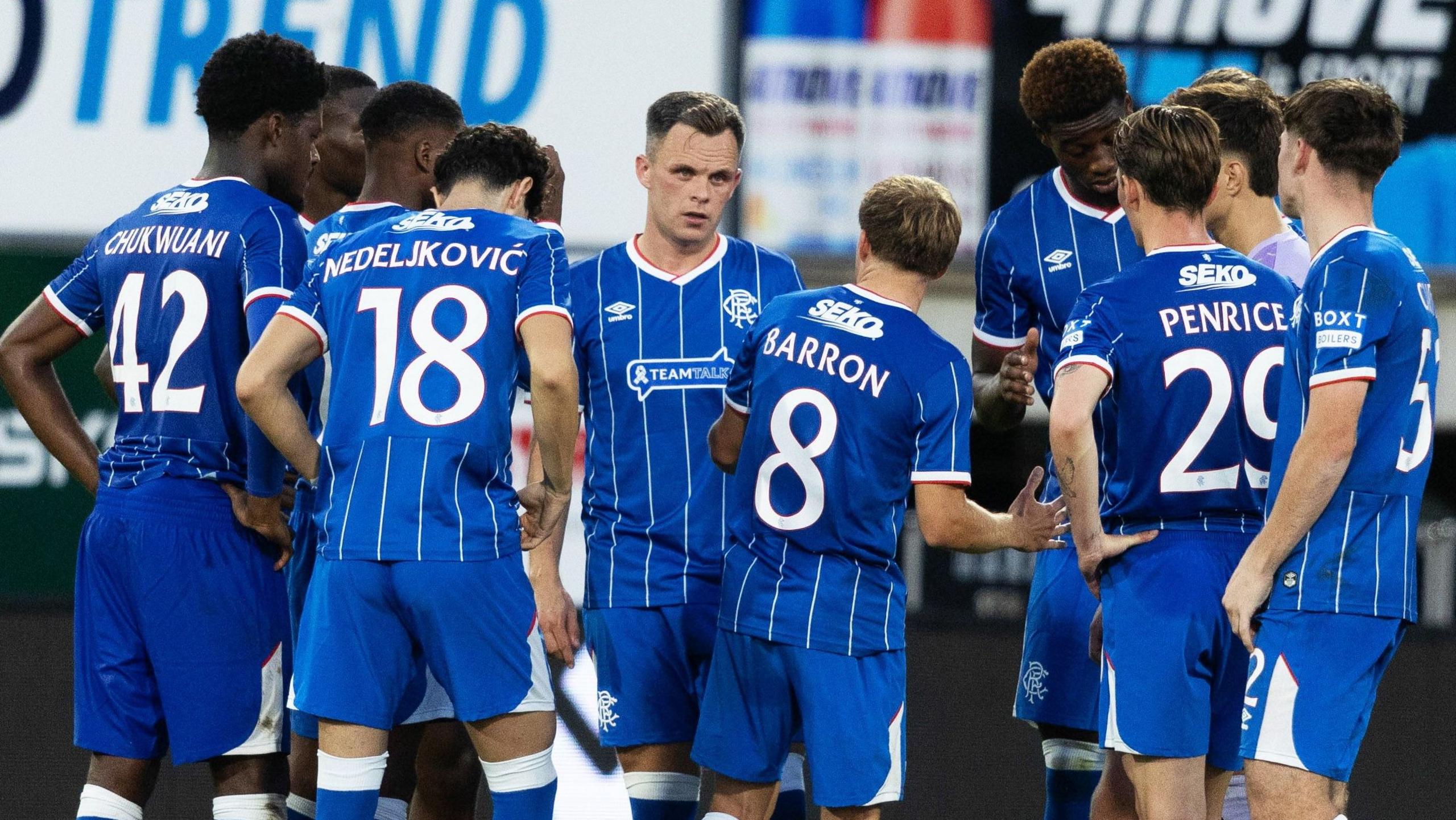
Footballers who suffer serious injuries often talk about the loneliness of the long recovery. The matches carry on without them, the team-mates build new routines, and the days fill up with physiotherapy sessions, gym work and the quiet arithmetic of how many months remain before a return is even possible. In those stretches, small gestures matter. A message from a team-mate, a call from a manager, a public mention from someone who still sees you as part of the picture: these things cannot heal a ligament, but they can keep a player’s head in the right place. For Rangers striker Youssef Chermiti, one such gesture has arrived from Portugal.
Luís Freire, the head coach of Portugal’s Under-21 side, has dedicated his team’s qualification for next summer’s UEFA European Under-21 Championship to Chermiti and to one other injured player, Al-Ittihad youngster Roger Fernandes. It was a generous and thoughtful thing to do, and it landed at precisely the moment when Chermiti, now several weeks into his rehabilitation, most needed a reminder that his career has plenty of road left in it. The tournament itself is also a ready-made target: a finals competition in Albania and Serbia that kicks off on 17 June 2027, with the final on 4 July.
Whether Chermiti can realistically make it there is a question that deserves a careful answer rather than a hopeful one. But before getting to that, it is worth understanding how he got to this point, what the injury has meant for Rangers, and why a short sentence from a national-team coach has become such a talking point around Ibrox.
The injury itself was brutal in its timing. It came in August, in the match against Hibernian, when Chermiti was taken off on a stretcher before half-time. Even before the medical staff completed their assessment, the manner of his exit told its own story. Scans later confirmed damage to his anterior cruciate ligament, one of the most feared diagnoses in the sport, and the club described the layoff only as a significant period, without offering a specific date for his return. For a player of 22 who had been enjoying a breakthrough year, it was a cruel interruption.
The wider context made it worse. Derek McInnes was only three games into his tenure as Rangers manager and was still searching for his first win when the Hibernian defeat left him with a long list of problems to solve. The Chermiti news arrived within hours of reports that the club had turned down a substantial bid from Galatasaray, a sequence of events that left the whole situation feeling oddly dramatic. In effect, the club had told a rival suitor that their striker was not for sale, and then lost him to injury almost immediately afterwards.
McInnes’s response was measured and sympathetic. He spoke about how disappointing the news was for Rangers, describing Chermiti as a big part of what the club wanted to achieve, and he spent as much time on the human side as on the tactical one. He pointed out that the player was very young and that it would be difficult for him to accept and understand what had happened. That empathy mattered, because the first days after an ACL diagnosis can be the hardest psychologically. The injury has taken him out of the team, but a manager who recognises the emotional weight of that is giving the player something valuable too.
Chermiti himself was soon in the public eye again, though in a different way. After seeing a specialist in London, he underwent surgery and posted a smiling picture from hospital on Instagram, marking the start of the long road back. It was a small but telling moment. There is no way to dress up an operation of that kind as anything other than a setback, but the picture showed a young man determined to treat it as the first step of a process rather than the end of something. Since then, reports have suggested that he has stripped his Instagram account back to just a handful of posts of himself in a Rangers shirt, a quiet signal that his focus is on returning to action.
What Rangers have lost is significant. In 43 appearances for the club, Chermiti has started 30 times and scored 15 goals, a respectable return for a young striker still adapting to a new club and a new league. He arrived at Ibrox from Everton as one of the club’s major attacking investments, and he had begun to repay that faith in his first full season. His ability to run the channels, to press from the front and to finish in the box had made him one of the most sought-after young forwards in Scottish football, which is why interest from clubs elsewhere was never likely to be far away.
The immediate consequence for the squad was a scramble for cover. McInnes confirmed that Rangers would look to strengthen their attacking options, and the injury happened within the transfer window, which gave the club a chance to respond. They did so on deadline day with the signing of Venezuelan striker Kevin Kelsy, a player who reportedly chose Rangers ahead of interest from Burnley and Celta Vigo. His arrival gave McInnes another forward who can operate across the front line, and it eased some of the pressure created by Chermiti’s absence.
Then came a second blow. Club captain and striker Lawrence Shankland, who joined from Hearts and had scored three goals in his first five Premiership appearances for Rangers, was also ruled out with a hamstring problem. Reports suggest he is on course to return in the new year, which leaves McInnes relying on Kelsy, Ryan Naderi and Bojan Miovski in the meantime. Those three have shared the burden well, and Naderi in particular has been making headlines, but the loss of two senior forwards inside a short period is the kind of thing that tests the depth of any squad.
It is against that backdrop that Freire’s dedication takes on its full meaning. Portugal’s Under-21s secured their place at the finals with a convincing victory over Gibraltar, completing a campaign in which they remained unbeaten and produced an impressive attacking record. Scotland’s Under-21s, who include Rangers winger Findlay Curtis, finished third in the same group, which gave the qualifying story a Rangers flavour on both sides of the divide. After the final whistle, Freire could have spoken only about the performance or the table, but he chose to remember the players who were not there.
He singled out Chermiti and Fernandes, highlighting the contribution and commitment of everyone who had been involved throughout the campaign and acknowledging that the pair had suffered serious injuries. His central message was brief and almost philosophical. Portugal, he said, has a great team, and dreams guide life. It is a short line, but it carries a lot of weight in the context of a footballer facing nearly a year of rehabilitation. It acknowledges that the dream of playing in a major tournament does not simply evaporate because of an injury, and it tells the player that his place in the group has not been forgotten.
That is more than polite sentiment. Chermiti played a real part in Portugal’s qualification, featuring in five qualifying fixtures, including high-profile matches against Scotland and Azerbaijan earlier this year, and scoring twice along the way. He was unable to take part in the final stretch of the campaign because of the injury suffered at Ibrox, but his influence on the squad was clear enough to earn a public tribute from his coach. For a player who has been tipped by some observers for a senior call-up to Jorge Jesus’s squad, being highlighted in this way is also a signal that the national team set-up continues to see him as part of its future.
It is worth pausing on what that means for a young player. Rehabilitation from a serious knee injury is as much a mental challenge as a physical one. The work is repetitive, the progress is often slow, and there are inevitably days when the target feels impossibly distant. Having a concrete, public goal to aim at can make a significant difference. A European Championship finals tournament is the kind of target that gives shape to a recovery, a point on the calendar that makes the daily grind feel purposeful. Freire’s words have effectively turned a vague hope into a defined ambition.
Now comes the harder part: being honest about the timeline. Reports from Rangers-focused outlets have been cautious, suggesting that Chermiti is unlikely to feature for the club until very late in the season, if at all this campaign. A well-regarded football journalist went further on a recent podcast, saying that supporters probably will not see him until next season. Those assessments are consistent with what is generally understood about recoveries from this type of injury, which tend to take many months and which clubs rarely rush. The finals begin in mid-June 2027, which is not an impossible target, but it leaves very little margin for error.
That is why the language around this story needs care. Calling the Portugal dedication fitness motivation is accurate, because it gives Chermiti something to work towards. Treating the Euros as a firm objective would be unwise. Anyone who has watched a player return from a serious knee injury knows that the road back is not linear, and that the best clubs build their plans around caution rather than optimism. The medical staff at Rangers will set the pace, not the tournament calendar, and Chermiti’s long-term health will matter far more to the club than the question of whether he appears in Albania or Serbia next June.
From a Rangers point of view, the best-case scenario is one in which he returns late in the campaign, rebuilds his match fitness gradually and enters next season as a fully fit striker in his early twenties. If he can combine that with the confidence that comes from knowing both his club and his country believe in him, the injury could ultimately be remembered as a painful interruption rather than a turning point. If he can also earn a place in the Portugal squad for the finals, that would be a bonus rather than an expectation.
There is also an important point about how Rangers manage the situation in the meantime. McInnes has made it clear that he does not intend to be defined by the loss of a single player. The signing of Kelsy and the emergence of Naderi show a squad that is adapting, and the manager’s insistence on building rather than weakening the group suggests a long-term view. That approach should help Chermiti, because it removes any pressure to return before he is ready. A squad with options is a squad that can afford to wait.
It is also worth noting the quiet professionalism of the way Chermiti has handled things so far. There has been little in the way of public commentary about his recovery, no dramatic statements and no attempts to set a date for his comeback. The hospital photograph and the trimmed Instagram feed are the only real clues, and both point in the same direction: a young man putting his head down and getting on with the work. That is exactly the attitude clubs want from a player in this position, and it suggests that the Portugal dedication has landed on fertile ground.
Freire’s gesture has a broader significance too. National-team coaches are often accused of treating club players as assets to be borrowed and returned, so a public dedication to an injured striker stands out. It speaks to a culture within the Portugal Under-21 set-up that values its players as people, and it reflects well on a manager who has taken a talented group through an unbeaten qualifying campaign. For Rangers, it is also a reminder that the club’s young players are being watched and valued at the highest levels of the international game.
For supporters, the story offers a rare moment of unalloyed warmth in a season that has had its share of difficulty. Fans know how much Chermiti means to the team, and they have seen how quickly the loss of key forwards can change the shape of an attack. A reminder that the player is respected and supported, and that there is a bright goal waiting at the end of his recovery, is welcome news. It does not alter the facts of the injury or the length of the layoff, but it does lift the mood.
None of this should obscure the fundamental reality. Chermiti has a long way to go, and the next several months will be defined by patient, unglamorous wo∠rk. There will be good days and bad days, moments of optimism and moments of frustration. The best that Rangers and Portugal can do is to give him the space, support and encouragement to complete that journey properly. The dedication from Freire is a small piece of that support, but it is a meaningful one.
What it ultimately offers is perspective. Football can be ruthlessly short-term, with attention shifting from one match to the next and from one player to the next. A message like Freire’s cuts against that. It says that a player’s value is not defined solely by whether he is available this week, and that the people around him are thinking about what he can do once he is fit again. In the long, quiet stretch of a rehabilitation programme, that kind of perspective can be worth a great deal.
It also helps to understand what the months ahead will look like in general terms. Recoveries from this type of surgery are usually staged, moving from regaining movement and strength in the early weeks, to controlled running and gym work, and eventually to ball work and contact with team-mates. Each phase has its own checks, and clubs tend to wait for the player to pass them rather than rushing to meet a date. That is not a medical forecast for Chermiti, whose own timetable will be set by Rangers’ staff and his surgeon, but it explains why those close to the club talk in terms of seasons rather than weeks.
There is a squad-building angle as well. Rangers now have a striker group that looks very different from the one McInnes expected to inherit. Kelsy arrived late and is still finding his feet, Naderi has been enjoying a productive spell, Miovski provides experience, and Shankland is expected back in the new year. By the time Chermiti is fit again, the competition for places could be fierce, which means he will need to return in good condition to reclaim a central role. For a young player, that is both a challenge and an incentive.
The international picture is similarly competitive. Portugal’s depth in attacking positions is among the best in Europe, and a place in a finals squad is never guaranteed, even for players who contributed to qualification. Freire’s dedication shows goodwill, but selection for the tournament will depend on fitness and form once the time comes. That is exactly how it should be, and it means Chermiti has to treat the Euros as an opportunity to earn rather than an entitlement. The reminder that he is valued does not remove the need to prove, once fit, that he is ready.
Finally, there is the question of how the mental side of recovery is supported. Players coming back from long injuries often describe the importance of routine, of small targets and of people around them who understand the process. A manager who has been empathetic, a club that has made clear it wants him back, and a national-team coach who has publicly remembered him are all part of that network. The football itself is only one part of a comeback; the environment around a player matters at least as much, and on that front Chermiti has reasons to feel supported.
So is Youssef Chermiti realistically going to be at the Under-21 finals next summer? The honest answer is that nobody can say yet, and anyone who claims certainty is guessing. The injury is serious, the timeline is long, and the priority has to be a full and safe recovery. But the possibility is real enough to motivate him, and that is the point. A goal does not have to be guaranteed to be useful. It simply has to be worth working towards.
For now, the picture is clear enough. A talented young striker is at the start of a hard road, with a club that backs him, a manager who has spoken warmly about him and an international coach who has chosen to remember him publicly at a moment of celebration. The target is out there, in June, in Albania and Serbia, and whether or not he reaches it, the effort to get there will be part of the story of his comeback. As Freire put it, dreams guide life. For Chermiti, the next job is to keep dreaming while he does the work.








