
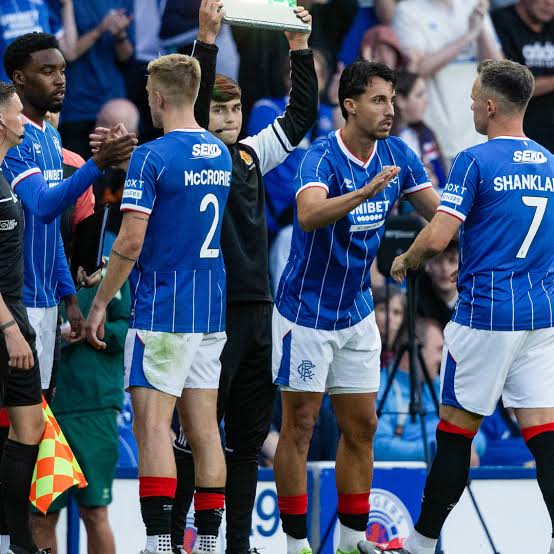
Ben Davies did not leave Rangers with a grudge, a headline-grabbing bust-up or a list of complaints about the people who ran the club. What the former Ibrox centre-back left with, by his own account, was a single nagging sense of something missing. Now 31 and settling in at Bolton Wanderers, Davies has looked back on a four-year association with the Glasgow giants and reduced his regret to one simple idea: he never got to see Ibrox at its very best, because the team around him did not win often enough to give the supporters what they have come to expect and demand.
It is a restrained, almost gentle kind of regret, and that is part of what makes it interesting. Footballers who pass through Rangers tend to leave with stronger opinions. Some talk about the pressure, some about the scrutiny, some about the way a bad run can turn a stadium of fifty thousand into a courtroom. Davies, speaking to the Bolton News, took a different line. He praised the size of the club and the passion of the fans, admitted that the results were not good enough, and accepted that this shaped what he felt and saw during his time in Govan.
The comments arrive at an intriguing moment. Rangers under Derek McInnes are enjoying their best run of the season, with a six-game winning streak, a pair of Old Firm victories inside eight days and a squad that has been rebuilt almost from top to bottom since Davies departed. The contrast between the team he describes and the one now preparing to host Kilmarnock at Ibrox is stark, and it gives his words a sharper edge than they might have had a year ago.
To understand the regret, it helps to remember how Davies arrived. He joined in the summer of 2022 from Liverpool, a defender who had come through the English system with spells at several clubs, including Preston and Sheffield United, before landing at Anfield. At Liverpool he had not broken into Jurgen Klopp’s first team, but the German manager spoke warmly about him on his way out, calling the move a positive outcome and insisting that Davies belonged on a big stage, including in European football. The fee was reported at somewhere between three and five million pounds depending on the source, and he was brought in as part of a busy summer in which Rangers also added Tom Lawrence, Rabbi Matondo and the Bayern Munich loanee Malik Tillman.
He arrived as a replacement for Calvin Bassey, who had been sold to Ajax, and that tag followed him around. Replacing a defender who had developed into one of the most coveted left-sided centre-backs in Europe was never going to be easy, and Davies himself seemed to understand the size of the task. When he signed, he spoke of wanting to turn a good career into a great one and of having his best years still ahead of him. He talked about being consistent, which in hindsight is the word that carried the most weight, because consistency was precisely what Rangers as a team struggled to find during the years that followed.
The Rangers he joined were managed by Giovanni van Bronckhorst, who had won the Scottish Cup and taken the club to a Europa League final in his first season. The expectation was that the squad would build on that, and the early signs, including the friendly against West Ham at Ibrox that Klopp’s comments were attached to, were upbeat. But the autumn of 2022 brought one of the most damaging periods in the recent history of the club. Rangers were beaten in all six of their Champions League group games, and the 7-1 defeat at Anfield on 12 October, against the club Davies had just left, became the defining image of that campaign. Van Bronckhorst was gone within weeks.
Davies played his part in that European campaign, and the experience of the Champions League, however painful the results, is one of the things he still credits. He told the Bolton News that the move allowed him to play Champions League football and Europa League football and to feature in some massive cup finals, and that he considers it a good experience overall. That is a generous framing given how some of those nights went, but it is also an honest one. Not many defenders who start their careers in the lower reaches of English football get to walk out at Anfield or sample the Champions League anthem, and Davies clearly values that.
What he regrets, then, is not the experience but the context. Over the four years he was on the books at Ibrox, Rangers finished second in the Scottish Premiership in 2022-23, second again in 2023-24 and second once more in 2024-25. Each of those seasons carried its own story, its own manager and its own sense of what might have been. Van Bronckhorst gave way to Michael Beale, who lasted until October 2023. Philippe Clement took over, won a League Cup and chased Celtic hard before being sacked in February 2025. Barry Ferguson stepped in as interim head coach, Russell Martin lasted only until October 2025, and Danny Röhl then arrived before McInnes took the job that he holds today.
That is a lot of managerial turnover for any defender to absorb. Every new coach brings a new system, a new set of demands on the back line and a new pecking order. For a player like Davies, who arrived with a reputation for composure on the ball and a strong left foot, the stability to settle into a rhythm was never quite there. By the numbers, he made 58 appearances for the club and scored once, a modest return for a player who was signed as a long-term starter. He also spent time away from the club on loan, with spells at Birmingham City and Oxford United, and that further complicates the picture of what his Rangers career actually was.
None of that is mentioned by Davies as an excuse. He is careful, in the comments that have been reported, to avoid pointing the finger at anyone. He does not blame managers, directors, team-mates or the weight of expectation. Instead he places the responsibility on the collective: we did not win enough. It is the sentence that sums up the whole interview, and it works because it is so plain. In a sport where players routinely hide behind vague language, a defender simply saying that the team did not win enough comes across as refreshingly direct.
There is also something quietly revealing in what Davies says about the supporters. He describes the crowd as amazing, notes that around fifty thousand turn up every week, and points out that the fans travel everywhere and sell out everywhere. Then he adds the qualifier that matters. Because the team did not give them what they were entitled to expect, he feels he never saw the best of that support. In other words, he is saying that the atmosphere he experienced was real but was not the full version, that there was a ceiling on how loud and how joyful Ibrox could be while the results were mediocre.
Anyone who has watched Rangers over the last few seasons will recognise that. Ibrox is one of the most intense stadiums in British football, but intensity can cut both ways. When the team is winning and the title race is alive, the place becomes a wall of noise and belief. When the team is drawing at home to Falkirk or losing a derby, the same intensity turns into anxiety and, at times, open frustration. Davies appears to have lived much more of the second version than the first, and he is honest enough to say so.
He also praised the supporters for their honesty, saying that the fans at Rangers do not hide their opinion. If they are unhappy they will tell you, and if they are happy they will tell you that too. That is a fair description of how the Ibrox crowd operates, and it is a trait that players often come to appreciate in hindsight even if it is uncomfortable in the moment. A defender who has played in front of a crowd like that tends to be better equipped to handle pressure elsewhere, and Davies suggested that his time at Liverpool had already given him some preparation for the scale and demands of the job.
The headline on one report of his remarks framed the whole thing as having no regrets, and there is truth in that as well as in the more cautious framing of a single major regret. Davies is not saying he made a mistake by moving to Rangers. He is not saying he would have done anything differently. He is saying that the one thing he wishes had been different is the thing that was largely out of his hands, namely the collective results of a team in transition. That is a subtle distinction, but it matters. Regret about the circumstances is not the same as regret about the choice.
It is worth asking why the circumstances were what they were. Part of the answer lies in the way Rangers conducted their recruitment during those years. A club that has to churn through managers, directors of football and playing staff at that pace will inevitably find it hard to build a coherent identity. Supporters and analysts have debated for years whether signings like Davies were part of a plan or simply reactions to short-term needs. Some critics have been blunt, labelling the money spent on him a poor return. Others point out that he was a decent, honest professional who played in a team that was repeatedly asked to rebuild on the fly.
The truth probably lies somewhere in between. Davies was never the commanding, dominant presence that fans hoped for when the club moved to replace Bassey, but he was also operating in a defence that was constantly being reshuffled. Goalkeepers changed, full-backs changed, partners at centre-half changed and so did the tactical systems he was asked to play in. It is difficult for any defender to look consistently good when the structure in front of and around him keeps moving, and that context is worth keeping in mind when judging a spell that did not live up to the early billing.
His departure, when it came, was low-key. He was out on loan in the second half of his time at the club, and his contract ran down to the end of June 2026. By the time the new season started he had moved to Bolton Wanderers, where he is now wearing the number six shirt on a deal reported to run until 2028. At 31, with the Championship offering a chance to reset, he has the opportunity to rebuild his reputation at a club where the expectations are very different. A player who has lived through the pressure of Rangers is likely to find the demands of a mid-table Championship side rather less suffocating.
There is something almost poignant about the timing of his comments, because the Rangers he speaks about no longer exists. James Tavernier, the captain through most of his time at the club, has left for Maccabi Tel Aviv. Connor Goldson and Borna Barisic, two of the defenders who shaped the club’s back line during the Gerrard and van Bronckhorst years, are long gone. The squad now is largely made up of players who arrived under the Cavenagh and McInnes regime, with Dan Neil wearing the armband and signings like Kevin Kelsy and Minsu Kim trying to establish themselves. The identity has changed completely.
And so has the mood. McInnes, who was under heavy pressure after European qualifying exits to Jagiellonia and Jablonec, has turned the season around with a run of wins that includes a 3-0 League Cup quarter-final victory over Celtic and a 1-0 win at Parkhead a few days later. Dan Neil’s brace in the first derby, Kelsy’s first goal for the club and Ryan Naderi’s winner at Celtic Park have given the fans something that Davies says was often missing in his own time: a team that wins when it matters and sends the supporters home happy.
If you take Davies at his word, that is exactly the experience he feels he missed. The occasions that define a Rangers career are the ones against Celtic, the big European nights and the title run-ins, and the best of those moments only feel as good as they do when the team is on a roll. A defender who plays through a period of second-place finishes, managerial sackings and heavy European defeats will naturally have a different memory of the club than one who plays through a title-winning side. It is not that Davies saw nothing good, but that he saw the version of Rangers that was still searching for itself.
There is a broader lesson in this for anyone who follows the club. Rangers is a place that magnifies whatever is happening on the pitch. A good run turns players into heroes and a bad run turns them into scapegoats. What Davies is describing, with admirable calm, is the experience of being a decent professional in the middle of a stretch where the club never quite matched its own standards. It is the kind of experience that does not generate dramatic headlines but does leave a quiet mark on the people involved
It is also a reminder that the human side of these stories is often more nuanced than the way they are discussed online. Fans, understandably, are focused on results and on value for money. Players, by contrast, tend to remember the dressing room, the travel, the games they played in and the atmosphere of the stadium. Davies has fond memories of the first of those, and a sense of frustration about the second, and the way he combines the two feels more honest than a straightforward verdict of success or failure.
Looking ahead, the interesting question is how his comments will be received by the Rangers support. Some will bristle at the suggestion that the fans were not given what they deserved, given that the players were the ones on the pitch. Others will see it as a fair and gracious reflection from a defender who knows he did not hit the heights. Still others will simply shrug, because the club has moved on and Davies is now a footnote in a long and eventful chapter of its history. All three reactions are understandable.
For Davies himself, the next chapter looks more promising. Bolton gives him the chance to play regularly, to be a leader in a back line and to rebuild the confidence that can be eroded by seasons of rotation and loans. The Championship is a demanding league, and a defender with his experience of high-pressure environments should be well placed to handle it. If he can string together a run of consistent performances, the Rangers years may come to look like a useful, if difficult, stepping stone rather than a disappointment.
One of the more striking aspects of his reflections is how little bitterness they contain. Plenty of ex-Rangers players have used interviews to take shots at the club, its management or its supporters, and the rolling coverage of Scottish football means that those comments are quickly amplified. Davies chose not to follow that path. He spoke warmly, acknowledged the scale of the club and was clear about the one thing he would change. In a media landscape that rewards controversy, that kind of measured honesty is easy to overlook.
It is also worth noting how well his regret fits with the broader narrative about Rangers in the years since the 2021 title. The club has spent heavily, changed managers repeatedly and finished second more often than not, while the sense that the gap to Celtic was both narrow and stubborn has hung over every season. Players who lived through that period often describe a similar feeling: that the talent was there, that the effort was there, but that the pieces never quite clicked into a winning whole. Davies is simply one of the few to say it plainly.
What would a better version of that story have looked like? Perhaps a title challenge that held up into April, a cup final won rather than lost, a European run that stretched into the spring. Any of those would have changed the way the supporters felt and the way the players remembered it. Davies is not claiming that he would have been the difference-maker, only that the collective outcome would have made the experience richer. That is a modest claim, and it is difficult to argue with.
So where does that leave Rangers fans? Perhaps with a small moment of reflection. The Ibrox faithful have endured a lot over the last four years, and the players who passed through during that time were, in many cases, carrying the burden of choices made elsewhere. Davies is not asking for sympathy, but his words do invite a slightly more generous reading of what that era was like from the inside. It was not easy, it was not always successful, and the best of the club’s atmosphere was sometimes out of reach.
Now, with McInnes steering the team through a purple patch and the derby wins still fresh, the conditions Davies describes as missing are starting to return. The crowd is louder, the mood is lighter and the results are doing the talking. Whether it lasts is another question, and the long, bruising nature of a Scottish Premiership season means there will be more tests ahead. But for the first time in several years, there is a genuine feeling that Rangers are giving their supporters something to believe in again.
That, ultimately, is the heart of Davies’s regret. It is not about him, or his performances, or the move itself. It is about the gap between what Rangers are supposed to be and what they were for much of the time he was there. He saw the size of the club, felt the passion of the crowd and understood what the shirt demands. He just did not get to play in the version of Rangers that fully matches all of that, and he is honest enough to say so. For a defender who has now moved on, that may be the most telling and most generous thing he could have said.








