A major revelation 😳 FIFA set to take legal action against Manchester City and Arsenal players

The tension was already high before the match even started. When Manchester City faced Arsenal in a crucial Premier League clash, everyone knew it would be intense. These were not just two teams playing for three points. These were two giants fighting for control, fighting for pride, and fighting for the title. Every pass mattered, every tackle mattered, and every small moment could change everything.
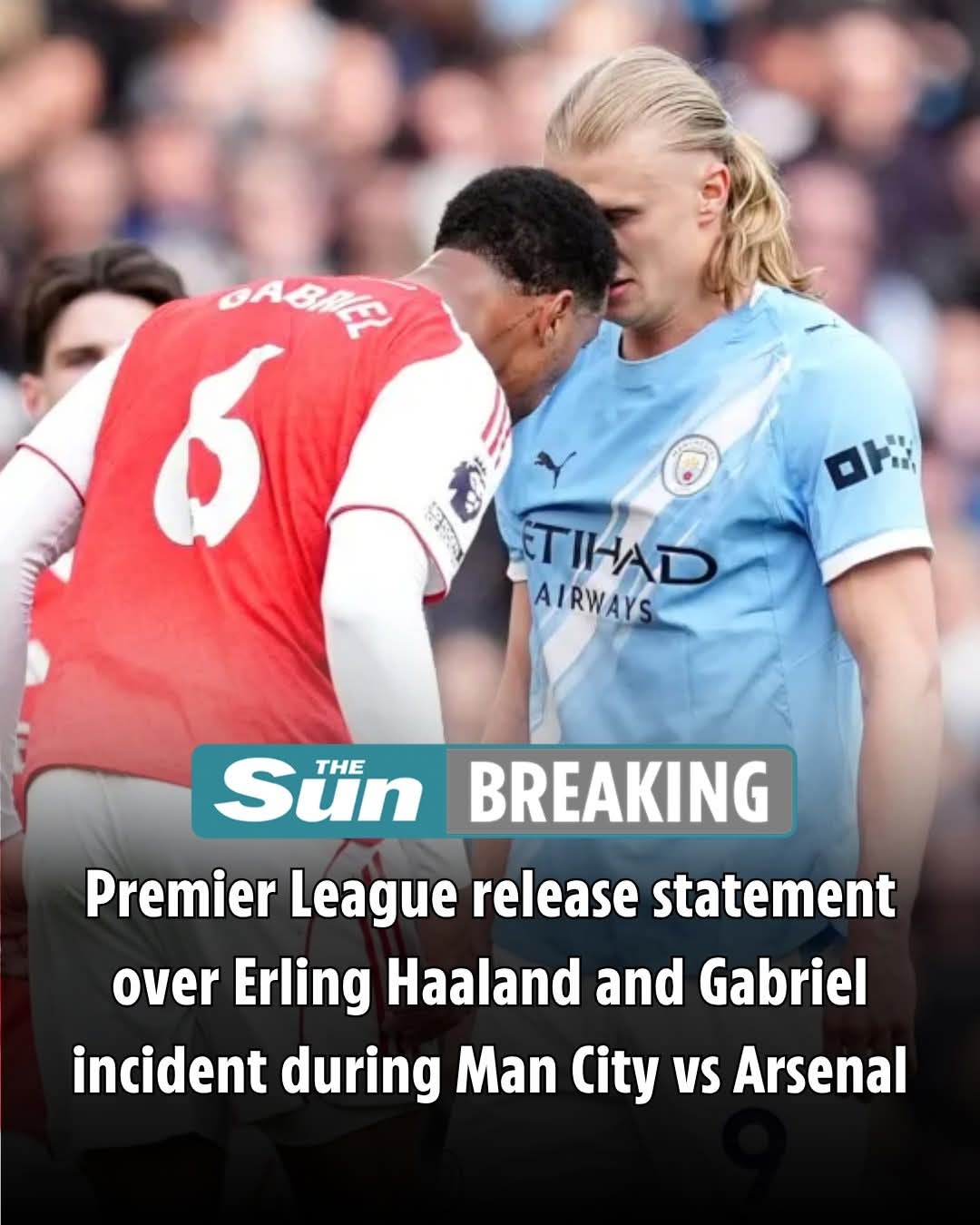
But in the middle of all the action, one moment stood out above the rest. It was not a goal. It was not a brilliant save. It was not even a tactical masterclass. It was a flashpoint. A heated moment between Gabriel Magalhães and Erling Haaland that has now become one of the most talked-about incidents of the season.
At the time, it looked like just another moment of aggression in a big game. Two strong players, both fighting for position, both refusing to back down. But when the cameras replayed it, and when the football world slowed it down frame by frame, it became clear that this was something more serious.
Gabriel appeared to move his head forward into Haaland. It was not a full swing. It was not extremely violent. But it was enough to raise questions. Was it intentional? Was it aggressive? Should it have been punished more harshly?
On the pitch, the decision was made quickly. Referee Anthony Taylor saw the incident up close. He had a clear view. He spoke to both players. And in the end, he decided to show yellow cards. One for Gabriel, one for Haaland. The game moved on.
At that moment, many fans accepted the decision. Some questioned it. Others were not sure what to think. Because in football, decisions like this often happen quickly, and the game does not wait.
But after the match, the conversation only grew louder.
Replays showed the head movement again and again. Pundits began to analyse it. Fans argued on social media. Some said it was a clear red card. Others said it was not strong enough. Some believed Haaland could have gone down to make the situation worse. Others respected him for staying on his feet.
And then came the official review.
The Premier League’s key match incidents panel looked at the moment again. This panel exists to review controversial decisions and give an independent opinion. They do not change the result of the match, but their judgement can influence how similar situations are handled in the future.
After reviewing the footage, the panel reached a decision. By a vote of three to two, they concluded that Gabriel should have been sent off.
That decision immediately changed the narrative.
What was once a debated moment became something clearer in the eyes of many. The panel believed that Gabriel’s action, specifically the extra movement of his head forward, counted as violent conduct. In football, violent conduct is one of the most serious offences. It usually leads to a straight red card and a suspension.
However, not everyone on the panel agreed. Two members felt that the contact did not have enough force. They argued that there was no clear backward movement before the head came forward, which usually shows intent. To them, it was not strong enough to be considered violent.
This split decision shows just how difficult these moments can be to judge. Football is not always black and white. Sometimes, it lives in the grey area, where opinions differ and interpretations vary.
Interestingly, even though the panel believed Gabriel should have been sent off, four out of the five members agreed that VAR made the correct decision not to intervene during the match. That might sound confusing, but it highlights an important part of modern football.
VAR is not there to re-referee every situation. It is there to correct clear and obvious errors. In this case, because Anthony Taylor had a clear view and made a decision, VAR official John Brooks chose not to overrule him.
This is where the debate becomes even more interesting.
If the panel later says it was a red card, but VAR says it was not a clear error, then where is the line?
That question is one that continues to divide fans, players, and experts.
For Manchester City, the result of the match was positive. They won 2-1, taking three important points in the title race. But the conversation after the game was not just about the score. It was about what could have happened.
If Gabriel had been sent off, Arsenal would have been down to ten men. That could have changed everything. The balance of the game would have shifted. The pressure would have increased. The tactics would have changed.
And beyond that, there would have been consequences for future matches. A red card for violent conduct usually means a three-game suspension. That could have affected Arsenal’s chances in the title race, especially during such a critical period of the season.
For Haaland, the moment also brought attention. Some people suggested that he could have made more of the contact. That if he had gone down, the referee might have shown a red card.
But Haaland chose not to.
After the match, he explained his thinking. He said that if he had gone down like many players do, it would likely have been a red card. But he also made it clear that it is not something he believes in.
He spoke about how he was raised, how his father taught him to stay on his feet. That message resonated with many fans. In a time when simulation and exaggeration are often criticised, Haaland’s decision felt different. It felt honest.
Even Pep Guardiola shared his thoughts on the situation.
Guardiola is not someone who hides his opinions, especially when it comes to refereeing decisions. He admitted that he does not always have sympathy for referees in England, but he also acknowledged the complexity of the situation.
He pointed to past incidents involving his players, where decisions went against them. He mentioned how sometimes players are punished more harshly when the opponent reacts dramatically.
In this case, Haaland did not react in that way. And Guardiola seemed to suggest that this might have influenced the outcome.
This brings up an uncomfortable truth in football.
Sometimes, how a player reacts can affect the decision.
If a player goes down, holds their face, or makes the contact look worse, referees are more likely to take strong action. If a player stays on their feet, the moment can be seen as less serious.
This creates a difficult situation. Players are often told to be honest, to play fair, to avoid diving. But at the same time, they know that not reacting can sometimes work against them.
Haaland chose honesty.
And while many people respect him for it, others wonder if it cost his team in that moment.
For Gabriel, the situation is also complicated.
Football is a fast and emotional game. Players make decisions in seconds. They react to pressure, to frustration, to the intensity of the moment. Sometimes, those reactions cross the line.
The panel’s decision suggests that this was one of those moments. That Gabriel’s action, even if not extremely violent, was still enough to be considered unacceptable.
But because the referee did not see it that way in real time, and because VAR did not intervene, the game continued without that punishment.
And that is why this story has become so big.
It is not just about one incident.
It is about the system.
It is about consistency.
It is about how decisions are made and how they are reviewed.
Fans want clarity. Players want fairness. Managers want consistency.
But football does not always provide those things.
Instead, it gives moments like this. Moments that spark debate, that divide opinion, that stay in people’s minds long after the final whistle.
As the title race continues, this incident could be remembered as one of the key talking points of the season. Not because it changed the result, but because it showed how fine the margins are at the top level.
One decision.
One moment.
One movement of the head.
That is all it takes to create a storm in football.
And even now, as the season moves forward, the debate is still alive.
Should Gabriel have been sent off?
Did Haaland do the right thing by staying on his feet?
Did the referee make the correct call in real time?
Did VAR handle it properly?
These questions may never have a single answer.
But one thing is certain.
This moment will not be forgotten anytime soon.