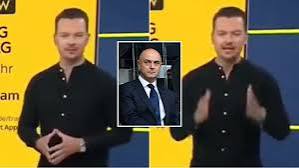
Angry Ginge on Pep Guardiola leaving Man City: 🗣️ “I actually felt sorry for him. Because he left as a failure.” “His last Manchester derby he got played off the park. He’s finished second to his apprentice.” “Fergie left with a guard of honour. Only certain men can do that.” Oof.

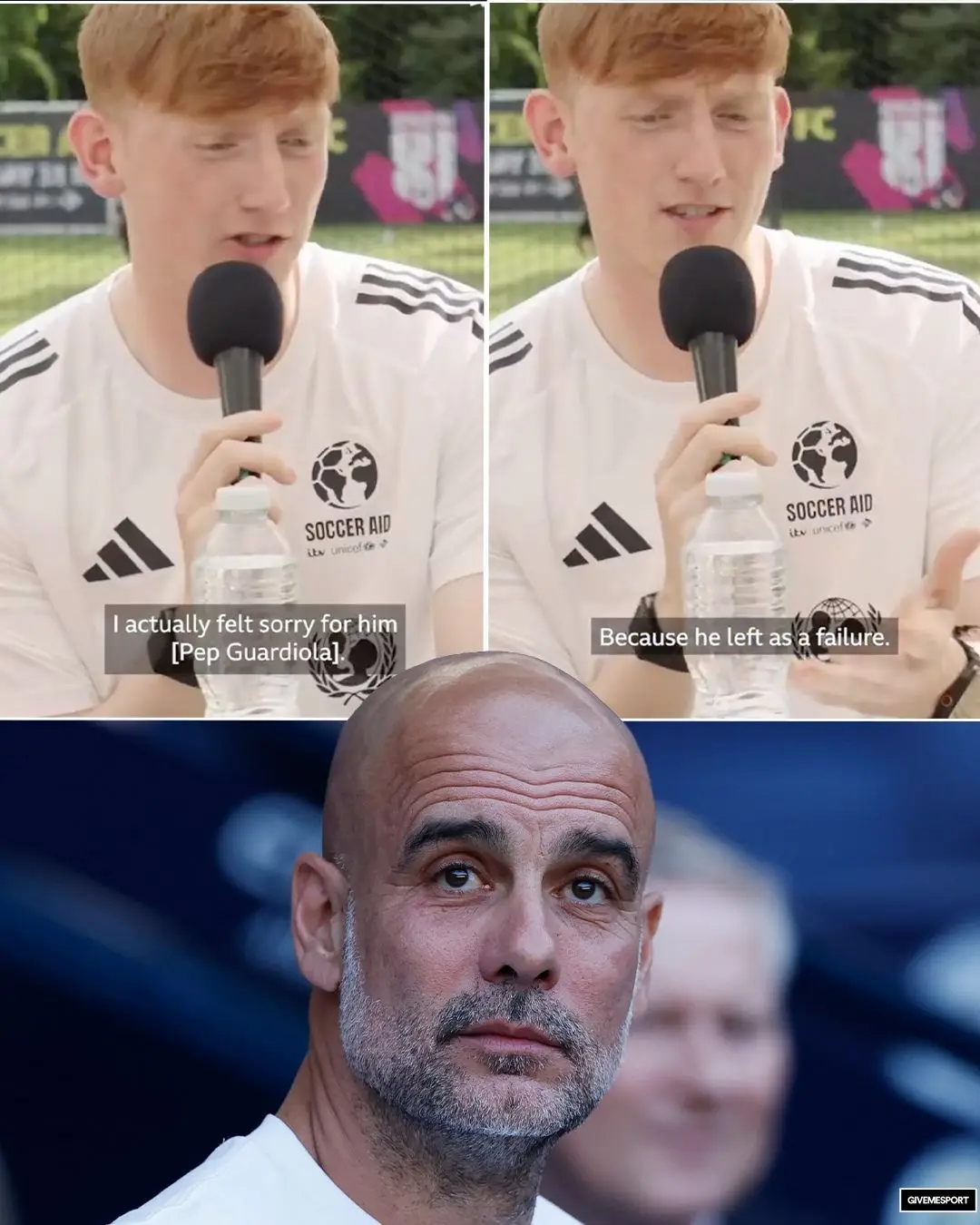
The debate around Pep Guardiola’s future at Manchester City has always carried weight, but it exploded into another level after comments from online football personality Angry Ginge, who delivered a brutally honest and emotional reaction to the idea of Guardiola eventually leaving the club.
His words were not polished or diplomatic. They were sharp, emotional, and designed to hit hard. And because of that, they instantly spread across social media, sparking arguments between fans, analysts, and football content creators.
Guardiola, one of the most successful managers in modern football history, has already built a legacy that few can match. His time at Manchester City has brought trophies, records, and a style of football that has defined an era. But football is also a game that moves quickly, and even the greatest figures are eventually judged by how their final chapters end.
That is where Angry Ginge’s comments came in, focusing not on Guardiola’s entire career, but on how things might be remembered when the story at City eventually closes.
Speaking with strong emotion, Angry Ginge said:
“I actually felt sorry for him. Because he left as a failure.”
It was a statement that immediately divided opinion. For some, it was disrespectful to a manager who has dominated English football for years. For others, it was simply a harsh but honest reflection of how quickly football can change its narrative.
In football, success is often measured not only by trophies but by timing, momentum, and the final image a manager or player leaves behind. Angry Ginge’s point was rooted in that idea. Even the most successful careers can be judged differently depending on how they end.
He continued with another bold claim about Manchester City’s performances in one of their biggest fixtures:
“His last Manchester derby he got played off the park. He’s finished second to his apprentice.”
This comment referenced the intense rivalry between Manchester City and Manchester United, a fixture that always carries emotional weight in English football. In recent seasons, Manchester United, under new leadership, have tried to re-establish themselves as a dominant force, while City have remained the benchmark for consistency and success.
The phrase “played off the park” is strong football language. It suggests complete dominance by one side over another, and in this context, Angry Ginge was suggesting that Guardiola’s City were outplayed in a key match, leaving a lasting negative impression.
The second part of his comment, “He’s finished second to his apprentice,” is even more provocative. It refers to the idea that some of Guardiola’s former coaching staff and tactical students have gone on to manage other clubs, sometimes competing directly with him. In modern football discussions, Guardiola is often described as a mentor figure whose influence stretches across multiple managers in Europe.
The suggestion that he could end up behind one of his “apprentices” is a dramatic way of saying that football moves in cycles, and even the greatest innovators can eventually be matched or overtaken by those they once inspired.
But the most emotional part of Angry Ginge’s reaction came when he compared Guardiola’s situation to one of football’s most iconic managerial exits.
“Fergie left with a guard of honour. Only certain men can do that.”
This reference points to Sir Alex Ferguson, who ended his legendary reign at Manchester United in 2013 after winning the Premier League. His final game saw opposing players line up to give him a guard of honour, a symbolic gesture of respect for his achievements and dominance over English football.
That moment became one of the most iconic scenes in Premier League history. It represented not just success, but respect from rivals, something that only a few figures in football have ever received.
By referencing this, Angry Ginge was drawing a comparison between two managerial legacies. On one side, Ferguson’s perfect ending. On the other, the suggestion that Guardiola’s exit might not carry the same level of celebration or emotional respect from rivals.
It is important to understand why comments like these gain so much attention. Guardiola is not just any manager. Pep Guardiola is widely considered one of the greatest tactical minds in football history. His time at Barcelona introduced a style of play that changed modern football forever. His success at Bayern Munich reinforced his reputation. And his achievements at Manchester City cemented his status as one of the most dominant managers in Premier League history.
Because of this, any discussion about his “failure” or “decline” is naturally controversial.
For many fans, the idea that Guardiola could be seen as a failure is almost unthinkable. He has won league titles, domestic cups, and the Champions League with City. He has built teams that dominate possession, control matches, and break records. Under his leadership, Manchester City have become a football machine, feared across Europe.
But football is not just about the past. It is also about the present and the future. And that is where the debate becomes more complicated.
Angry Ginge’s comments reflect a growing trend in modern football discussion: the focus on legacy versus recent performance. In today’s media environment, one poor season or one big defeat can quickly reshape how people view an entire career. Social media amplifies this effect, turning opinions into viral debates within minutes.
For Guardiola, this means every match, every derby, and every Champions League run is analysed not just for what it means now, but for what it might mean for his legacy later.
The idea of “leaving as a failure” is especially controversial because Guardiola’s standards are so high. When a manager wins consistently, expectations rise even further. At that level, success becomes the norm, and anything less can feel like disappointment, even if it is still objectively strong performance.
That is the harsh reality of elite football. The higher you climb, the harder it becomes to maintain the same level of praise.
Angry Ginge’s reference to a Manchester derby also highlights how rivalry matches shape perception. In football, derbies are not just games; they are emotional battles that often influence how managers are remembered. A single derby defeat can linger in fan memory far longer than multiple league wins against smaller teams.
When he said Guardiola was “played off the park,” he was tapping into that emotional memory of fans who judge seasons based on key moments rather than overall statistics.
The idea of being “finished second to his apprentice” also connects to a broader narrative in football: the evolution of tactical ideas. Guardiola’s coaching philosophy has influenced many managers across Europe. His focus on positional play, pressing systems, and technical control has become a blueprint for modern football coaching.
As a result, younger managers who studied his methods are now implementing similar ideas in their own clubs. In some cases, they are even competing directly against him and achieving success.
This creates an interesting dynamic where the student sometimes challenges the master. It is not necessarily about disrespect or decline, but about football evolving over time. What once was revolutionary eventually becomes standard, and new ideas emerge from it.
Still, framing this evolution as Guardiola being “finished” is where the controversy lies. It is a dramatic interpretation, not a factual conclusion. It reflects opinion, emotion, and rivalry rather than objective analysis.
Another key part of Angry Ginge’s argument is the comparison to Sir Alex Ferguson’s farewell. Ferguson’s exit was carefully planned, emotionally charged, and widely celebrated. He left at the top, after winning the league, and received respect from the entire football community.
But not every manager has that kind of ending. Football is unpredictable. Some leave after decline. Some leave after disagreements. Some leave quietly without ceremony.
The suggestion that only “certain men” deserve a guard of honour is tied to this idea of narrative perfection. It implies that greatness is not just about what you achieve, but how your story ends.
Whether Guardiola will receive a similar farewell remains unknown. His legacy at Manchester City is already secure in terms of trophies and records. But how the final chapter unfolds will shape how future generations remember his time in England.
If he leaves after another dominant spell, he will likely be celebrated widely. If he leaves after a difficult period, opinions may become more divided. That is the reality of football memory.
For now, Guardiola continues to manage at the highest level, still competing for major honours and still shaping the Premier League with his ideas and standards. But comments like those from Angry Ginge show how quickly football conversation can shift from admiration to debate, from respect to criticism, depending on timing and emotion.
In the end, this is what makes football discourse so intense. It is not just about results. It is about legacy, perception, emotion, and the stories people choose to believe.
And as long as figures like Guardiola remain in the game, and voices like Angry Ginge continue to speak freely online, these debates will only grow louder, sharper, and more emotional with every passing season.