Celtic vs Rangers: Confirmed lineups, team news, and the full context behind Old Firm


Sunday lunchtime brings the 454th meeting in the oldest and most fiercely contested rivalry in Scottish football, as Celtic host Rangers at Celtic Park with first place in the Scottish Premiership on the line for the very first time this season. Kick-off is at 12pm BST, live on Sky Sports, and both confirmed line-ups tell a story that goes well beyond eleven names apiece — injury crises, tactical continuity, a lingering refereeing controversy, and a genuinely fascinating context shape this fixture as much as anything likely to happen once the ball i
To understand why this particular fixture carries such heightened significance, even by Old Firm standards, it’s worth stepping back to look at how both clubs have arrived at this point in the season. Celtic go into the match still boasting a perfect domestic record — six wins from six Scottish Premiership fixtures, enough to keep them five points clear at the summit heading into kick-off. On paper, that’s about as strong a start as any club could hope for through the opening stretch of a season. Peel back that headline record, however, and a much shakier picture emerges: Celtic arrive off the back of consecutive defeats in cup and European competition, beaten 3-0 by these very same opponents in last weekend’s League Cup quarter-final at Ibrox, before following that with a 3-1 home defeat to Hungarian side Ferencvaros in their opening Europa League league-phase match in midweek.
Rangers, meanwhile, present something closer to the reverse trajectory. Derek McInnes’s start to life as Rangers manager was, by most measures, a difficult one — failing to win either of his opening two league matches in charge and suffering early continental exits against Jagiellonia Białystok and, on penalties, Jablonec, results that dropped Rangers out of both the Europa League and Conference League in quick succession. Since then, however, Rangers have rediscovered form in emphatic fashion, going unbeaten across a run of results that includes that statement 3-0 win over Celtic just seven days ago, closing what could have been a much larger points gap in the Premiership down to five.
Set against that backdrop, Sunday’s fixture arrives as a genuine crossroads moment for both clubs — Celtic looking to arrest a worrying slide in form and reassert their dominance domestically, Rangers sensing a rare opportunity to complete a piece of Old Firm history and turn what began as a rocky managerial start into one of the more remarkable early-season turnarounds Scottish football has produced in years.
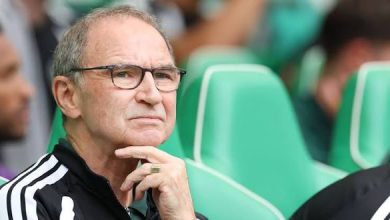
Martin O’Neill’s selection carries one particularly notable change from last weekend’s cup defeat: Sinisalo replaces Sam Johnstone in goal. Johnstone had started the previous derby but was, by most independent assessments, unconvincing on his Old Firm debut, and O’Neill’s decision to switch goalkeepers for this fixture suggests a manager willing to make bold calls even under significant external pressure, rather than simply persisting with an established choice out of habit or reluctance to be seen reacting to criticism.
In front of him, the back four remains settled: Ralston, Carter-Vickers, Trusty and Scales retain their places from recent weeks, giving Celtic a base of continuity at the back even as questions swirl elsewhere about the side’s overall form. Cameron Carter-Vickers in particular continues to anchor that defence as one of Celtic’s most consistent performers regardless of results elsewhere on the pitch, while Trusty and Scales provide the kind of experienced cover that O’Neill will be hoping proves resilient against a Rangers attack that scored three times in the corresponding fixture last weekend.
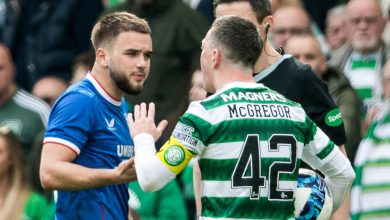
Central midfield sees captain Callum McGregor paired once again with Mika Baur — a pairing that inevitably draws extra scrutiny given Baur’s involvement in the controversial challenge on Ryan Naderi during last week’s cup tie, an incident that led directly to Rangers formally contacting the SFA over the officiating of the game. Baur himself has spoken publicly in the build-up about the mentality required from Celtic on Sunday, stressing that the response needed is about energy and application rather than aesthetic quality, and pointing to a need for better basic defensive work — tracking runners, closing down — after what he acknowledged was a below-par defensive performance in the first meeting.
Further forward, Hassan, Nygren and Duran occupy the more advanced midfield and support roles, with Kasper Hogh retained up front as the focal point of Celtic’s attack. Notably, summer signing Camilo Duran — described in build-up coverage as one of the more nailed-on names in Celtic’s starting XI regardless of the wider selection uncertainty — starts in a more withdrawn role rather than as the central striker, continuing a pattern seen in the cup defeat where Hogh was preferred through the middle following his return from
Celtic’s team news is not without its own significant complications. Yang Hyun-Jun remains unavailable, currently on international duty at the Asian Games — a reminder of how squad depth across a long season can be affected by international commitments that have nothing to do with club form or fitness concerns. Alongside him, Alistair Johnston, Callum Osmand and Jota are all ruled out through injury, representing a meaningful chunk of squad depth unavailable to O’Neill for a fixture of this magnitude.
There was, however, one piece of genuinely positive news in the build-up: midfielder Alex Oxlade-Chamberlain becomes available again having served a European suspension picked up following Celtic’s Europa League defeat to Ferencvaros in midweek. His return to full availability offers O’Neill a further attacking or midfield option, even though the experienced player was not restored directly into the starting XI for this particular fixture, suggesting the manager preferred to ease him back into contention from the bench rather than throw him straight into a high-pressure derby off the back of a suspension.
Adding a further layer of uncertainty to Celtic’s build-up, O’Neill was also reported to be conducting late fitness assessments on a number of unnamed squad members who picked up knocks during Thursday’s physically demanding defeat to Ferencvaros — a reminder of the genuine physical toll that comes with playing high-intensity European football on a Thursday before facing the club’s fiercest rivals just three days later. That Thursday-Sunday cycle has itself become a talking point in recent days, with former Aberdeen chief executive Keith Wyness having publicly warned that Celtic’s fixture congestion represents a “really big red flag” for a squad he considers “fairly thin” — a warning that gains extra resonance given the confirmed uncertainty around several players heading into this specific fixture.
Derek McInnes’s selection tells its own story of continuity mixed with genuine relief. Perhaps the single biggest talking point from the confirmed Rangers lineup is the inclusion of Ryan Naderi from the start, despite the German-Bulgarian forward having been widely reported as a major doubt throughout the week following the ankle injury he sustained in last weekend’s cup tie. Naderi was described as needing a late fitness test before Sunday’s game, with McInnes having previously characterised the state of his ankle in blunt terms as “a mess” — language that made his inclusion in the starting eleven feel far from guaranteed right up until team sheets were confirmed. His availability represents a significant boost for Rangers, given how central he’s become to the side’s attacking approach over recent weeks, culminating in his standout performance during last weekend’s 3-0 win.
Elsewhere, McInnes has largely kept faith with the same personnel that delivered that emphatic cup victory. Kevin Kelsy continues to lead the line as Rangers’ central striking option, a role that’s become increasingly significant given the club’s mounting striker injury crisis elsewhere in the squad. Behind him, Dan Neil and Nicolas Raskin retain their places in central midfield, continuing a partnership that had bullied Celtic’s own midfield pairing during the corresponding cup fixture just a week earlier — a repeat performance from that duo specifically is likely to be central to any hopes Rangers have of replicating their previous result.
At the back, the same defensive unit that helped deliver a clean sheet last weekend is retained: Fernandez and Makhanya continue as the central defensive pairing, with Sterling and Penrice occupying the full-back positions. That Fernandez-Makhanya partnership has been one of the more eye-catching stories of Rangers’ season so far, with the pair having anchored a dramatic defensive turnaround after Rangers had conceded six goals in their opening four league fixtures of the campaign.
Despite the relief of Naderi’s inclusion, Rangers’ overall absentee list remains considerably longer and more significant than Celtic’s. Captain Lawrence Shankland remains sidelined after undergoing hamstring surgery, an injury that has already ruled him out of both this fixture and last weekend’s cup tie, and which could keep him out of action for up to four months in total. Alongside him, Youssef Chermiti continues a long-term absence having suffered anterior cruciate ligament damage earlier in the season, an injury that ended his campaign entirely and directly prompted Rangers’ mid-season £9million move for Kelsy as a replacement option.
Further names are missing from McInnes’s available squad: Daisuke Yokota, whose own groin injury is set to require surgery and an extended recovery period, along with Kosta Nedeljkovic and Jose Cifuentes, both unavailable for this fixture. That’s a considerable list of absentees for any club to manage, and it leaves Rangers with a notably shallower pool of alternatives on the substitutes’ bench than a fully-fit squad would provide — a genuine concern given the physical demands of an away Old Firm fixture and the possibility of the game being decided, as so many are, by moments of impact from substitutes introduced in the closing stages.
There was at least a little more encouraging news regarding left-back Tuur Rommens, who has returned to full training after his own groin problem, though he wasn’t considered sufficiently match-ready to start on Sunday and continues to be monitored closely alongside one further unnamed squad member whose specific fitness issue has not been disclosed
No account of this fixture’s build-up would be complete without addressing the controversy that has hung over the week since the two sides last met. During that 3-0 League Cup win, Naderi was caught by a heavy, high challenge from Celtic’s Mika Baur, an incident that saw the resulting free-kick controversially awarded against Naderi rather than in his favour, despite replay evidence suggesting he had won the ball first. Naderi was withdrawn from that match not long afterwards, and the scale of the resulting ankle injury became clearer as the week progressed.
Rangers didn’t let the matter rest quietly. Chief executive Jim Gillespie made direct contact with the SFA’s head of referee operations, Willie Collum, specifically over the handling of the incident, while McInnes made his own frustration public, saying he wasn’t happy that the challenge had gone unreviewed and finding it strange that no retrospective action had been taken. That both Naderi and Baur now find themselves selected to face one another again, in the very next meeting between the clubs, adds a genuinely sharp edge to Sunday’s fixture that goes beyond the usual intensity of an Old Firm derby — this is, in a very literal sense, a rematch between the player at the centre of a significant injury controversy and the player whose challenge caused it, playing out in front of a hostile atmosphere at the ground of the club that delivered the challenge in the first place.
Beyond the individual subplots, the broader stakes attached to Sunday’s result are considerable. This is the first top-flight meeting between the sides this season, following Rangers’ 3-0 win in the corresponding League Cup fixture seven days earlier. A repeat of that scoreline, or anything close to it, would hand Rangers back-to-back victories over Celtic within the space of a single week — a feat that has been achieved only twice before across more than a century of meetings between these two clubs, in 1960 and 1998. It would also see Derek McInnes match a record previously set by Graeme Souness, one of the most storied names in the club’s modern history, by winning his first two Old Firm derbies in charge.
For Celtic, the equation carries an entirely different weight. A win would move O’Neill’s side eight points clear at the top of the table and go a considerable way toward silencing the mounting criticism the club has faced in recent days — criticism that has extended well beyond simple frustration over results, with fan-shareholder group Celtic Supporters Ltd explicitly linking the club’s recent stumbles to what they characterise as boardroom underinvestment during the summer transfer window, and prominent voices including former striker Chris Sutton echoing similar concerns about recruitment failures above manager level. A third consecutive defeat, by contrast, would only intensify that pressure further, adding fresh, uncomfortable questions to a week that has already proven deeply challenging for the
One further significant detail shapes Sunday’s occasion: for the whole of this season, away fans have been banned from attending Old Firm fixtures amid an ongoing ticket allocation dispute between the two clubs. That means Rangers travel to Celtic Park without a single travelling supporter inside the ground — a considerable additional challenge for McInnes’s side given how central atmosphere and crowd support typically are to derby occasions of this magnitude. Rangers’ own players have previously spoken about the psychological weight of playing in front of an entirely hostile stadium, with Celtic’s own Mika Baur separately reflecting on the reverse experience during last weekend’s cup tie, describing the sensation of playing at Ibrox in front of a stadium that felt entirely stacked against Celtic. Sunday offers the mirror image of that dynamic, with an expected capacity Celtic Park crowd solidly behind the home side throughout.
Sunday’s match represents the 454th official meeting between these two clubs in major competitions, a rivalry stretching all the way back to a first friendly encounter on 28 May 1888, when Celtic won 5-2. Remarkably, given more than a century of subsequent history, the overall head-to-head record between the clubs remains almost perfectly balanced: Rangers have won 173 of those meetings, Celtic 172, with a further 108 having ended level — a statistical symmetry that speaks to just how evenly matched these two institutions have remained across generations of Scottish football, despite periods of dominance running in both directions at various points throughout that long history.
Celtic host Rangers at Celtic Park on Sunday, 20 September, with kick-off scheduled for 12pm BST. Live coverage in the UK is available on Sky Sports, with build-up programming beginning an hour before kick-off. Whatever the result, Sunday’s match looks set to shape not just the immediate destination of bragging rights in Scotland’s biggest rivalry, but the broader narrative arc of both clubs’ seasons — Celtic hoping to arrest a worrying dip in form and silence mounting internal criticism, Rangers sensing a genuine chance to complete a rare piece of Old Firm history and cement one of the most remarkable managerial turnarounds Scottish football has seen in recent memory.