Gary Neville’s Composed Response to Carabao Cup Final Abuse — And Everything Else That Made Sunday Unforgettable

The Carabao Cup final at Wembley Stadium on Sunday was always going to be a charged occasion. Manchester City against Arsenal — two clubs locked in a season-long title race, two managers with contrasting philosophies, and a trophy on the line that carried far more symbolic weight than the competition’s modest prestige might normally suggest. For Pep Guardiola’s side, it was a chance to prove that the dark chapter of last season — when they finished without a single major honour for the first time in years — was firmly behind them. For Arsenal, it was an opportunity to claim a first piece of silverware in two decades and silence the growing narrative that they remain, despite all their progress, a club still waiting to cross the finishing line.
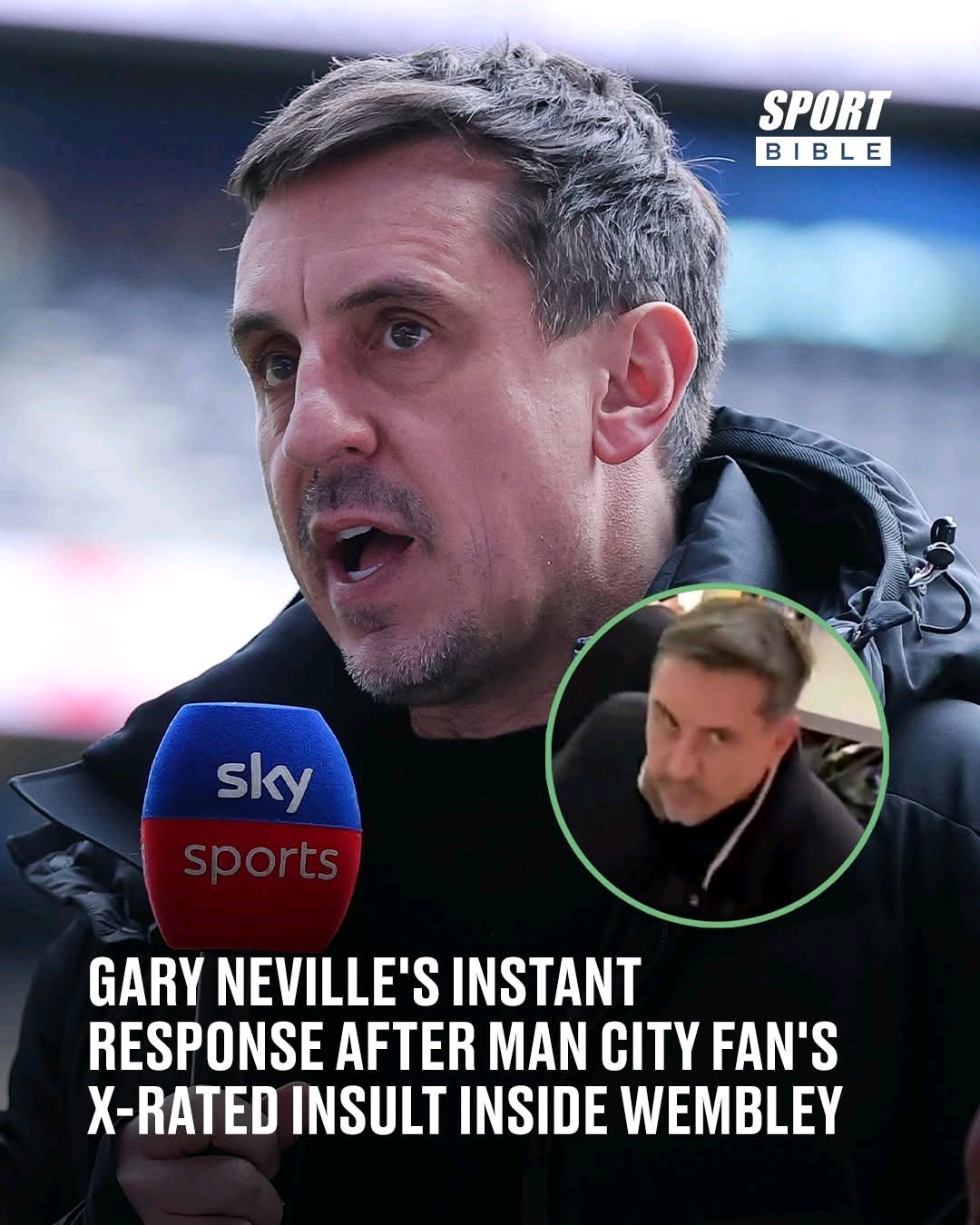
But amid all the drama on the pitch, one of the most talked-about moments of the day didn’t involve a goal, a tackle, or a tactical substitution. It involved a television pundit, a hostile supporter, and a single, perfectly timed gesture that sent the internet into a frenzy. Gary Neville, on commentary duty for Sky Sports alongside the incomparable Peter Drury, found himself on the receiving end of a sustained verbal assault from a Manchester City fan seated near the gantry at Wembley. His response — calm, measured, and instantly iconic — said more about the man than any number of broadcast minutes ever could.
—
## The Incident That Captivated the Internet
After the final whistle confirmed Manchester City’s 2-0 victory, Neville was doing what pundits and broadcasters often do in the aftermath of a major occasion — taking photographs with supporters, engaging with the crowd, soaking in the atmosphere that only a Wembley final can produce. It is, by all accounts, a fairly routine part of the job for someone of his profile and public-facing role.
What was not routine, however, was what happened next. A City supporter seated close to the working gantry seized the moment to unleash a torrent of abuse in Neville’s direction. The fan, clearly emboldened by his club’s victory and perhaps by something else entirely, called him a “red c***” — a reference, obviously, to Neville’s long and storied association with Manchester United, City’s most bitter rivals. He followed this up with a repeated chant of “Neville’s a w**ker,” delivered with the kind of enthusiasm usually reserved for actual goals rather than insults aimed at a television presenter.
Neville, to his enormous credit, did not rise to it. He did not engage in the kind of slanging match that would have played right into the fan’s hands and generated an entirely different kind of headline. Instead, he turned around, looked the fan squarely in the eye, and performed a slow, deliberate shushing gesture. It was the kind of response that communicates everything without saying a word — cool, dismissive, and faintly amused, rather than rattled or embarrassed.
The fan, undeterred and apparently delighted by the attention, pressed on. “Where’s your club?” he called out, a reference to Manchester United’s early and undignified exit from the Carabao Cup earlier in the competition. He then laughed loudly, clearly pleased with himself. Neville said something in return that cameras failed to pick up clearly, then gave a brief wave before the supporter continued his vocal celebration.
It lasted only a matter of seconds. But in the age of social media, seconds are all you need. A clip of the exchange, shared on X by the account @UtdKev08, accumulated more than 500,000 views within hours. The comment sections were predictably split — City fans applauding their compatriot’s creativity, United fans defending Neville, and neutrals largely agreeing that the shush was, objectively speaking, a masterclass in dignified self-restraint.
—
## A Long History of Hostility
It would be tempting to treat Sunday’s incident as an isolated piece of football banter, the kind of harmless ribbing that oils the wheels of the sport’s tribal rivalries. But for Gary Neville, the reality is somewhat more uncomfortable than that. The abuse he receives from supporters of clubs other than Manchester United — particularly City and Liverpool — has, at various points, crossed well beyond the boundaries of good-natured rivalry.
The most serious incident on public record occurred in 2019, when Neville was making his way into Brighton’s AMEX Stadium for the final game of that Premier League season. As he walked through the crowd, a drink was thrown at him by a group of Manchester City supporters. The incident was widely condemned, and it served as an unpleasant reminder that the resentment directed at Neville from certain quarters of English football goes considerably further than chants and finger gestures.
That a former footballer who retired from playing more than a decade ago continues to attract such visceral hostility speaks to the peculiar nature of his public persona. As a player, Neville was a ferociously committed and vocal Manchester United defender — the sort who wore his tribalism on his sleeve and never shied away from letting opponents know exactly what he thought of them. He was not universally liked, and he never appeared to particularly care about being universally liked. That authenticity earned him enormous respect among United supporters and considerable disdain from everyone else.
As a pundit, that dynamic has only intensified. Neville joined Sky Sports after retiring and rapidly established himself as one of the sharpest, most articulate, and most willing-to-say-what-others-won’t voices in British football broadcasting. He has criticised club owners, called out players, questioned managers, and waded into political controversies — most notably around Manchester United’s Glazer family ownership — with a forthrightness that very few in his position have matched. He has also, it must be said, maintained the kind of tribal edge that endears him to United fans while ensuring City and Liverpool supporters have no shortage of reasons to view him with suspicion.
Sunday was, in that sense, entirely predictable. A City fan, sitting close to a United legend in commentary, watching his team lift silverware over Arsenal — of course there was going to be some kind of provocation. The shush was simply Neville’s way of acknowledging the situation without dignifying it with anything more substantial.
—
## The Game Itself: O’Reilly’s Moment, City’s Redemption
Beyond the incident in the stands, of course, there was a football match. And it was one that delivered considerable drama, though perhaps less than Arsenal’s supporters had hoped for in terms of a genuine contest.
Manchester City ran out 2-0 winners, with both goals coming from Nico O’Reilly — a young player who, in the space of ninety minutes at Wembley, announced himself to a wider audience in the most emphatic way imaginable. To score once in a cup final is the stuff of childhood dreams. To score twice, against a team of Arsenal’s quality, on the grandest domestic stage available, is the kind of performance that careers are built around. O’Reilly’s double was clean, clinical, and perfectly timed, and the celebrations that followed suggested he understood completely the magnitude of what he had just achieved.
For Pep Guardiola, the victory carried a significance that stretched beyond the trophy itself. City had endured a miserable previous campaign by their extraordinary standards, failing to win a single major competition for the first time in years. There had been questions — some of them urgent — about whether the team was ageing, whether the squad needed significant investment, whether the Guardiola era was entering its twilight phase. Sunday’s performance did not definitively answer all of those questions, but it provided a powerful counter-argument. A City side that can dismantle Arsenal in a cup final is not a City side in terminal decline.
For Arsenal, the defeat was a painful one in multiple respects. Their quadruple ambitions — Premier League title, Champions League, FA Cup, and Carabao Cup — are now reduced to three competitions. More immediately damaging, perhaps, is the psychological blow of having lost to their primary title rivals at Wembley, in a game that they simply did not show up for in any meaningful way. There will be soul-searching to do. Mikel Arteta will have questions to answer. And with a meeting between the two clubs at the Etihad Stadium on 19 April looming large on the horizon — a game that could prove decisive in the title race — Arsenal cannot afford to carry the hangover from Sunday into that fixture.
—
## Neville’s Verdict on Kepa: Sharp, Clinical, Entirely Justified
If the shushing incident was the moment that most captured the internet’s imagination, Neville’s commentary during the game itself provided a more substantive insight into why he remains one of British football’s most respected analytical voices. His assessment of Arsenal goalkeeper Kepa Arrizabalaga was blunt, precise, and difficult to argue with.
Kepa had been selected ahead of David Raya — Arsenal’s preferred goalkeeper for most of the season and a Spain international — in what appeared to be a calculated gamble by Arteta. Given that the