I WILL BRING HIM BACK…” — ENZO MARESCA ALLEGEDLY SENT A SPECIAL MESSAGE TO JACK GREALISH THAT MOVED THE MAN CITY MANAGER

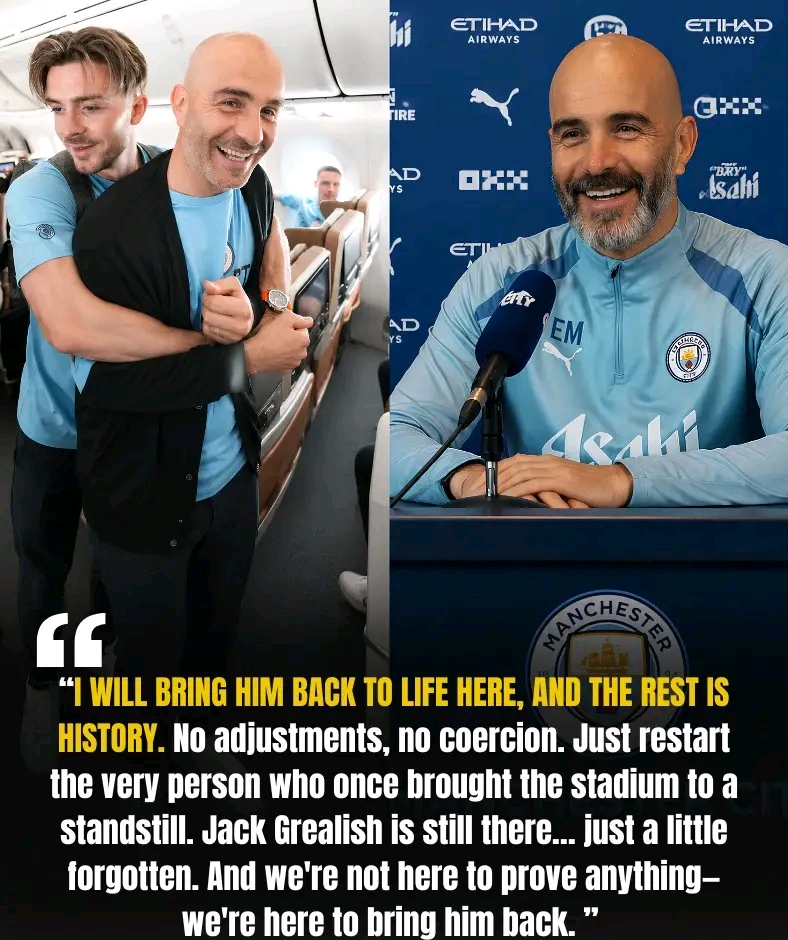
💙⚽ “I WILL BRING HIM BACK…” — those words, reportedly linked to a private message from Enzo Maresca, have set the football world on fire, and now Jack Grealish’s future at Manchester City looks more complicated than ever.
What started as quiet transfer noise has turned into a full-blown story of uncertainty, emotion, and possible redemption. At the centre of it all is Jack Grealish, a player once seen as the face of English flair, creativity, and confidence, now standing at a crossroads in his career at Manchester City.
And just when it looked like the story was fading into speculation, a fresh twist has emerged involving one of the most talked-about coaches in modern football, Enzo Maresca, who is currently leading Chelsea FC.
According to reports circulating around football circles, Maresca is believed to have sent a powerful and personal message to Grealish, suggesting that he still sees a place for him at the highest level of the game, and possibly even hinting at a future role where he could “bring him back” to his best form.
Those words, simple but loaded with meaning, have sparked debate, confusion, and excitement across the Premier League.
Because for Grealish, this is not just about transfers anymore. It is about identity, confidence, and what comes next in a career that has already seen both extreme highs and difficult moments under Pep Guardiola.
For Manchester City, Grealish’s situation has become one of the most delicate internal discussions of the summer. He arrived as a record-breaking signing, carrying expectations of becoming the creative heartbeat of the team. At times, he delivered exactly that—glimpses of brilliance, control in big matches, and crucial contributions in title-winning campaigns.
But consistency has remained the biggest question.
Under Pep Guardiola, roles are never guaranteed. Every player must adapt, evolve, and fit into a system where discipline is just as important as flair. Grealish has often found himself rotating in and out of the starting eleven, sometimes shining in key moments, other times spending long spells on the bench.
And that has led to growing speculation: is his long-term future still at Manchester City?
This is where Maresca’s name suddenly enters the picture in a dramatic way.
Having worked closely within the Manchester City system in the past as part of Guardiola’s coaching structure before taking his own managerial path, Maresca understands the philosophy, the expectations, and most importantly, the psychological demands placed on players like Grealish.
Now leading Chelsea, he is building a project focused on structure, confidence, and player revival. And according to insiders, he sees Grealish not as a finished player, but as someone who still has untapped potential waiting to be unlocked.
The alleged message—“I will bring him back”—is being interpreted in different ways. Some believe it is a reference to restoring Grealish’s confidence to his peak levels. Others see it as a signal that Maresca would be interested in working with him directly in the future, possibly away from the intense competition of Manchester City’s squad depth.
Whatever the true meaning, the impact has been immediate.
Inside Manchester City, there is said to be no panic, but there is awareness. Grealish remains an important figure in the squad, even if he is not always the first name on the team sheet. Guardiola values his ability to retain possession, draw fouls, and control tempo in tight games.
However, football at the highest level moves quickly, and City are always planning ahead.
The club has already begun transitioning certain positions, introducing younger profiles and reshaping their attacking options. That naturally raises questions about where Grealish fits in the long-term vision.
At 29 years old, he is not at the beginning of his career anymore, but he is not at the end either. This is usually the stage where a player either cements himself as a key figure or begins to reassess his role in a top squad.
And that is exactly why this story has gained so much attention.
For Grealish, the challenge is not talent. Nobody doubts his ability. His dribbling, close control, and creativity remain elite when he is at his best. The real issue has always been rhythm—how often he plays, how consistently he is trusted, and whether he can maintain top form across a full season.
At Manchester City, competition is fierce. Every position is contested by world-class players. Even a slight drop in form can result in rotation, and that is where Grealish’s situation becomes complicated.
Maresca’s involvement adds another layer entirely.
At Chelsea FC, Maresca is building a new identity. The club has gone through major changes in recent seasons, with new signings, new structures, and a clear attempt to create a long-term football philosophy rather than short-term fixes.
In that system, creative players are not just allowed to express themselves—they are required to understand tactical discipline while still producing moments of magic.
That balance is exactly what Grealish once embodied at his peak.
At Aston Villa, before his record move to Manchester, Grealish was the central figure of everything. Every attack flowed through him. Every big moment depended on his creativity. He was the leader, the entertainer, and the risk-taker.
At City, the role changed. Instead of being the main character, he became part of a wider system. And while that system brought trophies and success, it also reduced his individual spotlight.
This shift is at the heart of the current debate.
Maresca’s reported message is being seen by some analysts as an attempt to remind Grealish of who he was before he became a system player. A reminder of the freedom, responsibility, and trust that once defined him.
But there is also another angle.
Some believe Chelsea’s interest—if it develops beyond messages and admiration—could be part of a wider Premier League strategy to bring in experienced winners who understand pressure at the highest level.
Grealish, after multiple title-winning seasons with Manchester City, fits that profile perfectly. He knows what it takes to win leagues, manage expectations, and perform in big moments.
Still, any potential move would be extremely complex.
Manchester City are not a club that easily lets go of experienced players, especially those who can still influence important matches. Guardiola’s squads are carefully managed, and even players who are not always starters are often considered vital to the system.
That means any decision regarding Grealish would involve not just performance, but squad balance, depth, and tactical flexibility.
For now, there is no official confirmation of any transfer talks between City and Chelsea involving Grealish. Everything remains in the realm of reports, speculation, and behind-the-scenes conversations.
But football rarely stays quiet for long.
What makes this story so powerful is not just the transfer angle, but the emotional undertone behind it.
Grealish is a player who thrives on confidence. When he feels trusted, he delivers performances full of energy, creativity, and personality. When that trust is unclear, his game naturally becomes more cautious.
That is why Maresca’s alleged message has resonated so strongly. It speaks to something deeper than tactics or transfers—it speaks to belief.
Whether or not the message was exactly worded as reported, the idea behind it is clear: there are still people in football who believe Grealish has more to give.
And that belief matters.
As the summer window approaches, Manchester City will continue assessing their squad options. The club is always looking forward, always preparing for evolution, and always open to difficult decisions if they believe it benefits the team long-term.
Chelsea, on the other hand, are building something new, something ambitious, and potentially something that could reshape their identity under Maresca’s leadership.
In the middle of all this stands Grealish, a player with immense talent, huge experience, and a future that is suddenly being discussed again in headlines across England.
For now, he remains a Manchester City player. He remains part of a squad that competes for every trophy available. He remains under Guardiola’s system, learning, adapting, and contributing when called upon.
But the noise is growing.
And in football, when the noise grows, decisions often follow.
Whether Maresca’s words become nothing more than speculation or the beginning of something bigger, one thing is clear: Jack Grealish’s story at the top level is far from finished.
In fact, it may just be entering its most important chapter yet.