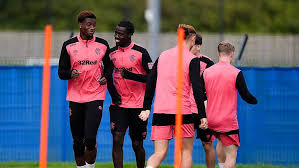
Ibrox View: McInnes finally listens as Rangers’ starting XI named vs Motherwell


There’s a particular satisfaction that comes from watching a manager under pressure actually respond to the noise around him, rather than digging in purely out of stubbornness. Derek McInnes’ confirmed starting XI for Rangers’ visit of Motherwell on Saturday afternoon suggests exactly that kind of responsiveness, with the Ibrox boss finally making the change that supporters and pundits have been calling for at right-back, even if he’s resisted the louder calls for wholesale surgery elsewhere in his defence. It’s a lineup that tells a story of a manager reading the room selectively — bending where the evidence has become overwhelming, holding firm where he still believes in his own
McInnes named his side as follows: Ivor Pandur in goal; Dujon Sterling, Emmanuel Fernandez, Olwethu Makhanya and James Penrice across the back four; Dan Neil and Nicolas Raskin anchoring central midfield; Djeidi Gassama, Kim Min-su and Findlay Curtis supporting Lawrence Shankland up top. Ryan Naderi and Daisuke Yokota were among the options McInnes retained on his bench, giving him attacking alternatives to call upon if Saturday’s contest requires a change of approach.
At first glance, it’s a side that looks broadly similar to the one that ground out victory at Falkirk in midweek, but the specific changes McInnes has made — and, just as tellingly, the ones he’s chosen not to make — say a great deal about where his head is at as he approaches what he himself has acknowledged is a defining period of his young Rangers reign.
The single most significant alteration to Rangers’ side is the recall of Dujon Sterling in place of Kosta Nedeljkovic at right-back, and it’s not an exaggeration to say this is a change that’s been building in the background for weeks. Nedeljkovic’s recent form has been a source of growing concern, most visibly through a bizarre own goal during Rangers’ win over Aberdeen that did little to settle nerves about his suitability for the position on a consistent basis. Against that backdrop, the clamour for McInnes to turn to Sterling — an experienced, more defensively secure option — had been steadily building among supporters and observers alike, and this weekend, for the visit of a dangerous, in-form Motherwell side, McInnes has finally made the call.
It’s worth stressing just how much sense this change makes given the specific opponent Rangers are facing. Motherwell arrive at Ibrox unbeaten through the opening month of the season, sitting third in the table, and fresh off a thumping 3-0 win over Dundee United that underlined the genuine attacking threat Alfred Johansson’s side possesses. This is precisely the kind of fixture where defensive uncertainty at full-back could be ruthlessly punished, and bringing in Sterling for what amounts to greater positional discipline and experience feels less like a reactive panic move and more like a considered response to a run of results and performances that had made the alternative untenable.
The far more contentious selection call, and the one that will generate the most debate among supporters heading into kick-off, is McInnes’ decision to retain Emmanuel Fernandez at the heart of his defence. This is a player who, after his showing against Falkirk in midweek, faced genuine and vocal calls to be dropped, with a startling pass-completion rate and a string of lost possessions raising serious questions about his current form and confidence levels. The clamour to see him axed in favour of an alternative option had grown loud enough that his continued inclusion here represents, in effect, McInnes backing his own judgement over the weight of outside opinion.
There’s a reasonable case to be made for that decision, even accounting for Fernandez’s recent struggles. He remains, for all his shakiness in possession, a player McInnes clearly still trusts to organise his backline, and dropping a defender purely on the back of one difficult performance — however alarming the underlying numbers — can sometimes do more harm than good if the alternative isn’t demonstrably more secure. It’s also true that Rangers’ summer transfer business, extensive as it was across thirteen incoming signings, didn’t specifically address central defensive depth in the way McInnes might have liked, meaning wholesale changes at centre-back were never entirely straightforward to engineer even if the manager had wanted to make them
Still, there’s no getting around the fact that this decision carries genuine risk. Motherwell’s front line, spearheaded by the pacy Tumi Maswanhise and supported by a fluid attacking trio behind him, is exactly the kind of threat that could exploit any hesitancy or lapse in concentration at the back, and if Fernandez repeats anything close to his Falkirk performance, McInnes will face immediate and justified criticism for not making the change supporters had been calling for. It’s a selection that could look either shrewd or stubborn by full time, and there’s genuinely no way of knowing which until the game is played.
In central midfield, Dan Neil’s return alongside Nicolas Raskin represents a straightforward and largely uncontroversial change from the side that started at Falkirk. The Sunderland signing missed the midweek victory through what was described as a minor knock, and his recall gives McInnes a different profile alongside Raskin compared to the more combative Cammy Devlin, who had deputised in his absence. Neil hasn’t yet fully found his feet in a Rangers shirt since his summer move, but there’s enough evident quality in his distribution and positional sense to suggest better performances lie ahead, and a fixture against a possession-focused Motherwell side gives him every opportunity to demonstrate exactly that.
Raskin’s continued presence alongside him, meanwhile, arrives with a welcome sense of finality after weeks of speculation regarding his future. With interest from Beşiktaş having failed to materialise into a completed transfer before the various relevant deadlines passed, Raskin now heads into this fixture with total clarity about where his season is heading, and McInnes will be hopeful that clarity translates into the kind of driving, combative performance that made the Belgian such an important figure for Rangers over the past two campaigns.
Ahead of that midfield pairing, McInnes has opted for continuity across his front four, and it’s not difficult to see why. Findlay Curtis retains his place having impressed in his two starts since breaking into the side, showing exactly the kind of directness and confidence that marked his loan spell at Kilmarnock last season. Kim Min-su continues in the number ten role, having quickly emerged as arguably Rangers’ most eye-catching summer addition despite having yet to open his goalscoring account — a situation that feels more a matter of time than a cause for genuine concern given the quality of his overall performances. Djeidi Gassama retains his place on the opposite flank having strung together an upward trajectory in form over the past fortnight, even if his end product remains a work in progress compared to the sheer technical quality he shows in patches.
And at the point of the attack, there was never any doubt Lawrence Shankland would continue leading the line. His brace against Falkirk took his tally to three goals in his last two appearances, providing exactly the kind of composed finishing that had been conspicuously missing during Rangers’ difficult opening month. With confidence clearly flowing, McInnes had no reason whatsoever to disrupt his in-form captain ahead of a fixture that demands a clinical edge in front of goal.
Notably absent from the starting XI, though very much present in the broader conversation around this Rangers squad, are deadline-day arrivals Kevin Kelsy and Badredine Bouanani. Both have been training with the first team since their respective moves were completed, and McInnes has previously spoken about needing conversations with both players to establish exactly how much they can realistically contribute at this early stage of their integration. Their continued absence from the starting lineup — and their omission even from the confirmed matchday squad reported around this fixture — suggests a manager taking a deliberately unhurried approach with his two highest-profile new arrivals, rather than rushing either into first-team action purely to appease supporters eager to see the club’s record-adjacent investment out on the pitch as soon as possible.
That patience is a defensible position given the physical and tactical adjustment both players face after arriving so late in the window, but it does mean McInnes continues to lean on his existing group of attacking options rather than the reinforcements specifically brought in to address the goalscoring void left by Youssef Chermiti’s long-term injury. Whether that patience holds if results start to slip again remains an open question, but for now, at least, the front line McInnes has selected is built on form rather than reputation or price tag.
None of these individual calls exist in a vacuum, and it’s worth stepping back to consider just how much pressure has been building around McInnes heading into this fixture. Rangers’ start to the season has been genuinely difficult by any measure — an underwhelming opening stretch of results, elimination from both the Europa League and Conference League qualifiers, the latter via a gut-punch penalty shootout defeat to Czech side Jablonec that prompted serious external questioning of his position. Pundit Aiden McGeady recently articulated exactly the kind of pressure now bearing down on the Ibrox boss, arguing that with Rangers having spent over £35 million in a record summer of recruitment, the club’s board will inevitably reach a point where results simply have to justify that outlay, regardless of the wider difficulty of constantly changing managers.
Back-to-back wins over Aberdeen and Falkirk have eased some of that immediate scrutiny, even if neither performance was especially convincing, and this Motherwell fixture represents a genuine opportunity for McInnes to build something more substantial — a run of results, rather than a series of isolated rescue acts, that could begin to change the broader narrative around his start to the job. Given that Motherwell inflicted a painful 3-2 defeat on Rangers at Ibrox in their last visit — a result widely credited with kickstarting last season’s dramatic late-campaign collapse — there’s an obvious psychological dimension to this fixture that goes well beyond the three points on offer.
What emerges from studying this team sheet closely is a picture of a manager picking his moments to compromise rather than capitulating wholesale to outside pressure. Bringing in Sterling for Nedeljkovic addresses a problem that had become too visible and too costly to ignore, responding directly to weeks of mounting concern about a specific individual’s form. Retaining Fernandez, by contrast, suggests McInnes isn’t simply reacting to the loudest current of criticism, and is instead making a considered judgement call about which alternative genuinely represents an upgrade rather than a change for change’s sake.
That kind of selective responsiveness is, in many ways, exactly what supporters should want to see from a manager under pressure — evidence that he’s actually listening to legitimate, evidence-based criticism, rather than either ignoring it entirely out of stubbornness or overreacting to every piece of noise generated by a difficult run of results. Whether history judges this particular team sheet kindly will depend, as it always does, on what happens over the following ninety minutes. But as a statement of a manager’s mindset heading into a genuinely pivotal fixture, it’s a lineup that suggests McInnes retains both the self-belief to back his own judgement and the humility to recognise when the evidence against a particular selection has simply become too strong to ignore any longer
Beyond the individual selection debates, the broader stakes of this fixture remain exactly as significant as they’ve looked all week. A third consecutive Premiership win would represent genuine, sustained momentum for a Rangers side that desperately needs it, both to continue closing the gap on Celtic at the top of the table and to settle the increasingly loud questions about McInnes’ medium-term future at the club. Given Motherwell’s excellent underlying form and their recent history of causing Rangers real problems at Ibrox specifically, nothing about this fixture is straightforward, but the changes McInnes has made — and the ones he’s resisted — suggest a manager who has thought carefully about exactly how he wants to approach this particular test, rather than simply picking his strongest available eleven on autopilot.
For now, the team sheet is set: Pandur; Sterling, Fernandez, Makhanya, Penrice; Neil, Raskin; Curtis, Kim, Gassama; Shankland. It’s a side built on a mixture of form, patience and one overdue concession to mounting external pressure — and by full time on Saturday, we’ll know a great deal more about whether McInnes got the balance of those competing instincts right.