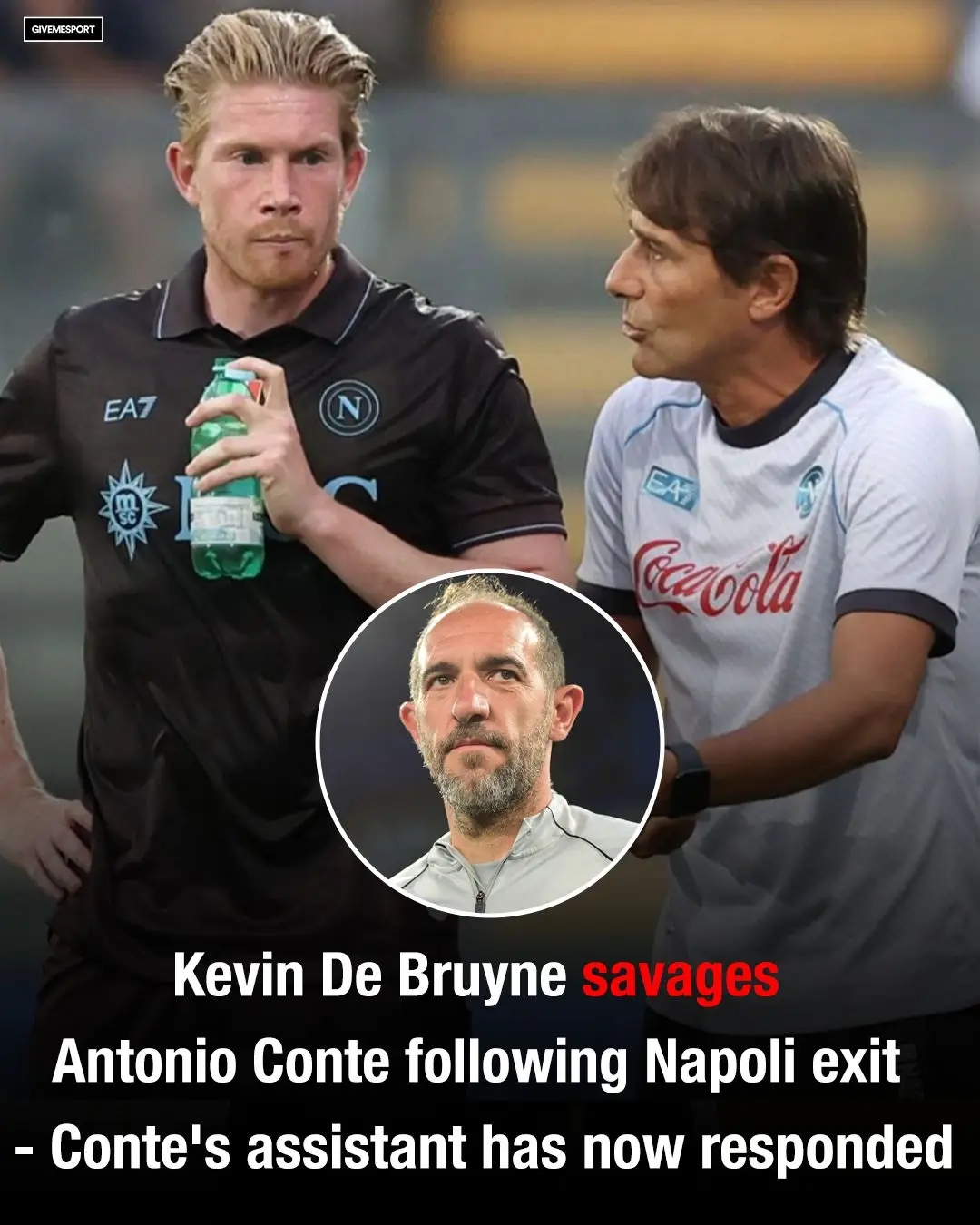
Kevin De Bruyne has once again found himself at the centre of a major football storm, this time after speaking openly and honestly about his difficult time under former manager Antonio Conte at Napoli. The Belgian superstar did not hold back in a recent interview, and his words have now sparked a strong reaction across Italy and the wider football world.
What makes this story even more explosive is the timing. Conte has only just left Napoli by mutual consent after two seasons filled with both success and frustration. He delivered a Serie A title in his first year, but things quickly fell apart in his second campaign, and the club ended the season behind Inter Milan in the title race. Napoli also struggled badly in Europe, crashing out early in the Champions League group phase, even though they managed to lift the Supercoppa Italiana as a small consolation.
For De Bruyne, however, the silverware meant little compared to his personal experience inside the system. The Belgian midfielder, now 34, arrived in Naples with huge expectations. Many believed he would be the final piece of Conte’s tactical puzzle, a creative force capable of unlocking stubborn defences and turning tight matches into victories.
Instead, what followed was a season full of frustration, injuries, and tactical restrictions that left one of the world’s most gifted midfielders feeling disconnected from the football he loves.
De Bruyne’s first season in Italy was already difficult before a ball was even kicked properly. In October, he suffered a serious thigh injury that kept him out for four months. That setback alone disrupted his rhythm and limited his influence on the pitch. By the time he returned, Napoli’s tactical structure had already settled into a rigid system that did not suit his strengths.
He ended the season with just 21 appearances, scoring five goals and providing four assists. For most midfielders, those numbers would be respectable, but for a player of his calibre and reputation, it felt underwhelming. More importantly, it was the lack of creative freedom that bothered him most.
In his interview with Belgian media outlet Het Nieuwsblad, De Bruyne made it clear that his vision of football and Conte’s philosophy never aligned. He explained that from the beginning, he struggled to understand where he fit into the system. According to him, he was never used in his preferred position, and that made it hard for him to express himself on the pitch.
He described the football as defensive and cautious, built around narrow margins and low-risk decisions. The team often played in a shape that resembled a 4-5-1 system, prioritising structure over creativity. In De Bruyne’s view, this approach limited attacking freedom and reduced the number of scoring opportunities.
While he avoided direct insults, his frustration was clear. He suggested that promises were made when he joined the club, particularly about how he would be used tactically, but those promises were not fully kept. That sense of disappointment became a recurring theme in his comments.
At one point, he admitted that football under Conte lacked enjoyment for him. That statement alone sent shockwaves through Italian media, because De Bruyne is not known for making emotional or controversial remarks. He is usually calm, professional, and focused on performance rather than public criticism.
But this time, something clearly broke through that usual restraint.
He also pointed out that Napoli’s attacking output suffered under the system. The central striker, he noted, managed only around ten goals across the season, which in his opinion reflected the cautious nature of the team’s approach. For a creative midfielder who thrives on fluid attacking movement, that was a sign that something was missing.
Behind the scenes, there had already been speculation that not everything was smooth between player and coach. Conte is known for his strict tactical discipline and intense training methods, while De Bruyne has always thrived in more flexible, expressive systems, like the one he enjoyed at Manchester City under Pep Guardiola.
That contrast in football philosophy is now seen as one of the main reasons for the tension in Naples.
De Bruyne’s comments also raised questions about his future at the club. He admitted that although he still had a year left on his contract, he wanted to sit down with the club to discuss what comes next. His words suggested uncertainty, even hinting that a departure this summer might not be impossible if things do not change.
For Napoli supporters, this was a worrying development. The club had hoped that signing a player of his experience would elevate them to consistent European contenders. Instead, they now face the possibility of losing him after just one season.
The situation became even more intense when Conte finally left the club. While Napoli officially described the departure as mutual consent, it was clear that the second season had not gone as planned. The team’s drop in performance, combined with internal disagreements, made continuation difficult.
However, Conte’s exit did not end the story. In fact, it opened the door for public criticism that had previously remained silent.
Shortly after De Bruyne’s interview circulated, Conte’s assistant and long-time tactical partner Cristian Stellini responded strongly. Stellini, who briefly served as interim manager at Tottenham Hotspur in 2023, did not hold back in defending his former boss.
He suggested that Napoli may have made a mistake in signing older, highly experienced players who prioritise style over results. Although he did not mention De Bruyne by name in a flattering way, the message was clear. He questioned whether such players fully embrace the demands of Conte’s system.
Stellini argued that professional footballers must adapt to the team’s needs rather than focus on personal preferences. In his view, experience should come with leadership, enthusiasm, and the ability to set an example for younger players.
He also claimed that De Bruyne did not show enough joy or positive energy during his time at the club, suggesting that his attitude may have influenced how he was perceived internally.
The assistant manager then pointed to examples of other elite professionals who adapted successfully to different tactical environments. One of the names mentioned in the broader conversation was Luka Modrić of AC Milan, who has continued to perform at a high level while maintaining professionalism and leadership qualities, even in more structured systems.
Stellini’s message was essentially simple: great players must adapt, not complain.
This response only added more fuel to an already heated debate.
Football fans across Europe quickly divided into two camps. One group supported De Bruyne, arguing that world-class creative players should not be restricted by overly defensive tactics. They believe that Napoli wasted his talent by forcing him into a system that does not suit his natural game.
The other group backed Conte and his coaching staff, insisting that discipline and structure are what win titles. From their perspective, players must adjust to the manager’s plan, not the other way around.
As the debate continued, attention also turned to De Bruyne’s broader career situation. At 34, he is in the final stage of his elite playing years. After leaving Manchester City, many expected him to take a leadership role in Italy and help build something special at Napoli.
Instead, his season has been disrupted by injury, tactical disagreement, and now public controversy.
Despite everything, De Bruyne remains focused on the future. His attention has now shifted to international duty with the Belgium national football team ahead of the upcoming World Cup. He is expected to play a key role alongside players like Romelu Lukaku, Jeremy Doku, and Thibaut Courtois.
For Belgium, this could be one of his final major tournaments, and there is a sense that he wants to end his international career on a high note, away from the club-level drama that has surrounded him in Italy.
Still, questions remain about what comes next at club level. Will he stay at Napoli and try to rebuild trust with a new coaching direction? Or will this summer mark the end of his short and turbulent Italian adventure?
Many believe a fresh start could be the best solution for both sides. De Bruyne thrives in systems that allow creativity, quick passing, and attacking freedom. Napoli under Conte was built on control, structure, and defensive stability. The clash between those identities was almost inevitable.
For Conte, this episode is another reminder of how demanding modern football has become. Even successful managers are now judged not just on results, but also on how players feel within their systems. Winning a league title is no longer enough if the dressing room harmony is damaged.
For De Bruyne, the situation is more personal. He has always been a player who expresses himself through vision, passing, and intelligence. Being restricted in that expression appears to have left him frustrated enough to speak out publicly for the first time in years.
As the football world continues to react, one thing is clear: this is not just a simple disagreement. It is a clash of football philosophies, personalities, and expectations at the highest level of the game.
Whether De Bruyne stays or leaves, and whether Conte rebuilds his reputation elsewhere, this episode will be remembered as one of the most talked-about player-manager tensions of the season.
And for Napoli, it raises a bigger question about identity. Are they a club that builds around strict tactical discipline, or one that allows creative stars like De Bruyne to shine freely?
The answer to that question may decide their future more than any single transfer or trophy ever will.