Erling Haaland continued his unstoppable rise on the world stage as Norway made a powerful return to the FIFA World Cup with a 4-1 win over Iraq, a match that immediately reminded everyone why he is considered one of the most dangerous strikers in world football. The Manchester City forward scored twice on his World Cup debut, taking his international tally to an incredible 57 goals, and once again showed his trademark power, timing, and cold finishing inside the box.
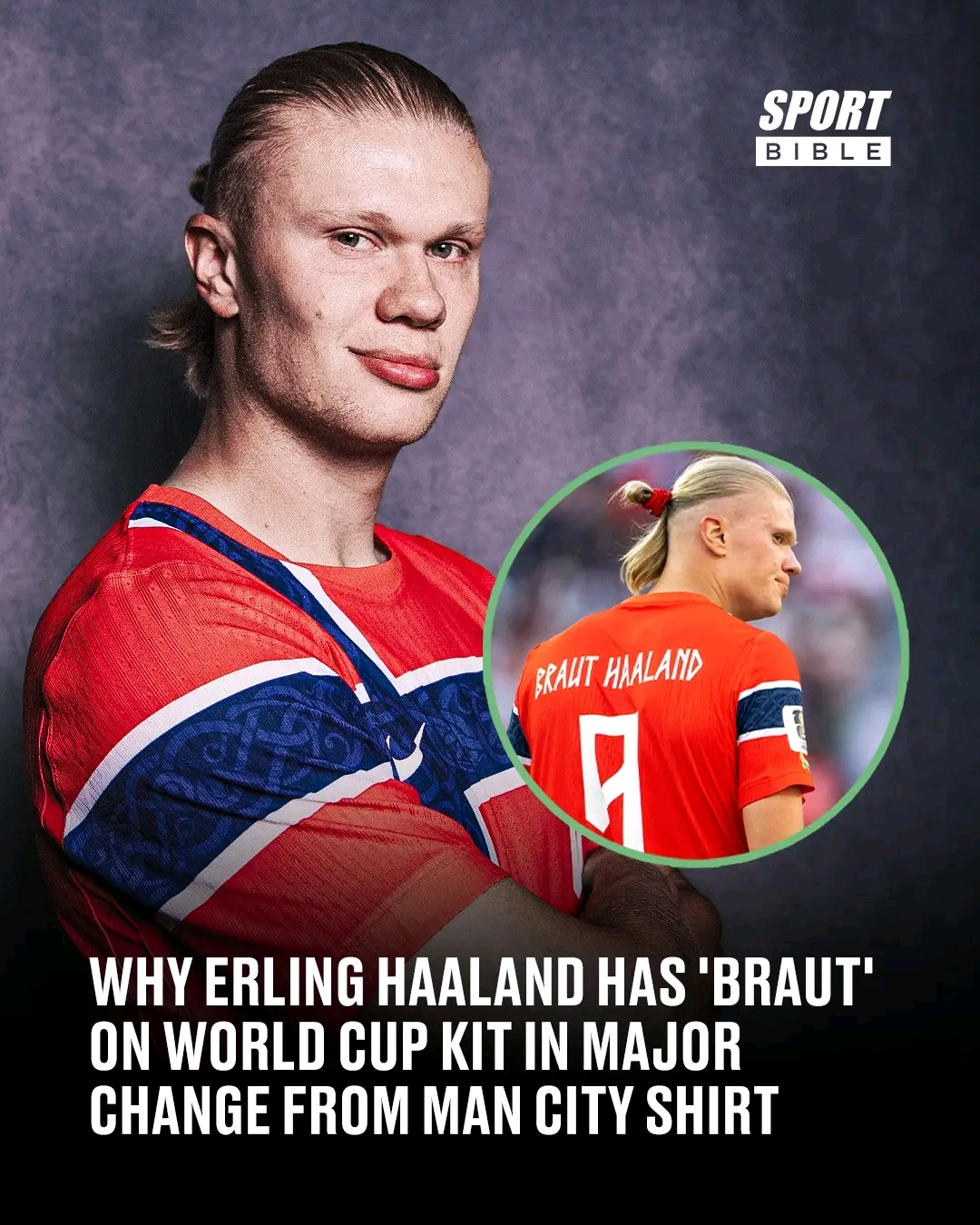
But while the goals grabbed attention, something else caught the eyes of fans watching closely. On his Norway shirt, the name printed across his back was not just “Haaland” like it usually is at Manchester City. Instead, it read “Braut Haaland”, a detail that sparked curiosity across social media and led many supporters to ask why the Norwegian star uses a different name on the international stage.
The match itself was a strong statement from Norway, who returned to the World Cup after a long 28-year absence and immediately showed they were not just there to participate. Against Iraq, they played with confidence and control, dominating large parts of the game while still showing patience when the match became tense. Haaland opened the scoring just before the half-hour mark, reacting quickly inside the penalty area and finishing with his usual calm precision.
Iraq responded through Aymen Hussein, who briefly brought the match back to level terms, but Norway’s reaction was immediate and ruthless. Just before half-time, Haaland struck again, restoring the lead and putting his side back in control. It was a goal that reflected everything he is known for: strength in movement, perfect positioning, and a finish that left the goalkeeper with no chance.
As the second half continued, Norway grew even more comfortable. Midfielder Martin Ødegaard controlled the tempo in midfield, dictating play and creating chances with his vision and passing ability. Leo Østigård added a third goal with a powerful header from a corner, before Iraq’s misery was completed with an own goal in stoppage time, sealing a 4-1 result that felt fully deserved for the Scandinavian side.
However, even with all the goals and the convincing performance, the conversation quickly shifted online to Haaland’s shirt name. For Manchester City, he is simply listed as “Haaland” with his famous number nine. But for Norway, the jersey reads “Braut Haaland”, a name that holds deeper personal and cultural meaning.
The reason behind it is connected to his family background. “Braut” is his mother’s maiden name, while “Haaland” comes from his father, Alf-Inge Haaland, the former Leeds United and Manchester City defender. His mother, Gry Marita Braut, was a successful heptathlete in Norway, meaning both sides of his family have strong sporting history. By using both names, Erling Haaland carries forward a tradition that recognises both parents equally.
In Norway, it is not unusual for people to use both maternal and paternal surnames, although it is not mandatory for athletes. In Haaland’s case, it is a personal choice that reflects pride in his heritage. He also uses “Braut Haaland” on his social media accounts, making it part of his identity beyond football. It is not a branding decision, but rather a cultural and family connection that he has chosen to keep close.
Despite being born in Leeds, England, Haaland has always identified strongly as Norwegian. His connection to Norway goes beyond nationality on paper. When he was just three years old, his family moved back to Bryne, the town where his parents are from. It was there that he began his football journey, joining the local club’s academy and developing the early foundations of the player he would later become.
He made his senior debut for Bryne before moving on to Molde, where his talent quickly became impossible to ignore. From there, his career accelerated rapidly, taking him to Red Bull Salzburg, Borussia Dortmund, and eventually Manchester City, where he became one of the most feared goal scorers in world football. Despite all the fame and success, he has never distanced himself from his roots.
The decision to represent Norway rather than England is another part of his identity that fans often revisit. Because he was born in England, Haaland was technically eligible to play for the Three Lions. However, he has always made it clear that his loyalty lies with Norway, the country where he grew up and developed as a person and player.
In a past interview, he explained his reasoning in simple terms. Having lived in England for only a few years as a child before returning to Norway, he felt a stronger emotional and cultural connection to his home country. He has openly said that he is proud to be Norwegian and never seriously considered switching national allegiance, even though the option was there.
His commitment to Norway is now paying off on the world stage, as he leads a national team that is finally back at the World Cup after nearly three decades. Alongside captain Martin Ødegaard and a growing generation of talented players, Norway are aiming to make a real impact in the tournament, and Haaland is naturally at the centre of those ambitions.
The victory over Iraq was followed by a wave of excitement among Norwegian fans, who now look ahead to tougher challenges in the group stage. Norway are scheduled to face Senegal next, a match that will test their defensive strength and tactical discipline, before a highly anticipated clash with France, one of the tournament favourites.
For Haaland, the focus will remain the same as always: scoring goals and leading from the front. But moments like the “Braut Haaland” shirt detail remind fans that there is more to him than just finishing ability. His identity is shaped by both sides of his family, his upbringing in Norway, and his experiences growing up in England before fully committing to his Norwegian roots.
As the tournament continues, his performances will be closely watched not only for goals but for leadership and influence. Every touch he makes will be analysed, every celebration shared across social media, and every match will add another chapter to his growing legacy.
In a World Cup filled with drama, surprises, and global attention, Haaland’s story stands out because it blends elite football talent with personal identity and cultural pride. Whether he is known as Haaland or Braut Haaland, one thing remains unchanged: he is one of the most dangerous strikers in world football, and Norway’s hopes at this World Cup depend heavily on his ability to deliver when it matters most.