Premier league FA intervene on Gabriel Magahaes and Erling Haaland incident as FA hand Five match ban to the players

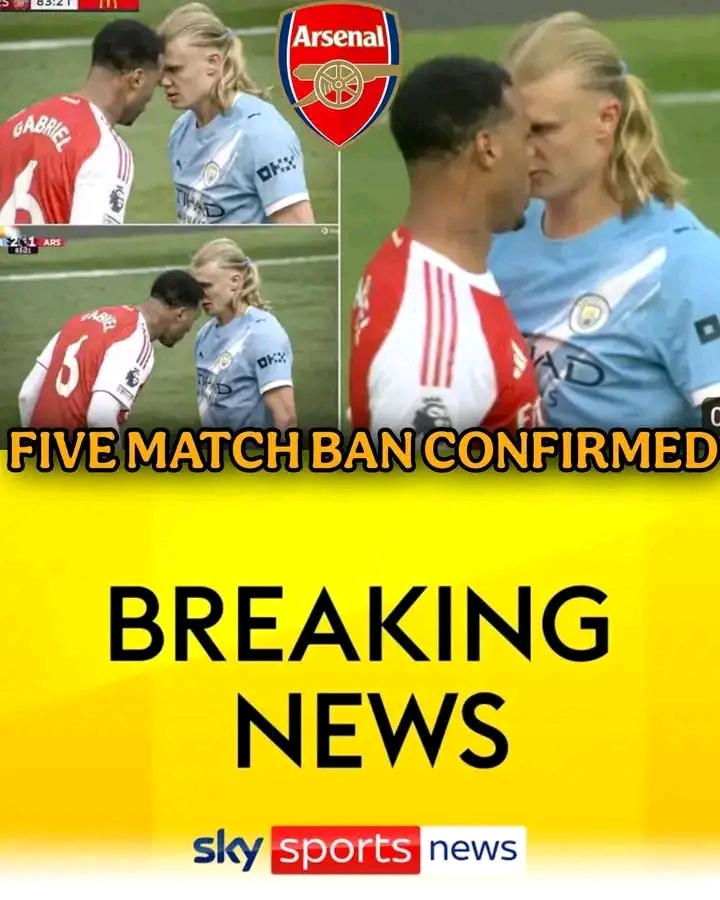
The drama from the explosive clash between Manchester City and Arsenal did not end when the final whistle blew. In fact, that was only the beginning of a much bigger story, one that has now shaken the Premier League and sent shockwaves across the football world.
What started as a heated on-pitch confrontation between Erling Haaland and Gabriel Magalhães has now turned into a serious disciplinary case, with the The Football Association stepping in to take strong action.
And now, the decision is out.
A five-match ban has been confirmed.
The moment itself looked simple at first glance, just another flash of anger in a high-pressure game. But when you slow it down, when you look deeper, when you understand the tension behind it, you begin to see why the FA decided this could not be ignored.
The two players had been battling all game long. Gabriel was marking Haaland tightly, not giving him space, not allowing him to breathe. Haaland was pushing back, using his strength, using his movement, trying to break free and find the chance to score.
Every time they came close, there was contact.
Every time they challenged, there were words.
And slowly, those words turned into something more dangerous.
Then came the moment that changed everything.
Gabriel stepped forward and moved his head into Haaland during a heated exchange. It was quick, but clear. Players reacted immediately. Some rushed in to separate them, others shouted, and the referee had to step in quickly to calm things down.
At the time, the decision seemed final.
A yellow card.
No red.
The referee allowed the game to continue, and VAR reviewed the incident but chose not to upgrade the punishment. The explanation given was that the action was not considered “excessively aggressive or violent.”
But football does not always end with what happens on the pitch.
After the match, the incident was reviewed again, this time by the FA.
And this time, the judgment was different.
The FA looked at the same footage, but with more time, more angles, and more analysis. They also considered the context, the build-up, the reaction, and the rules surrounding violent conduct.
And they came to a strong conclusion.
The action crossed the line.
It was not just a moment of frustration.
It was not just part of the game.
It was violent conduct.
And violent conduct cannot be ignored.
That is why the FA decided to step in and take action, even though the referee had already made a decision during the match. This is something that does not happen often, but when it does, it means the situation is serious.
The announcement of the five-match ban came as a shock to many.
Fans had been arguing about whether Gabriel should have been sent off during the game. Some believed he was lucky to stay on the pitch. Others felt the yellow card was enough.
But very few expected such a strong punishment after the match.
Five matches is not a small ban.
It is a huge blow.
For Arsenal, it could not have come at a worse time.
They are in the middle of a title race. Every match matters. Every player is important. Losing a key defender like Gabriel for five games could have a massive impact on their chances.
He is one of their most important players in defense. Strong, aggressive, and reliable. He plays a big role in how the team controls games and stops opponents.
Without him, the team will have to adjust.
Other players will need to step in.
New partnerships will need to be formed.
And in a season where every point counts, that kind of disruption can be very dangerous.
For Manchester City, the decision brings a different kind of reaction.
Some fans feel justice has been done.
They believe that the incident should have been punished more strongly during the game, and that this decision corrects that mistake.
Others are more focused on the result of the match, which City already won, thanks to Haaland’s decisive goal.
For Haaland himself, the news adds another layer to the story.
After the match, he had already spoken about what happened between him and Gabriel. He revealed that words were exchanged, that tensions were high, and that he chose not to escalate the situation.
Now, with the FA confirming the ban, it feels like his side of the story has been supported.
But even then, Haaland did not ask for this.
He did not fall to the ground.
He did not create a scene.
He simply continued playing.
And that is what makes this situation so interesting.
Because in modern football, many players might have reacted differently.
They might have exaggerated the contact.
They might have tried to force the referee into making a stronger decision.
But Haaland chose not to do that.
And yet, the punishment still came, just later.
This raises questions about how football handles these situations.
Should decisions be final on the pitch?
Or should they always be open to review after the game?
Some people believe that the referee’s decision should be respected, no matter what.
Others believe that fairness is more important, even if it means changing decisions later.
In this case, the FA clearly chose fairness.
They believed the original punishment was not enough.
They believed the action deserved more.
And they acted on that belief.
For Gabriel, this is a difficult moment.
Not just because of the ban, but because of the attention.
Every mistake at this level is seen by millions.
Every action is analyzed.
Every decision is discussed.
And now, his name is at the center of one of the biggest controversies of the season.
He will have time to think about what happened.
Time to reflect.
Time to learn.
Because football is not just about physical ability.
It is also about control.
Control of emotions.
Control of reactions.
Control of decisions in high-pressure moments.
This incident shows how quickly things can go wrong.
One moment.
One decision.
And everything changes.
For Arsenal manager Mikel Arteta, this creates a big challenge.
He now has to find a way to keep his team strong without one of his key players.
He has to manage the dressing room, keep players focused, and make sure this situation does not affect their confidence.
Because moments like this can do more than just remove a player.
They can affect the whole team.
They can create doubt.
They can create distraction.
And in a title race, that can be dangerous.
For the Premier League itself, this situation highlights the intensity of the competition.
This is not just about football.
It is about pressure, emotion, and the fine line between passion and discipline.
Players are pushed to their limits.
They are expected to perform at the highest level.
And sometimes, that pressure leads to moments like this.
But the rules are there for a reason.
To protect players.
To maintain fairness.
To keep the game under control.
And when those rules are broken, there must be consequences.
That is the message the FA has sent with this decision.
A strong message.
A clear message.
A message that says no player is above the rules.
As the season continues, this moment will not be forgotten.
It will be remembered when Arsenal play their next matches without Gabriel.
It will be remembered when fans talk about key turning points in the title race.
It will be remembered when these two teams meet again.
Because they will meet again.
And when they do, all eyes will be on Gabriel and Haaland.
On what they do.
On how they react.
On whether the tension is still there.
Because football has a way of bringing stories back.
Of creating new chapters from old moments.
And this story is far from over.
For now, the focus is on the ban.
Five matches.
Five games where Gabriel will have to watch from the sidelines.
Five games where Arsenal must find a way to cope.
Five games that could define their season.
And for Haaland, it is another reminder of the battles he faces every week.
Not just with defenders.
But with emotions.
With pressure.
With expectations.
He continues to stand strong.
To score goals.
To lead his team.
And to show why he is one of the most dominant players in the game today.
In the end, this is what football is about.
Moments.
Decisions.
Consequences.
And stories that stay with us long after the match is over.
This was one of those moments.
One that started with a clash.
Grew into controversy.
And has now turned into a major turning point in the season.
And as everything moves forward, one thing is certain.
The impact of this decision will be felt for a long time.