Rangers are heading into a massive summer rebuild, and the feeling around Ibrox is that there will be no half measures this time. After a season that showed both promise and painful inconsistency, especially in defence, the club now appear ready to make bold decisions, clear out underperforming players, and bring in fresh talent that can finally give stability at the back.
It has been a difficult campaign to fully judge, but one thing has stood out more than anything else: Rangers simply conceded far too many goals. The defensive structure looked unsettled from the start of the season, and even when results went in their favour, there was always a sense that the backline could be exposed at any moment.
This became even more obvious during the final stretch of the season. In the last seven Scottish Premiership matches, Rangers conceded at least two goals in every single game. That kind of record is simply not acceptable for a team aiming to win titles. Even when they managed to win games, it often came through attacking power rather than defensive control.
The pattern in those matches tells its own story. There were moments of resilience, but also repeated lapses in concentration, poor positioning, and mistakes that cost crucial points. At times, the defence looked like a group of players who had not fully settled into a consistent partnership.
Across those final games, Danny Rohl’s side were forced to constantly adjust their centre-back pairing due to injuries, rotation, and lack of stability. Whether it was Souttar alongside Fernandez or Djiga stepping in, the combinations rarely looked fully secure.
The result was a defensive unit that never truly clicked.
As the season came to an end, it became increasingly clear that major changes were coming. One of the most notable departures already confirmed is James Tavernier, a long-standing figure at the club whose exit marks the end of an era. Alongside him, several loan players and short-term signings are also set to leave, including Max Aarons, Jayden Meghoma, Derek Cornelius, and Nasser Djiga, all returning to their parent clubs.
Djiga’s situation is particularly interesting. There was at one point genuine discussion about whether Rangers might try to keep him permanently, especially after some improved performances earlier in the season. However, his form dipped significantly towards the end, and that momentum has now disappeared.
His loan spell started with promise but became increasingly inconsistent. While he showed physical strength and commitment, he struggled with decision-making under pressure. In high-stakes matches, especially against top opposition, those weaknesses were exposed.
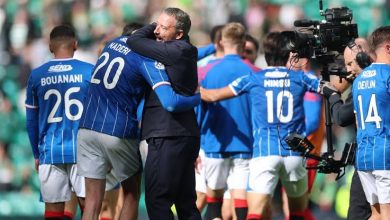
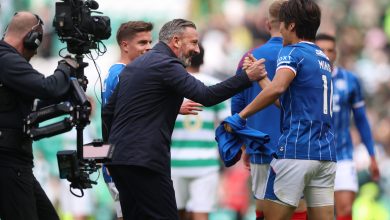
The Old Firm clash at Parkhead in particular highlighted those issues. It was a difficult afternoon where Rangers were defensively fragile, and Djiga struggled to cope with the intensity of the match. Mistakes in possession and positioning added pressure on an already unstable backline.
That performance, combined with the general defensive record in the final weeks of the season, appears to have shifted Rangers’ thinking. Rather than extending his stay, the club are now looking elsewhere for more reliable options.
At one stage, there was hope that Rangers might build a long-term defensive partnership involving Djiga and another centre-back. But football moves quickly, and plans can change just as fast. The club’s recruitment focus now seems to be leaning toward younger, more consistent defenders who can grow into long-term roles at Ibrox.
This is where a new target has emerged.
Rangers have reportedly made progress in their pursuit of Dundee defender Luke Graham, with reports suggesting that personal terms have already been verbally agreed. While nothing has been officially signed yet, the development indicates strong interest from both the player and the club.
Graham is seen as a player with significant potential. Still only 22, he has already established himself as a key figure for Dundee, showing maturity beyond his years. His performances have attracted attention not only from Rangers but also from clubs in England, including Norwich City and Portsmouth, making this a competitive transfer race.
Dundee are believed to value him at over £1.5 million, which in today’s market is considered reasonable for a young, developing centre-back with first-team experience. His contract situation also gives Dundee some control, as he is still tied to the club until 2027.
What makes Graham particularly attractive to Rangers is his profile. He is a strong, left-footed centre-back who is comfortable in physical duels and aerial battles. He reads the game well and has shown the ability to stay calm under pressure, something Rangers’ defence has often lacked this season.
His statistics further highlight his consistency. Over the course of the season, he made 35 league appearances, contributing not only defensively but also offensively with goals and assists. He also helped Dundee keep multiple clean sheets, showing his importance at both ends of the pitch.
When compared to Rangers loanee Djiga, the differences become more noticeable. While both players are physically strong and aggressive defenders, Graham has shown more consistency across a longer period of games.
Both players recorded similar numbers in tackles and interceptions, but Graham’s overall influence on matches has been more stable. He also holds a slightly better record in aerial duels, which is a key requirement for centre-backs in the Scottish Premiership.
In terms of duels, Graham has come out on top more frequently, winning a higher percentage of both ground and aerial challenges. That kind of reliability is exactly what Rangers have been missing in crucial matches.
Djiga, on the other hand, has shown flashes of quality but also moments of uncertainty. While he has had games where he performed well, his inconsistency has made it difficult for the club to fully trust him in high-pressure situations.
One of the biggest concerns has been his vulnerability when defending crosses and set pieces. In several matches, opposition forwards were able to exploit spaces behind him, leading to dangerous chances and goals conceded.
For a club like Rangers, where defensive stability is essential for winning titles, these weaknesses are difficult to overlook. Even if a player has potential, the demand at Ibrox is immediate performance and reliability.
That is why the potential signing of Luke Graham is being viewed as such an important move. He represents not just a replacement, but a shift in recruitment strategy. Rangers are increasingly looking toward players who are proven in the Scottish Premiership, understand the physical demands of the league, and can adapt quickly without a long settling-in period.
There is also a wider strategic direction behind this approach. The club’s leadership has expressed a desire to prioritise talent from the Scottish and SPFL markets. This is not only about football quality, but also about reducing risk in transfers and building a squad with stronger local understanding.
Graham fits that vision perfectly. He is young, already experienced in the league, and still has room to develop into a top-level defender. With proper coaching and structure, he could become a long-term pillar of Rangers’ defence.
At the same time, Rangers are aware that they cannot rely on one signing alone to fix their defensive issues. The departure of multiple defenders means that several reinforcements will be required. The club will likely target at least two or three new centre-backs before the start of next season.
John Souttar may remain one of the few experienced options available, but even his long-term role is not guaranteed as the club reshapes the squad. Emmanuel Fernandez is also attracting interest from England, which could further weaken the defensive depth if he leaves.
This makes the summer transfer window absolutely critical for Rangers. The decisions made in the coming weeks will shape not just next season, but the long-term direction of the team.
For supporters, there is frustration but also hope. The defensive struggles of the past season have been difficult to watch, but the club’s willingness to act quickly in the transfer market is seen as a positive sign.
If Rangers can secure Luke Graham and add one or two more strong defensive options, there is belief that the team can become far more balanced and competitive again.
But as always in football, potential must be turned into performance. Signings on paper mean little unless they translate into stability on the pitch.
For now, all attention is on the negotiations, the departures, and the rebuilding process. Rangers are not just planning a summer of change—they are planning a defensive reset that could define the next era at Ibrox.