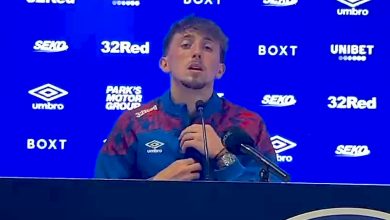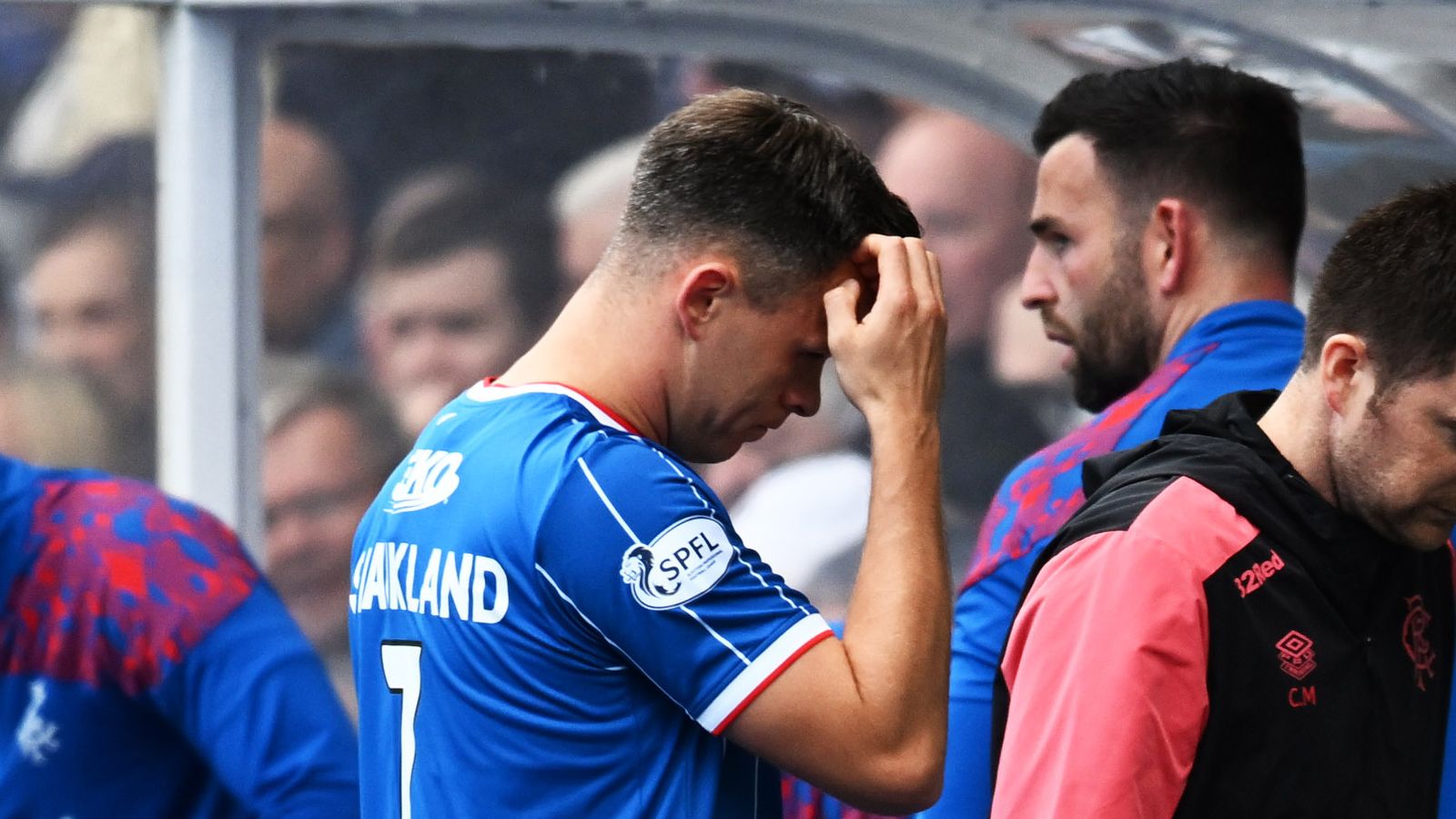
Derek McInnes had barely finished celebrating a third straight William Hill Premiership win when the mood at Ibrox turned sharply sombre. Lawrence Shankland, Rangers’ captain and the man whose goals had just fired his boyhood club to the top of their early-season form, was in the medical room rather than the celebratory huddle. Eight minutes into Saturday’s 1-0 victory over Motherwell, Shankland grabbed the back of his leg, signalled immediately to the bench, and limped off in visible distress. What followed in the hours after full time was a manager trying to measure his words while privately fearing the worst — and a football club forced to reckon, for the second time this season, with the loss of a first-choice striker just as momentum was building.
By full time, the scale of the concern was already obvious. McInnes told Rangers TV that the issue felt “quite significant,” and that Shankland himself had described the sensation as strikingly similar to the hamstring injury that wrecked his final months at Hearts. That comparison alone was enough to send a shiver through Ibrox, because everyone at the club remembers exactly how long that one kept him out. It wasn’t a knock he shook off in a fortnight. It was closer to three months of his life in maroon spent parked on the sidelines, watching a title race he had personally dragged into contention slip away without him.
The parallel McInnes drew wasn’t incidental colour — it was the whole ballgame. Back in January, Shankland was in the form of his career, the division’s outright top scorer and the central reason Hearts were sitting six points clear at the summit, chasing a first title since 1960. Then, in a Scottish Cup exit to Falkirk, he pulled up with a hamstring strain in extra time of a penalty shootout defeat. Scans confirmed a six-to-eight week prognosis. In practice, it dragged on far longer than that, costing him the run-in of a Hearts title bid that ultimately fell away without their talisman leading the line. McInnes, who managed Shankland during that spell, later reflected that had his forward stayed fit through that stretch, “he would have got his 30 goals” and would arguably have walked the division’s player of the season award. Instead, Hearts lost their title challenge, and Shankland lost three months of a career that was otherwise building toward a World Cup call-up.
That history is precisely why Saturday’s incident carries so much weight. This is not an unknown quantity or a first-time soft-tissue niggle that clubs can shrug off with generic optimism about “day-to-day” assessments. This is a player, a manager, and a medical team who have all been through this exact injury together before, at another club, and who know from bitter experience that the recovery timeline can run well past the conservative end of any estimate. McInnes was careful in his phrasing after the game — repeatedly stressing that Rangers “don’t want to speculate too much” before a scan confirms the extent of the damage — but the subtext was unmistakable. When your own player is telling you it feels like the one that kept him out for three months, you don’t need a scan to know you’re bracing for bad news.
The frustrating part, from a Rangers perspective, is how innocuous the moment looked. There was no crunching tackle, no awkward stretch for a ball, no visible mechanism that would explain a serious muscular injury. Shankland himself, according to McInnes, felt fine going into the match and could point to nothing specific he’d done on the pitch before it “just pulled up” on him. That is often the hallmark of hamstring problems in in-form players carrying a heavy recent workload, and McInnes offered his own theory for what may have contributed: a rapid turnaround from Wednesday night’s League Cup tie away to Falkirk, played on an artificial surface, followed by a switch back to Ibrox’s grass just three days later.
McInnes noted that Shankland’s output in that midweek win over Falkirk had been unusually high, and floated the idea that switching pitch surfaces in quick succession — from 4G plastic to natural turf — can leave players more susceptible to exactly this kind of strain. It’s a theory rather than a diagnosis, but it fits a broader pattern that Scottish football has wrestled with for years, as more lower-league and cup venues use artificial or hybrid pitches while top-flight sides still play predominantly on grass. For a 30-year-old forward carrying a recent hamstring history into a season already packed with midweek cup football, World Cup preparation, and a new manager’s demanding pressing structure, the compressed calendar may have simply caught up with him.
Whatever the specific trigger, the outcome on the pitch was immediate. Shankland was replaced inside ten minutes by fellow forward Ryan Naderi, who needed only a matter of minutes himself to make an instant impact — netting the game’s only goal to seal a third consecutive league win under McInnes. It was, in isolation, exactly the kind of impact substitution every manager dreams of. But the mood in the away end and the home stands alike shifted the moment cameras caught Shankland’s face on the touchline: this was not a captain frustrated at being withdrawn as a precaution. This was a player who already suspected the truth.
Rangers confirmed that Shankland would be sent for scans on Monday, with the club understandably reluctant to attach a firm timescale to his absence until the results are in. That caution is standard practice, but it does little to dampen the anxiety inside Ibrox. Given the player’s own description of the sensation and the direct comparison to an injury that cost him roughly three months of football, the working assumption around the club is that this will not be a short-term issue. Best case, Rangers are braced for a recovery measured in weeks rather than days. Worst case — and given the history, it is the scenario being quietly prepared for — Shankland could be missing for a large chunk of the season’s opening months, potentially into the turn of the year.
The timing could scarcely be worse. Rangers are about to enter one of the most demanding stretches of their fixture calendar: an Old Firm double-header against Celtic, starting with a Premier Sports Cup quarter-final at Ibrox and followed just a week later by a Premiership trip to Celtic Park. Those are precisely the fixtures a club wants its captain and focal point available for, not games where the manager is forced to reshuffle his forward line on the fly. Shankland is now considered almost certain to miss both. Beyond the Celtic ties, there is also a looming international dimension: Scotland’s new head coach, Sébastien Pocognoli, is preparing to name his first squad later this month, and Shankland’s involvement — after his exploits at the World Cup over the summer — is now in serious doubt if the injury proves as severe as feared.
There is a real sting to the timing beyond simply the fixtures being missed. Shankland had only just started to look like the player Rangers signed him to be. His move from Hearts in the summer — completed before he departed for World Cup duty with Scotland — was framed from day one as a dream transfer, the boyhood Rangers fan finally pulling on the jersey he’d supported as a kid. But early-season form in a new environment, under a new head coach and captaining a squad going through wholesale change, isn’t always instant. Shankland had needed a handful of matches to find his feet.
That changed dramatically in the space of a week. He scored in successive matches — vital contributions in wins away at Aberdeen and then at Falkirk in midweek — form that had finally clicked and looked set to carry Rangers into a genuinely exciting autumn. He was, by his manager’s own admission, “in good form, getting himself moving” and starting to look like the attacking spearhead the club had banked on when they brought him back to McInnes’s side. Then, within minutes of kick-off against Motherwell, all of that momentum was ripped away. It is a cruel footballing irony: the very form that made this injury sting so much is also, per McInnes’s surface theory, plausibly connected to the accumulated physical load that may have caused it.
For a captain still bedding into a new dressing room, an extended fitness absence this early is not just a blow to the team’s goal output — it’s a disruption to leadership continuity at a club that has already been through considerable upheaval. Shankland was handed the armband as a statement of trust from a manager who knows him intimately, having worked with him previously at both Hearts and Aberdeen. Losing him for a prolonged spell means Rangers must find not just goals from elsewhere, but a voice in the dressing room and on the pitch to fill the void his absence leaves.
Shankland’s setback lands on top of an existing wound. Rangers have already lost Youssef Chermiti for the vast majority of the campaign after the young striker suffered anterior cruciate ligament damage in a defeat to Hibernian last month — an injury that will keep him out for the long haul, almost certainly ruling him out for the rest of the season. That loss alone had already reshaped Rangers’ attacking plans before a ball was kicked against Motherwell, prompting the club to move for reinforcements in the transfer market. Now, with both Chermiti and Shankland unavailable, McInnes finds himself without either of the two most senior centre-forward options he had planned to build his season around.
McInnes didn’t shy away from the scale of the challenge when discussing it after the Motherwell win, acknowledging that if he’d been told at the start of the campaign that both Chermiti and Shankland would suffer significant injuries, it would have felt like a considerable weight to carry. It’s a rare admission of vulnerability from a manager usually careful to project control, but it underlines just how quickly Rangers’ attacking depth chart has been tested. Two forwards signed and trusted to lead the line — one a marquee returning hero, the other a promising young talent — both sidelined for extended spells inside the opening weeks of the season.
The obvious silver lining, and the one McInnes leaned on repeatedly in his post-match comments, is that Rangers do at least have options — even if none carries quite the same pedigree as their now-sidelined captain. Ryan Naderi’s impact off the bench against Motherwell was the perfect advertisement for squad depth done right: thrown on inside ten minutes, he needed barely more than that to make the difference and secure the points. His timing could not have been better, both for the result and for his own claim to a starting berth in Shankland’s absence.
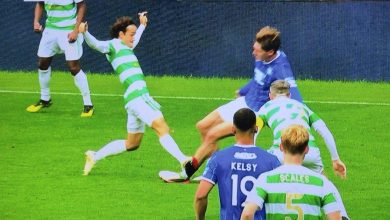
Then there is Kevin Kelsy, whose competitive debut for the club came off the bench in the same match. Signed for a fee in the region of £9.5 million from Portland Timbers — making him Rangers’ second-most expensive signing in the club’s history behind only Tore André Flo — Kelsy represents a genuinely significant financial commitment to solving exactly this kind of scenario. He didn’t manage to get on the scoresheet on his introduction, missing a presentable chance, but the raw attributes that persuaded Rangers to spend such a considerable sum were evident: physical strength, mobility, and the profile of a forward built to lead a line rather than simply support one. With Shankland now facing an extended absence, the pressure and opportunity both fall squarely on Kelsy’s shoulders to prove the outlay was justified far sooner than anyone at Ibrox might have originally planned.
Beyond those two, McInnes also has Kim Min-su and Bojan Miovski to call upon — options that, taken together, at least give Rangers a plausible route through the coming weeks without their captain, even if none offers quite the same guarantee of end product that a fully fit Shankland provides. McInnes pointed to the broader squad picture with a note of genuine optimism, arguing that the introduction of Kim to the side has already helped, and that Rangers are creating chances and starting to look like a team developing a clear attacking identity — even before considering that they were doing so without their two most senior strikers.
That framing matters. It would be easy to read Shankland’s injury purely as catastrophe, but McInnes’s post-match comments suggest a manager trying to strike a balance: real concern over losing his captain for a significant period, tempered by genuine belief that the squad built over an eventful summer of recruitment — fourteen new signings in total — has the depth to cope. Whether that optimism survives contact with an Old Firm double-header remains to be seen.
Shankland’s injury cannot be viewed in isolation from the wider context that has shadowed Rangers’ season so far. This is a squad rebuilt at considerable expense — reportedly in the region of £35 million across the transfer window — with McInnes tasked with converting that outlay into results and silverware quickly. Pundits and former players have already questioned whether the scale of spending raises the stakes to a point where anything less than sustained progress could put the manager’s position under threat, particularly given a mixed start that included a draw at Dundee United and a Europa League qualifying exit. Losing both Chermiti and now Shankland, the two headline forward additions of very different transfer strategies — one a marquee homecoming, the other a statement signing — for extended periods adds another layer of pressure to a campaign already being watched closely for signs of stumbling.
There is also a footballing romance to Shankland’s story that makes this injury land harder than a simple team-news update might suggest. This was a player who spent years being talked about as Rangers’ great what-if — the Ibrox-supporting forward who kept banging in goals for Hearts and Dundee United while speculation swirled about a “dream move” that never quite materialised, until it finally did this summer. His arrival was framed by the player himself as the fulfilment of a boyhood ambition, and by the club as a statement of intent domestically. Three goals in his last two appearances before the injury were exactly the kind of early proof-of-concept Rangers fans had been waiting for. Watching that story interrupted so abruptly, and by an injury he immediately recognised from painful personal experience, adds a layer of poignancy that pure squad-depth analysis doesn’t capture.
For now, everything hinges on Monday’s scan. Rangers have been careful not to attach numbers to the recovery timeline until then, and there remains a version of events in which the injury proves less severe than the worst-case comparison Shankland himself has drawn. But the early signals — his manager’s choice of the word “significant,” the specificity of the player’s own comparison to a three-month absence, and the caution both have shown in avoiding premature optimism — all point toward a club preparing for the captain to be missing for a considerable stretch.
In the immediate term, that means Naderi, Kelsy, Kim, and Miovski will be tasked with sharing the goalscoring burden through an Old Firm cup quarter-final and league fixture in quick succession, without the presence and know-how of the man handed the armband over the summer. In the medium term, it means a Scotland squad announcement later this month will arrive with added scrutiny, as Pocognoli waits on updates over whether his captain-in-waiting on the international stage will even be fit for selection. And in the longer term, it means Rangers’ season — one already carrying the weight of record summer spending and heightened expectation — must now find a way to build momentum without arguably its most symbolically important signing for what could be a large portion of the campaign.
Derek McInnes has been here before with Shankland, just at a different club and in a different set of colours. He knows how long these recoveries can drag, and he knows exactly what a title race, or in this case a title challenge, can lose without its talisman. The hope at Ibrox is that this time the outcome is kinder. The fear, rooted in bitter recent history, is that Rangers may simply have to find a way to cope without their captain for a good while yet.