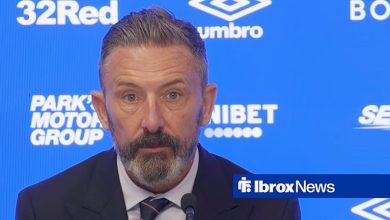
Rangers’ Cerny Pursuit: The Financial Impasse Threatening to Derail McInnes’ Dream Reunion


As Derek McInnes continues to orchestrate one of the most ambitious squad rebuilds in Rangers’ recent history, one target has emerged that represents not merely a tactical acquisition but a sentimental reunion with a player whose impact on Ibrox extended far beyond the statistical contributions he made during his time there. Vaclav Cerny, the Czech winger who impressed dramatically during an impressive loan spell in the 2024-25 season, has become a primary focus for Rangers’ recruitment team as they seek to add creative firepower to their attacking arsenal. However, sources close to the situation have revealed that Rangers’ hopes of re-signing the 28-year-old may founder on the rock of financial reality, with Turkish club Besiktas—Cerny’s current employers—set to demand a fee that could prove beyond Rangers’ reach.
This situation encapsulates both the ambitions and the constraints facing modern Scottish football. Rangers possess the desire and the vision to reunite with a player they believe can significantly enhance their attacking capabilities, yet they are confronted by the financial realities of operating in a market increasingly dominated by wealthier institutions from larger leagues. The Cerny saga, therefore, provides a fascinating lens through which to examine not merely Rangers’ transfer strategy but the broader dynamics of contemporary football transfer markets and the mechanisms through which ambition becomes constrained by financial reality.
To fully understand the significance of Rangers’ pursuit of Vaclav Cerny and the motivation driving their efforts to secure his services, one must first appreciate the impact he made during his loan spell at Ibrox in the 2024-25 season. Cerny didn’t merely contribute competently during his time in Glasgow; he impressed observers with his creativity, his goal-scoring ability, and his overall contribution to Rangers’ attacking play. The winger became a fan favorite, demonstrating precisely the kind of directness and threat that modern Scottish football demands.
Cerny’s loan spell represented the kind of temporary arrangement that can occasionally provide clubs with solutions to immediate needs while allowing players to demonstrate their capabilities in new environments. For Rangers, the Czech international’s arrival on loan offered an opportunity to add creative firepower to their attacking department without the substantial financial commitment required for a permanent transfer. For Cerny, the loan provided an opportunity to play regularly at a significant club and to stake a claim for a more permanent move.
However, the relationship that developed between player and club was more than merely functional. Cerny’s performances suggested genuine mutual affection, with supporters warming to his style of play and his evident commitment to Rangers’ cause. The winger scored prolifically during his time at Ibrox, contributing goals that were often crucial to the team’s performances. This combination of effectiveness and genuine connection to the club created the foundation for what many at Rangers envisioned as a permanent relationship.
As the loan spell concluded and Cerny returned to his parent club, the suggestion emerged that Rangers would attempt to secure his services on a permanent basis. This wasn’t merely wishful thinking or vague aspiration; it represented a genuine conviction among Rangers’ hierarchy that Cerny was precisely the type of player McInnes required to fulfill his vision for the club. The winger’s ability to create, to score, and to provide the directness and unpredictability that characterizes elite attacking football made him an obvious target for a club seeking to challenge domestically and compete in European competition.
The narrative took a significant turn in the summer of 2025 when Cerny, rather than returning to Ibrox on a permanent basis, instead completed a move to Turkish Super Lig side Besiktas. The transfer fee, reported to be in the region of £4.2 million (approximately 5 million euros), represented a significant investment by the Turkish club in a player they clearly believed could contribute substantially to their objectives. For Rangers, the development represented a disappointment—the loss of a player they had hoped to secure and the necessity to redirect their transfer attentions elsewhere.
However, the fundamental dynamic of the situation was not necessarily unfavorable to Cerny’s aspirations regarding a Rangers reunion. Besiktas, despite their status as a major Turkish institution, are not among European football’s elite in terms of global competitiveness. The Turkish Super Lig, while possessing considerable quality and attracting international talent, is not regarded as equivalent to the Premier League, La Liga, Serie A, or even the Bundesliga in terms of competitive level or commercial prestige. For a player of Cerny’s abilities and aspirations, a move to Besiktas could represent either a progression to a significant club or a potential dead-end, depending on how his time in Turkey unfolded.
The question of whether Cerny’s Besiktas move has proven successful in sporting terms is crucial to understanding Rangers’ renewed interest. If the Czech international has struggled to establish himself or found himself marginalized at the Turkish club, then a return to Rangers—a club where he was successful and loved—would represent an attractive proposition. Conversely, if he has thrived at Besiktas and established himself as a key player in their system, his willingness to leave and his employers’ motivation to facilitate his departure become far less clear.
The critical issue confronting Rangers in their pursuit of Cerny is not sporting in nature; rather, it is fundamentally financial. According to sources who have provided information to Football Insider, Besiktas are not prepared to accept a fee that merely represents their investment in the player. Instead, the Turkish club is set to demand an increase on the £4.2 million they invested in signing Cerny approximately one year prior to Rangers’ renewed interest.
This negotiating position, while potentially frustrating from a Rangers perspective, is entirely rational from Besiktas’ standpoint. Several factors support the Turkish club’s hardline approach. First and foremost, Cerny remains under contract with Besiktas for two additional years, meaning the club faces no immediate pressure to negotiate. With such an extended contract remaining, Besiktas can afford to adopt a patient approach and wait for a buyer willing to meet their valuation.
Secondly, the principle of player economics suggests that a club would not willingly accept a reduced fee for a player after such a brief period. To do so would establish a precedent that investment in players can be quickly recovered at a loss, undermining the entire logic of player acquisition. Besiktas’ demand for an increased fee or at minimum full recoupment of their investment reflects the club’s desire to maintain the economic integrity of their transfer operations.
Thirdly, Cerny’s performances at Besiktas, whatever their objective quality, have likely been satisfactory enough to justify the club’s position that they remain content with his presence. If Cerny had proven to be a poor acquisition or had struggled significantly at Besiktas, the Turkish club might be more motivated to cut their losses and accept a reduced fee. However, indications suggest that Cerny has been at least an adequate performer at his current club, reducing their incentive to facilitate his departure at a discount.
For Derek McInnes and Rangers’ recruitment team, the financial demands emanating from Besiktas present a significant challenge. The club has been active in the transfer market throughout the summer, securing multiple signings and investing substantially in squad improvement. While Rangers possess considerable financial resources by Scottish standards, they are not among European football’s wealthiest institutions. The concentration of wealth in the Premier League means that even well-resourced Scottish clubs operate under financial constraints that prevent them from competing freely with English clubs for players.
Pete O’Rourke, Football Insider’s Transfer Correspondent, articulated the challenge clearly in comments shared on the Transfer Insider podcast: “It’s a difficult deal to do for Rangers for several reasons. Financially, obviously, it’ll be very challenging. He’s on a big contract at Besiktas, and obviously Besiktas signed him for around 5 million euros last year. They’ll be looking to recoup all of that if not more if they were to sell Cerny just one year after his arrival in Turkey, because he still has two more years left on that deal. I don’t think they’ll be in any rush to lose the Czech Republic star.”
This assessment encapsulates the reality confronting Rangers. The club genuinely desires Cerny’s services and believe he would significantly enhance their attacking capabilities. However, their financial capacity to pay Besiktas’ asking price is questionable. The realistic range of fees Rangers might be willing to pay—likely in the region of £4-5 million, representing minimal profit on Besiktas’ investment—falls short of the Turkish club’s requirements. This mismatch between what Rangers can realistically afford to pay and what Besiktas is prepared to accept creates a seemingly insurmountable obstacle.
The situation is further complicated by the timing of Rangers’ interest. Having allowed an entire season to pass since Cerny left Ibrox, Rangers approach Besiktas from a position of weakness rather than strength. The Turkish club has invested a season’s worth of effort and resources into integrating Cerny into their squad, making it logical from their perspective that any club wishing to acquire him would need to recognize this investment through an enhanced fee.
While the Cerny situation represents a genuine disappointment for Rangers, it must be understood within the broader context of McInnes’ transfer strategy. The manager has demonstrated throughout the summer that he is pragmatic regarding targets and unwilling to become emotionally invested in specific acquisitions to the point where rational financial decision-making becomes compromised. This pragmatism, while potentially frustrating in the Cerny case, reflects the discipline required to successfully navigate modern transfer markets.
Rangers’ scouts have been casting a wide net across European football, identifying targets across multiple markets and at varying price points. Rather than focusing exclusively on established players at significant clubs—who inevitably command premium fees—Rangers have also been exploring opportunities in emerging markets and among younger players with potential for development. This approach provides greater flexibility and reduces the risk of becoming locked into protracted negotiations for singular targets whose price expectations are unrealistic.
The exploration of Scandinavian football represents a particularly interesting dimension of this strategy. Former Manchester United chief scout Mick Brown has reportedly suggested that Rangers’ recruitment team is scouting Scandinavia to identify the “next Erling Haaland”—a reference to the premium placed on identifying young talent before they become established stars commanding elite fees. This strategy reflects a recognition that some of the best value in modern football can be found by identifying promising young players from less fashionable leagues, developing them at a significant club, and potentially profiting from their subsequent development.
## The Scandinavian Strategy: A Smarter Approach to Recruitment
The focus on Scandinavian football appears to have already borne fruit for Rangers, with players including Silas Andersen from BA Hacken and the previously discussed Jens Hjerto-Dahl from Tromsø emerging as targets. These players represent a different profile from Cerny: younger, with greater development potential, and operating at price points more aligned with Rangers’ actual financial capacity. While these signings carry greater risk than acquiring an established player of proven quality, they also offer potential upside and the opportunity to develop players within Rangers’ system.
This recruitment strategy suggests a manager and a club thinking intelligently about how to maximize their resources in an increasingly competitive transfer market. Rather than attempting to outbid wealthier English clubs for established talent, Rangers are identifying markets where they can compete effectively and acquiring players who can develop at Ibrox before potentially generating substantial returns through subsequent sales or establishing themselves as key performers for the club.
The scouting operations in Scandinavia have been informed, according to reports, by the performances of Nordic national teams at the World Cup. The Norwegian national team, in particular, attracted attention through their tournament performances, suggesting that Scandinavian football may be producing talent of higher quality than commonly perceived. For Rangers and other clubs seeking value in the transfer market, this represents a logical avenue of exploration.
The Cerny situation also reflects broader dynamics within contemporary football transfer markets. The concentration of wealth in certain leagues and among certain clubs has created a two-tier system where elite institutions can command premium fees regardless of their players’ performances or market value, while other clubs operate within tighter financial constraints.
Rangers, despite being a historically significant club and one of the two major institutions in Scottish football, must operate within these constraints. The Turkish Super Lig occupies an intermediate position in European football’s hierarchy—more prestigious than the Scottish Premiership but less wealthy and competitive than the Premier League or major Continental leagues. This positioning allows Besiktas to maintain their negotiating stance without fear of Rangers finding alternative suppliers for attacking wingers.
Furthermore, the prevalence of loan arrangements in modern football means that players like Cerny can be temporarily tested at different clubs before permanent moves are negotiated. While this benefits clubs seeking to assess players, it also means that employers can become comfortable with players in their systems and resist their departure even if alternative opportunities present themselves. Besiktas’ apparent reluctance to facilitate Cerny’s departure reflects this comfort with his presence and their ability to maintain a player they believe can contribute to their objectives.
As the reality that a Cerny deal at the necessary price point is unlikely to materialize becomes clearer, Rangers will presumably redirect their efforts toward alternative targets. The club’s scouting network and the ambitious nature of McInnes’ recruitment strategy suggest that alternative options are being explored simultaneously rather than sequentially. Rather than placing all hopes on a single target, Rangers are likely pursuing multiple avenues and will pivot quickly if one opportunity proves unviable.
The signings already completed this summer—particularly of players like Dan Neil, Cammy Devlin, and the imminent arrival of Vanja Dragojevic—suggest that McInnes is not viewing Cerny as an irreplaceable component of his plans. While the Czech winger would clearly enhance Rangers’ attacking capabilities, his absence is not a fatal blow to the manager’s vision for the club. This perspective provides Rangers with negotiating leverage of a sort: the ability to walk away from negotiations if the price exceeds their assessment of the player’s value.
The Cerny situation presents an interesting tension between sentiment and pragmatism in football. From a romantic perspective, a reunion between a player who was loved at a club and that club represents something appealing. The narrative of Cerny’s successful loan spell, his popularity at Ibrox, and his desire to return to Scotland has genuine appeal both to supporters and to those within the club.
However, McInnes’ pragmatism in recognizing that the financial terms being demanded by Besiktas are simply not justifiable demonstrates the reality of modern football management. Sentiment cannot drive transfer strategy; financial discipline and rational assessment of value must prevail. Paying £6, 7, or 8 million for Cerny when he can potentially be replaced by younger players at reduced cost would represent a failure of strategic thinking, regardless of the emotional appeal of the reunion narrative.
As the summer transfer window progresses toward its conclusion, the likelihood of Rangers successfully re-signing Vaclav Cerny appears increasingly remote. Besiktas’ negotiating position, supported by the length of Cerny’s contract and their apparent contentment with his performances, creates a financial barrier that Rangers appear unwilling or unable to surmount.
This represents a disappointment for supporters who cherished Cerny’s contributions during his loan spell and envisioned a permanent reunion. However, it also represents a demonstration of the discipline and pragmatism that characterizes modern football management at its best. Derek McInnes, through accepting that the Cerny deal is not viable at the right price, is protecting Rangers’ financial position and ensuring that resources are deployed toward signings that offer genuine value.
The exploration of alternative markets—particularly Scandinavian football—suggests that Rangers’ recruitment strategy is comprehensive and adaptable. Rather than viewing the Cerny situation as a failure, it might more accurately be understood as a recognition that sometimes the romantic path and the pragmatic path diverge, and the pragmatic path must take precedence.
The 2026-27 season will reveal whether Rangers’ recruitment strategy—shaped by both successful acquisitions and deals that couldn’t be completed at the right price—has ultimately been vindicated. What is certain is that McInnes has approached the transfer window with a clarity of vision and a discipline regarding financial decision-making that bodes well for Rangers’ future competitiveness, even if it means bidding farewell to romantic notions of Cerny’s return to Ibrox.