Referee begs for forgiveness after huge three wrong decisions made in city clash that cost Arsenal the three points as PGMOL takes full action on the match officials – Final statement released

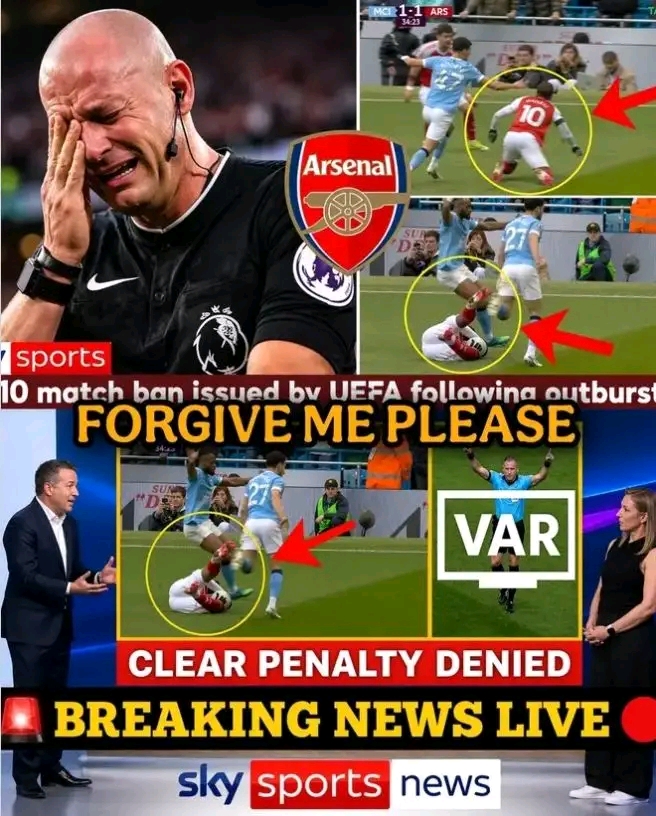
BREAKING NEWS has shaken the football world once again, and this time it is not about a last-minute goal or a transfer drama, but about something far more controversial and painful for fans, especially those who support Arsenal. What happened in the recent clash between Arsenal and Manchester City has now turned into a storm that refuses to calm down, and the centre of it all is the referee, a man who has now come out to beg for forgiveness after what many are calling one of the most shocking officiating performances of the season.
The match itself was already a high-stakes encounter. Whenever Arsenal faces Manchester City, the tension is always high. These are two of the biggest teams in England, both fighting for the Premier League title, both full of world-class players, and both managed by top-level coaches who demand perfection. On this day, everything was set for a classic. The stadium was full, fans were loud, and the players were ready to give everything.
But instead of talking about beautiful football, goals, tactics, and brilliance, everyone is now talking about decisions. Wrong decisions. Costly decisions. Decisions that may have changed the direction of the title race.
From the very first half, things already started to look strange. Arsenal began the game strongly, pressing high and creating chances. Players like Bukayo Saka and Martin Ødegaard were controlling the tempo, moving the ball quickly, and causing problems for Manchester City’s defence. It looked like Arsenal had come with a clear plan and strong belief.
Then came the first controversial moment.
Arsenal thought they had won a clear penalty. A dangerous attack into the box ended with one of their players being brought down. The fans screamed. The players surrounded the referee. From every angle, it looked like a foul. Even commentators were shocked. But the referee waved play on. No penalty.
VAR checked it. Everyone waited. Still, nothing was given.
That was the first big decision.
At that moment, you could feel something change. The energy of the game shifted. Arsenal players looked frustrated. The crowd grew angry. And Manchester City, led by players like Kevin De Bruyne and Erling Haaland, slowly began to take control.
Then came the second major incident.
A City goal that many believe should never have stood. The build-up to the goal had a possible foul in it. Arsenal players were appealing again, asking the referee to review the action. But once again, the referee allowed the goal to stand. VAR checked, but still no change.
2 wrong decisions.
The tension was now unbearable.
Arsenal fans were furious. The players looked like they were fighting not just their opponents, but also the officials. And in matches like this, small margins matter. One decision can change everything. Two wrong decisions? That can destroy a game.
But it didn’t stop there.
The third and most painful moment came late in the match. Arsenal were pushing for an equaliser. The game was still open. Hope was still alive. Then another incident happened inside the box, this time involving a potential foul on an Arsenal attacker.
Again, no penalty.
Three major decisions. Three moments where Arsenal felt robbed.
At full-time, Manchester City walked away with the victory. Arsenal walked away with anger, frustration, and questions. Big questions.
Fans immediately took to social media. Former players spoke out. Pundits began to analyse every moment. The words “robbery” and “scandal” started appearing everywhere.
And then came the pressure on PGMOL, the organization responsible for referees in English football.
Professional Game Match Officials Limited, known as PGMOL, could not ignore the situation. The noise was too loud. The evidence was too clear. Something had to be done.
Behind the scenes, an investigation began. Match footage was reviewed again and again. Experts looked at every decision. Communication between the referee and VAR was analysed.
And then, this morning, the final statement was released.
It confirmed what many already believed.
Mistakes were made. Serious mistakes.
PGMOL admitted that the referee got key decisions wrong. Not just one, but multiple. They accepted that Arsenal were denied clear opportunities due to these errors. And in a rare and dramatic move, strong action was taken against the match officials.
The referee was removed from upcoming fixtures. Internal disciplinary actions were applied. And most shocking of all, the referee himself came forward publicly.
In an emotional statement, he begged for forgiveness.
He admitted that he made errors. He admitted that those errors affected the outcome of the match. He said he understood the pain of the players, the fans, and the club.
This is something you almost never see in football.
Referees rarely speak. They rarely apologise. But this time, the situation was too big to ignore.
His words were simple, but powerful. He spoke about pressure, about the speed of the game, about the difficulty of making decisions in real time. But he did not hide. He did not make excuses. He accepted responsibility.
Still, for Arsenal fans, the apology may not be enough.
Because what is done cannot be undone.
Those three points are gone. In a title race where every point matters, this could be the difference between winning the league and finishing second. And that is what makes this situation so painful.
Manager reactions have also added more drama to the story.
Arsenal’s manager, Mikel Arteta, tried to stay calm but could not hide his frustration. He spoke about fairness, about respect for the game, and about how decisions like this damage football. He stopped short of directly attacking the referee, but his message was clear.
On the other side, Pep Guardiola was more careful with his words. He acknowledged that decisions are part of football and said his team simply focused on playing. But even he admitted that sometimes these situations are difficult to accept.
Fans are now divided, not about what happened, but about what should happen next.
Some are calling for technology improvements. Others are demanding more accountability from referees. Many are asking why VAR, which was introduced to reduce mistakes, failed to correct such clear errors.
And this is the biggest question of all.
If VAR cannot fix obvious mistakes, then what is its purpose?
The Premier League has invested heavily in technology. The idea was simple: reduce human error, make the game fairer, and ensure that big matches are decided by players, not officials. But moments like this make people lose trust.
For Arsenal, the focus now shifts to what comes next. The players must recover mentally. They must find a way to move forward, even though the pain is still fresh. In football, you cannot stay down for too long. Another match is always coming.
But deep inside, this result will hurt for a long time.
Because they know what could have been.
If even one of those decisions had gone their way, the result might have been different. If two had gone their way, they might have won. If all three had been correct, we could be talking about a completely different title race right now.
Instead, we are talking about apologies.
We are talking about investigations.
We are talking about mistakes.
And that is not what football should be about.
This story is far from over. More reactions will come. More analysis will be done. And for the referee at the centre of it all, this moment will likely follow him for the rest of his career.
Football is a beautiful game, but it is also a cruel one.
And sometimes, the biggest moments are not decided by skill or tactics, but by decisions that should never have gone wrong.
For Arsenal fans, this is more than just a loss.
It feels like something was taken from them.
And even though forgiveness has been asked for, it may take a very long time before it is truly given.