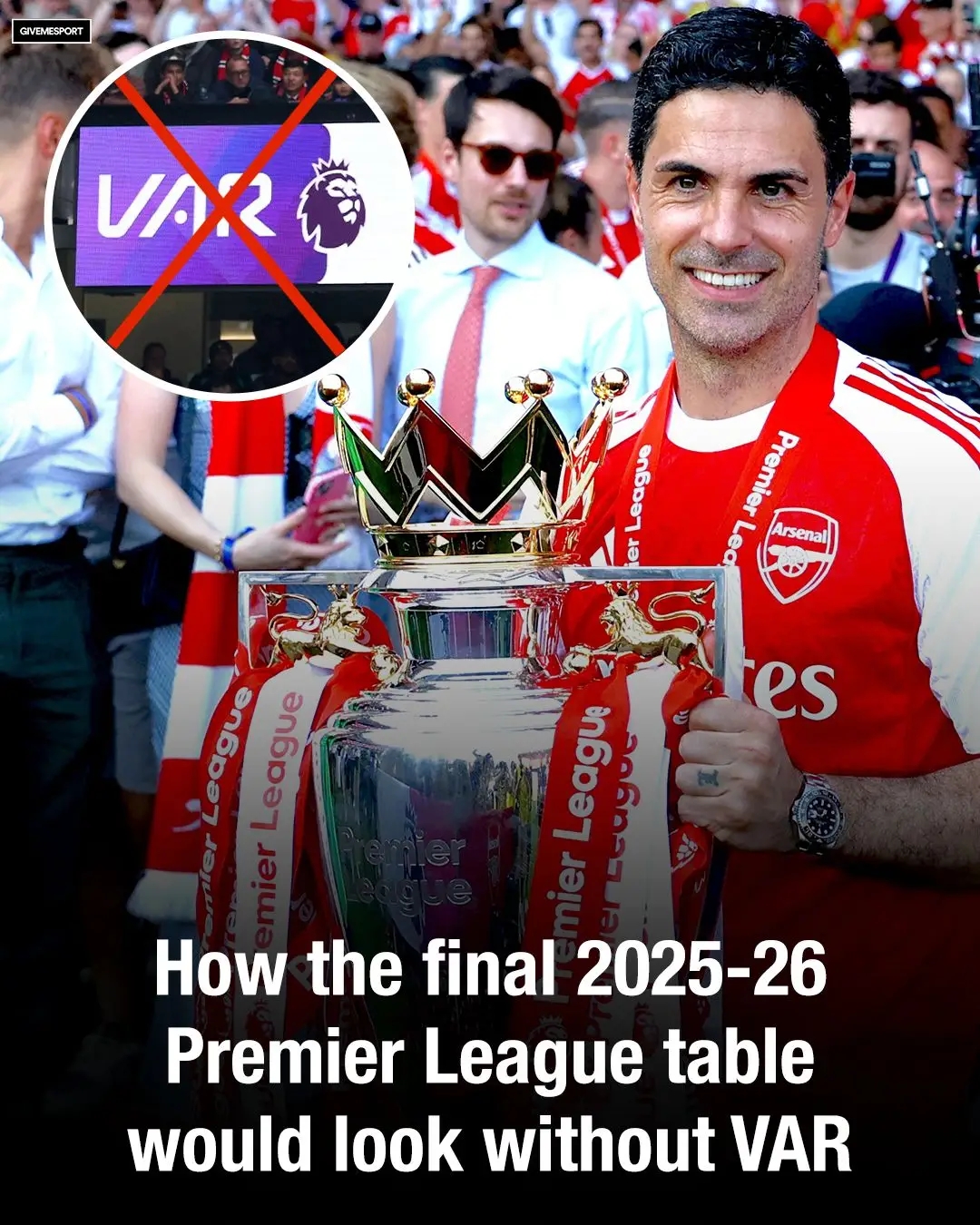
The 2025–26 Premier League season delivered drama, goals, surprises, and controversy right until the final whistle of the campaign. But as always in modern English football, one topic continued to dominate discussions more than anything else: VAR.
Since its introduction in the 2019–20 season, the Video Assistant Referee system has never stopped dividing opinion. For some, it represents progress, fairness, and technological accuracy. For others, it has ruined the emotional heartbeat of football.
And now, as the season ends, a new question has taken over football debate: what would the final Premier League table look like without VAR?
According to analysis published by data platform AceOdds, the answer is dramatic, controversial, and in some cases, completely transformative for several clubs across the league.
But before diving into the alternative table, it is important to understand the ongoing frustration surrounding VAR and why so many fans want it gone.
Across the country, supporters have consistently voiced their anger about the system. A major survey conducted by the Football Supporters’ Association revealed that a huge majority of fans are unhappy with how VAR is used in the Premier League.
Three-quarters of supporters said they are against VAR in its current form. Even more striking, 90% said it has not improved the matchday experience at all. An overwhelming 91% believe it has destroyed the natural joy of celebrating goals, while 94% said watching football on television is less enjoyable because of constant interruptions.
Football supporters argue that VAR has changed the rhythm of the game completely. Instead of instant emotion, fans now wait nervously for decisions that can take several minutes. Goals are no longer pure moments of celebration, but moments of uncertainty.
As FSA Premier League network manager Thomas Concannon explained, many fans believe the technology has removed spontaneity from football. Supporters feel that what made football special—the raw emotion of goals, refereeing decisions, and unpredictable drama—has been heavily affected.
Despite repeated adjustments to speed up decisions and improve accuracy, VAR remains one of the most controversial systems ever introduced into English football.
With that frustration still growing, analysts have now simulated what the 2025–26 Premier League table would look like if VAR did not exist at all.
The results are fascinating.
Across the league, some clubs gain points, others lose them, and several teams dramatically change position in the table. While the top of the table remains relatively stable, the mid-table and relegation battles look very different.
### The relegation battle without VAR
At the bottom of the alternative table, the impact of VAR becomes immediately clear. Small margins in football often decide survival, and without VAR, those margins shift dramatically.
Wolverhampton Wanderers would still finish bottom of the Premier League. Even though they would gain three extra points in a VAR-free season, it would not be enough to save them from relegation. Their struggles throughout the campaign would remain decisive regardless of technology.
Burnley F.C. would also still drop into the Championship. However, interestingly, they would actually benefit the most from VAR being removed, gaining five additional points. Even so, it would not be enough to lift them out of the relegation zone.
Perhaps the most significant change in the bottom three involves Nottingham Forest. In the real table, Forest managed to survive, but without VAR, their situation becomes far more dangerous. The data suggests they would lose six points in a VAR-free scenario, which would push them into 18th place and relegation territory.
This highlights just how crucial VAR decisions were for their survival. A handful of penalty calls, offside margins, or red card interventions ultimately made the difference between safety and relegation.
### Mid-table chaos and unexpected movement
The middle of the table shows even more dramatic shifts, with several clubs moving up and down depending on how VAR decisions are removed.
West Ham United remain in the Premier League comfortably, finishing 17th in both realities, although their points total remains unchanged at 39. They neither benefit nor suffer significantly, but their position highlights how tight the lower mid-table battle was.
Tottenham Hotspur are one of the biggest winners in the VAR-less table. In real life, Spurs endured a disappointing campaign, finishing 17th. Without VAR, however, they climb three places to 14th, gaining six extra points. This improvement suggests that several key decisions went against them during the season, potentially including disallowed goals or controversial penalties.
Crystal Palace, on the other hand, suffer a points deduction of five in the VAR-free version. That drop pushes them slightly lower in the table and highlights how VAR sometimes benefited them in tight matches.
Sunderland A.F.C. experience one of the most dramatic swings in points. They lose six points without VAR, which sends them tumbling down six positions. This shows how heavily their season may have been influenced by key VAR interventions at critical moments.
Newcastle United remain relatively stable, moving slightly but largely maintaining their position in the middle of the table. Their consistency across both versions of the table suggests fewer controversial VAR-related swings in their season.
Chelsea F.C. also drop slightly in the VAR-free version, losing a small number of points and finishing just inside the bottom half. While not a dramatic fall, it still reflects how fine margins influenced their season.
### The top half and Champions League race
The most interesting changes come in the battle for European qualification, where VAR decisions often have the biggest impact on high-stakes matches.
Everton F.C. are one of the biggest winners, climbing multiple places in the VAR-free table. They gain two points, which pushes them further up the table and significantly improves their final standing. Their rise highlights how important marginal VAR decisions were in tight matches throughout the season.
Brighton & Hove Albion also benefit strongly, gaining seven points in the absence of VAR. This makes them one of the standout overperformers in the alternative table and suggests that they were on the receiving end of several key VAR-related setbacks during the season.
Brentford F.C. and Fulham F.C. both experience minor movements, climbing or dropping slightly depending on decisions that VAR would normally influence.
Bournemouth F.C. also climb slightly in the VAR-free table, gaining valuable points that help improve their overall league position.
One of the most significant storylines in this section involves Liverpool F.C..
Without VAR, Liverpool would finish sixth in the Premier League. That would mean missing out on Champions League qualification, a major blow for a club of their stature. They lose five points in the VAR-free model, showing how tightly contested their season was and how crucial certain refereeing decisions proved to be.
This change alone highlights the massive impact VAR has on elite competition. A handful of marginal calls can decide Champions League football, financial rewards, and even transfer decisions for the following season.
### The title race stays tight at the top
At the very top of the table, the situation remains extremely close between the league’s biggest contenders.
Arsenal F.C. would still finish as champions in the VAR-free table, but their points total drops by five. They still manage to secure the title due to superior goal difference, proving just how tight the race is at the highest level.
Manchester City also experience a slight points increase in the absence of VAR, gaining two additional points. Despite this improvement, they still finish second, missing out on the title by the narrowest of margins.
Manchester United remain unchanged in both versions of the table, highlighting a season where VAR had minimal impact on their overall position and points total.
Aston Villa also remain consistent, although they lose two points in the VAR-free version. Despite that, they still secure a strong top-four finish, maintaining their Champions League qualification spot.
### What the data really shows
Looking at the full picture, the most important conclusion is not which clubs benefit or suffer the most, but how influential VAR has become across the entire league.
The system does not just affect one or two matches. It influences relegation battles, European qualification, mid-table positioning, and even title races.
A single overturned goal or penalty decision can change millions of pounds in revenue, shift club strategies, and alter the emotional outcome of entire seasons.
For supporters, this is exactly why VAR remains so controversial.
Many fans argue that football should be decided on the pitch in real time, not through long video reviews. Others believe that without VAR, too many clear errors would go uncorrected.
The debate is unlikely to end anytime soon.
### Conclusion
The simulated 2025–26 Premier League table without VAR paints a fascinating alternative reality. Some teams climb, others fall, and several clubs experience dramatic swings in fortune.
But the biggest takeaway is clear: VAR matters.
Whether fans love it or hate it, the technology now plays a major role in shaping the modern Premier League. It influences champions, relegated teams, and European qualifiers.
And as long as controversial decisions continue to happen, the question will remain the same every season:
Would football be better without VAR?
For now, there is no simple answer. But one thing is certain—football without VAR would look very different indeed.