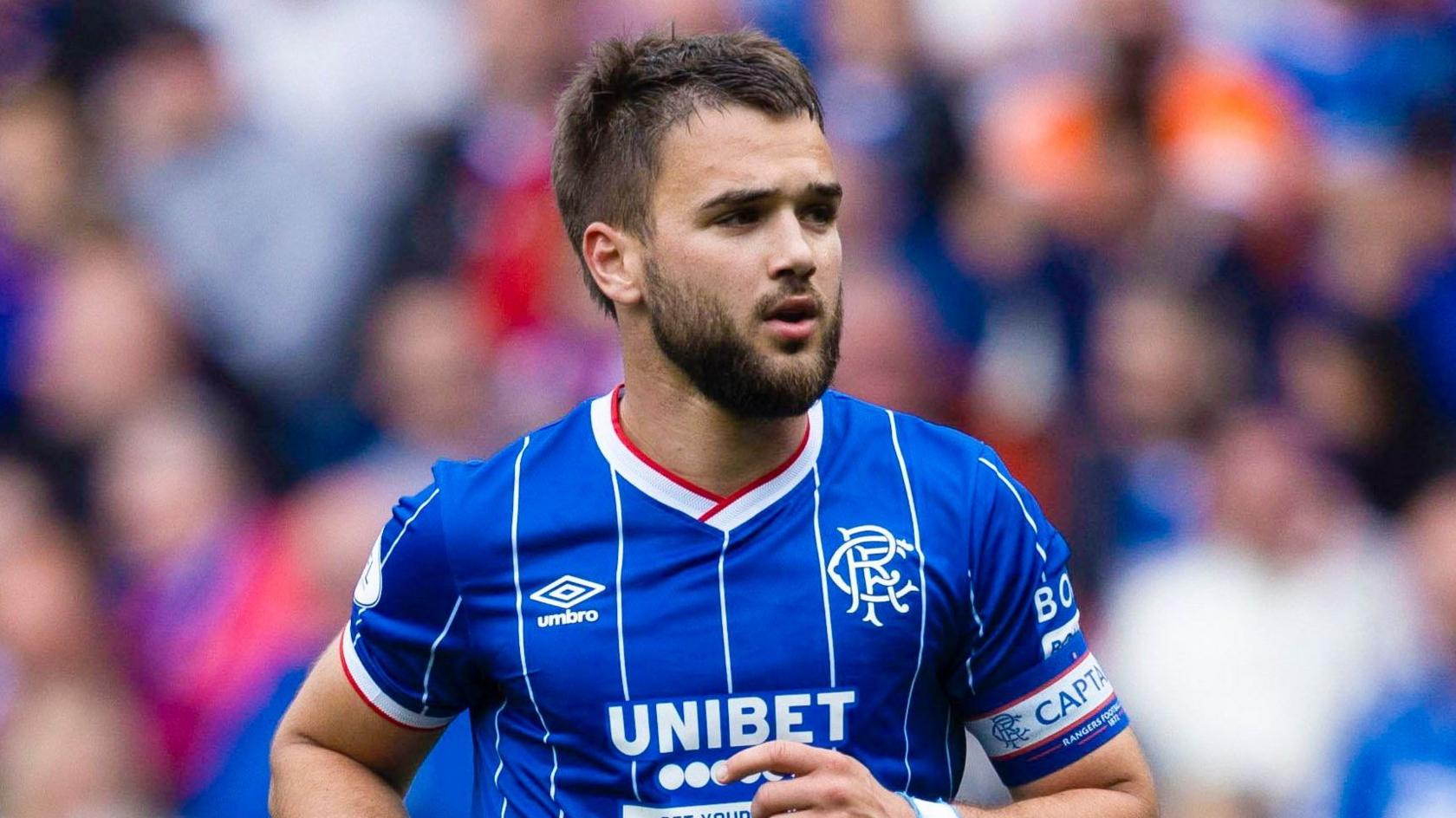
Nicolas Raskin’s summer was supposed to end with a farewell. Instead it ended with a shrug, a handful of rejected offers and a midfielder who now insists, through the usual channels of transfer reporting, that he is content to stay at Ibrox. The latest update, which circulated on Yahoo Sports under the headline about where he stands after a change of plans, is brief, but it sits on top of a much longer and more interesting story about ambition, valuation and the strange limbo that a good player enters when everybody expects him to leave and he does not.
To understand why this matters, it helps to remember how firmly the expectation had settled. Nobody truly expected Raskin to be a Rangers player by the end of the summer window, and even people high up at the club surely felt that, because large sums were being spent elsewhere, the money from his sale was likely in mind. That sentence captures something important about how modern clubs operate. Recruitment is rarely a series of isolated decisions. It is a chain, in which the sale of one player funds the purchase of another, and a player who is assumed to be leaving can find that his departure has already been spent. When the sale does not happen, the club is left with a gap in its finances and a player whose mind has already moved on.
Raskin’s mind, by his own account, had moved on. He told Belgian journalists during international duty that it was a bit of a disappointment because he had been mentally ready to leave. He found the uncertainty hard to handle, and said that on the bus to the stadium before the Falkirk game he still did not know whether he would stay at Rangers. There is something almost cinematic in that image, a professional footballer travelling to a match without knowing whether it would be among his last for the club. It is also a reminder of how little control players have over these moments. Whatever the player wants, the outcome depends on two clubs, a deadline and a price.
The reasons for the expected exit were not hard to find. Raskin is a Belgian international who arrived at Rangers in January 2023 from Standard Liège and has been, by the measure of most observers, one of the club’s most consistent performers since. He is described as one of Rangers’ highest-performing players since his arrival, and his form at the World Cup was expected to make an exit more likely. A good tournament is the best advertisement a midfielder can have, and for a player at a club outside the major leagues it tends to prompt a flurry of interest. That is what happened. Besiktas were heavily linked, and Bologna, Real Betis and Villarreal were also interested in signing the 25-year-old.
Interest, however, is not the same as a deal, and the gap between the two is where Rangers held their ground. Besiktas came the closest to securing his signature but could not match the valuation that Rangers placed on him. The club’s position was consistent: they had a price, they were prepared to wait for it and they were not going to be hurried by the calendar. A separate report indicated that Rangers rejected a loan offer ahead of the Scottish deadline, even after lowering their asking price. That detail is revealing. A club that is desperate to sell takes the loan, or accepts a lower fee, or both. A club that rejects a loan even after softening its demand is signalling that it values the player’s presence more than the marginal benefit of the cash.
There was also a Saudi dimension, which Raskin appears to have regarded with little enthusiasm. Al Ittihad showed interest while their window was still open, but Derek McInnes did not want to sell without being able to sign a replacement. That last clause says a good deal about the manager’s priorities. McInnes is working to a season in which Rangers have ambitions of challenging for the title, and weakening the midfield without a ready successor would have been a risk to those ambitions. The same report suggested that Raskin had no plans to join a Saudi club and was focused on earning a move to a major European league, with the Premier League believed to be his ultimate goal. That is consistent with the way he had been linked in the previous year, when Everton and Leeds were mentioned, and it gives a clear picture of the kind of destination he has in mind.
It is worth pausing on how unusual this combination is. A player who wants to leave, a club that is prepared to let him go for the right price, and several suitors who cannot or will not pay it. In many cases such a standoff ends badly. The player sulks, the manager leaves him out, the dressing room takes sides and the relationship deteriorates until a cut-price sale in January resolves things on terms nobody likes. There was some suggestion that Raskin’s situation came close to that pattern. One report says McInnes left him out of matchday squads at one point while the exit talk was at its loudest. I have not seen that detail confirmed by a second source, so it is best treated cautiously, but it is plausible that a manager facing a player with his head elsewhere would choose to rest him.
What happened next is the more interesting part. Instead of festering, the situation seems to have settled. Raskin was included in the starting eleven in each of Rangers’ next five matches across all competitions, and he confirmed that he was not angry about the failed move. He was careful in how he put it, speaking warmly of the club while leaving the door open to the future. He said that Rangers is a good club, that he is playing his matches and that the squad is a great one, doing great things. That is a diplomatic statement, and diplomacy of this kind is a skill. A player who says the right things while privately hoping for a move is behaving in a way that every club understands.
The football backed up the words. Raskin produced his best performance of the season so far in a 1-0 win over St Mirren. Earlier he had a starring role in the win against Falkirk, which was taken as evidence that he remained a key man for McInnes. There is a quiet logic in this. A player who has been denied a move has two options. He can let his frustration show in his performances, which damages his value and his reputation, or he can produce his best football, which protects both. The sensible choice is obvious, and Raskin appears to have made it.
The newest report goes a step further. According to Mark Hendy, writing for Football FanCast and cited by the Yahoo piece, Raskin is now happy at Ibrox and is not pushing for an exit. The phrase “change of plans” in the headline refers to exactly this shift, from a player who spent the summer expecting to go to one who now seems to have reconciled himself to staying, at least for the present. It is worth being careful with such claims. A player’s happiness is a hard thing for an outsider to measure, and transfer reporting has a habit of describing the mood of a footballer in terms that are convenient for whoever is doing the telling. But the available evidence does point in the same direction as the headline. He has been playing regularly, performing well and speaking constructively, and there is no public sign of a dispute.
There is also a sporting reason for contentment. Rangers are in a position that few predicted at the start of the season. Results have changed the mood around McInnes and placed the club in the title conversation. Raskin continues to be a key part of the club’s hopes of ending their latest wait for a Scottish Premiership title. For a player who has yet to win the league at Ibrox, that is a real incentive. A title would be a significant addition to a career, and it would do his reputation no harm when the next window opens. In that sense, staying and succeeding may be the best route to the move he wants.
That, it seems, is the thinking behind a reported understanding between the player and the club. Keith Wyness, speaking to Football Insider, suggested that Rangers have accepted that Raskin could leave next summer, provided that he remains committed during the current campaign. He believes private discussions may have helped settle the matter, giving the player clarity about what is expected of him this season. If that is accurate, it describes a sensible arrangement. The club gets a motivated player during a title challenge, and the player gets a clear path to a transfer at the end of it. If Raskin performs consistently, Rangers can protect his market value and enter next summer from a stronger negotiating position. Both sides benefit from the same behaviour, which is the best kind of arrangement.
The contract situation reinforces the logic. Raskin’s deal at Rangers runs until 2028. That means that by the time of the summer 2027 window he will have a single year left, which is the point at which a club’s negotiating power starts to decline, since a player with twelve months remaining can leave for nothing a year later. One report puts his estimated transfer value at around 9.3 million euros, and says he will have one year remaining when that window opens. That figure is an estimate from a data site and should not be treated as a firm valuation, but it gives a sense of the scale of money involved. Rangers will want to sell before the clock runs down, and Raskin will want to move before his own prime passes. The summer of 2027 therefore looks like the natural meeting point.
None of this means that January is entirely quiet. Multiple bids are reported to have been made for Raskin from teams across Europe, including Hull City, south of the border. That detail needs to be read with some care. It is not clear from the report when those bids were made, and it is possible that the reference is to the summer rather than to anything more recent, since the wording sits alongside the discussion of the earlier window. Hull’s interest, if real, would also sit oddly with his reported ambitions, because a move to the Championship is not obviously the step up that a player aiming for the Premier League would want, though the Championship does offer a route to it.
A more cautious reading of the January picture comes from reporting that no club is currently in talks with him. One outlet says that, as things stand, no club is in talks with the midfielder over a move, and that agreeing personal terms with him is one thing while dealing with Rangers is another. That sentence is shrewd. Many a transfer has foundered not on the player’s wishes but on the selling club’s reluctance, and Rangers have shown both the willingness and the ability to say no. The same report notes that the owners did not want to reduce the first-team options mid-season last January, and are unlikely to change their stance this time. If that holds, Raskin will not be actively shipped out, and an exit would require a bid too good to turn down.
There is a broader point here about how clubs of Rangers’ stature manage their best players. They sit in an awkward space between the elite and the rest. They can attract and develop players who are good enough to interest clubs in the major leagues, but they cannot always keep them when those clubs come calling. The usual solution is to sell at the right moment, ideally after a strong season and with a fee that justifies the loss. The risk is that a club which sells too readily becomes a stepping stone, and one that holds out too long ends up with an unhappy asset whose value falls. Rangers’ handling of Raskin has so far tried to avoid both traps. They refused to be rushed in the summer, and they appear to have agreed a route to an eventual sale that preserves his value.
Raskin’s own career offers some context for the choices he is making. He was born in Liège and came through the youth ranks in Belgium, returning to Standard Liège in 2019. He joined Rangers on 31 January 2023 on a long-term contract for an undisclosed fee. His progress since then has been steady rather than spectacular. He has made 160 appearances for the club in all competitions and scored 14 goals, which is a respectable return for a central midfielder. He earned his first senior Belgium call-up in March 2025, and his place in the national setup has become more secure since. For a player of his profile, the next step is a club where he can play in the biggest competitions, and that is the logic behind his ambition.
The same figures show a player who has become more productive as he has matured. He has scored in each of the last few seasons, with the best return coming in 2025-26, and his appearance numbers show a player who is rarely absent. That consistency is what attracts the interest of clubs looking for a reliable midfielder. It is less glamorous than the numbers of an attacker, but it is the kind of reliability that managers value, and it explains why Rangers were so reluctant to let him go for less than their price.
It would be easy to read the whole episode as a story about a frustrated player and a stubborn club, but a fairer reading is that both sides acted rationally. Raskin wanted a step up and was entitled to explore it. Rangers wanted a fair price and were entitled to demand one. The market, as it often does, failed to produce an agreement within the window, and the result was a compromise that suits both parties for the moment. That is not a dramatic outcome, but it is a perfectly reasonable one, and it is arguably the best result available.
There are risks, of course. A player who has been denied a move can become restless, particularly if his form dips or if a bigger club appears in January with a serious offer. Rangers will be aware that the harmony of the present could be disturbed by a single bid. They will also be aware that an unhappy Raskin is worth less than a happy one, and that the reported understanding about next summer is only as strong as the goodwill on both sides. If the title challenge fades, or if a manager changes, or if an offer arrives that is too good to refuse, the picture could change quickly.
There is also the question of replacement. A club that expects to lose a key midfielder next summer needs a plan for the succession, and that planning begins now. One report mentions Lewis Ferguson as a name who could be considered as a potential replacement. That is speculation, and it should be treated as such, but it illustrates the kind of thinking that a club must do. Selling a player is easy. Replacing him with someone of equal quality is the hard part, and a mistake at that stage can undo the benefit of a good sale.
From Raskin’s perspective, the next several months are an opportunity. A title win would give him something concrete to show for his time at Ibrox, and a run of strong performances would reinforce his value to potential buyers. His contentment, if it is real, is not a sign of lowered ambition. It is a recognition that the best route to a bigger move is through success where he is. A player who leaves a club in the middle of a title challenge, having agitated for the exit, risks a reputation as a mercenary. A player who helps the club to the title and departs on good terms leaves with his standing intact.
The wider lesson of the episode is about patience. Transfer windows create an artificial sense of urgency, as though a player’s career depends on a single deadline. In reality, careers are longer and more flexible than that. A move that does not happen in August can happen in January or the following summer, and the intervening months can be used to improve a player’s position. Raskin, who is only 25, has time. The failed summer exit, which felt like a setback at the time, may turn out to have been a pause that allowed him to strengthen his case.
It is also worth acknowledging how little we truly know. The reporting on this subject is a mixture of named journalists, anonymous sources and data estimates, and it is shaped by the commercial incentives of an industry that thrives on speculation. Different outlets give slightly different numbers for his appearances this season, one saying sixteen and another recording fifteen, a discrepancy that probably reflects the timing of the updates rather than any real disagreement. The claims about his happiness, about private understandings and about forthcoming bids are all reported at one remove. They may well be accurate, but they should be held loosely, and the safest conclusion is the modest one: that for now he is playing well, saying the right things and staying, and that the next decision point will come when the windows reopen.
Taken together, the picture is of a footballer who has handled an awkward situation with some maturity. He wanted to leave, was told he could not, admitted his disappointment honestly and then went back to work. That is more than can be said of many players in similar circumstances. Rangers, for their part, have shown that they can resist pressure and protect their interests while keeping a valued player engaged. If the title challenge continues and Raskin remains central to it, the outcome could be good for everyone: a trophy for the club, a platform for the player and a healthy fee at the end
For supporters, the sensible attitude is probably to enjoy him while he is there. Players of his quality do not stay forever at clubs in Rangers’ position, and the realistic expectation is that he will move on within the next year or so. The change of plans that the headline describes is not a promise to stay for good. It is a decision to make the most of the present, which is a more modest and perhaps more honest commitment. If it leads to a title, few will complain. If it leads to a lucrative sale next summer, the club will be able to say that it got the best of both worlds. And if something unexpected happens in January, there will be another headline, another update and another change of plans.