£3.18 BILLION vs £2.31 BILLION: The Wage War That Explains Everything About Manchester City and Arsenal

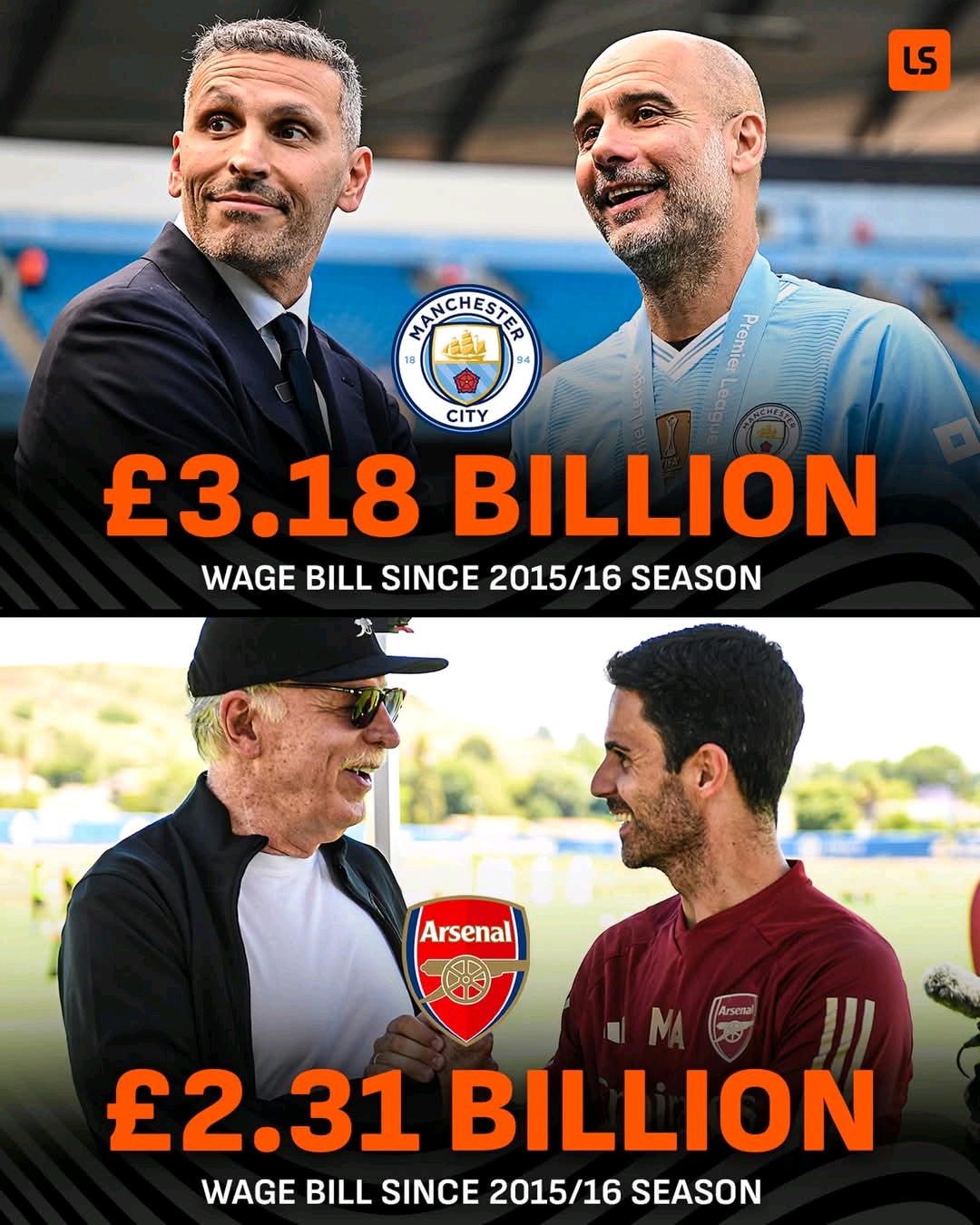
The image says it all. Two clubs. Two modern giants of English football. Two different financial paths. And one staggering comparison that has reignited one of the most heated debates in the Premier League era. Since the 2015/16 season, Manchester City have reportedly spent £3.18 billion on wages. In the same period, Arsenal have spent £2.31 billion. Nearly a billion pounds separates them. That gap is not just a number. It is a story about dominance, ambition, recruitment, pressure, expectations, and the price of sustained success at the highest level of football.
When you look at Manchester City over the past decade, you are looking at a machine built for relentless excellence. League titles, domestic cups, European glory, record-breaking points totals, historic trebles. This level of consistency does not happen by accident. It is engineered. It is funded. It is maintained through elite recruitment and elite retention. Wages are the fuel that keeps a super-squad intact. To keep world-class players in their prime, to extend contracts, to fend off interest from Europe’s biggest clubs, you must pay at the very top of the market. That is the reality of modern football.
Pep Guardiola’s era has defined this spending cycle. When you demand tactical intelligence, technical brilliance, and mental perfection every single week, you need players capable of delivering it. And players capable of delivering it command elite salaries. Manchester City did not just build a starting eleven. They built depth. Two players for every position. International stars sitting on the bench. Rotation without weakening the system. That depth costs money. Serious money.
Now look at Arsenal’s £2.31 billion figure. On its own, it is enormous. It represents ambition, investment, and years of rebuilding. Arsenal have not been passive participants in the financial race. They have spent heavily, especially in recent seasons, to close the competitive gap. But the difference between £3.18 billion and £2.31 billion reflects different phases in their journeys.
From 2015 onwards, Arsenal were navigating the end of one era and the start of another. The latter years under Arsène Wenger were marked by transition. Then came managerial changes, restructuring behind the scenes, and a squad overhaul that required patience. Wages were spent, yes, but not always with the ruthless precision seen at Manchester City. There were contracts that did not deliver value. There were players who arrived with promise but left without impact. Rebuilding costs money, but mistakes cost even more.
The contrast sharpens when you examine outcomes. Manchester City transformed wage spending into silverware at a relentless rate. Arsenal, until recently, were rebuilding identity, culture, and belief. Only in the past few seasons under Mikel Arteta has the wage investment begun to translate into a genuine title challenge. The trajectory has shifted. Arsenal are no longer content with top-four finishes. They are pushing for the crown.
But the billion-pound question remains: does spending nearly £1 billion more on wages guarantee dominance? It certainly increases your probability. Higher wages attract elite players. Elite players win decisive matches. Decisive matches win titles. Yet football is not a spreadsheet. It is not a simple equation of pounds equals trophies. It requires leadership, tactical brilliance, chemistry, timing, and sometimes fortune.
Manchester City’s wage structure has been part of a wider ecosystem. Recruitment aligned with philosophy. Youth integration through a world-class academy. Strategic signings at the right moment. When they needed a defensive leader, they invested. When they needed a clinical striker, they acted. The wage bill rose, but so did the trophy count.
For Arsenal, the narrative is evolving. The £2.31 billion figure represents lessons learned. It includes years of recalibration. Under Arteta, the club has shifted toward a younger, hungry core. Long-term contracts for players entering their prime. A blend of academy graduates and carefully targeted signings. Arsenal’s wage bill today is structured differently than it was five or six years ago. It is more aligned with performance and potential.
Critics argue that the gap in wage spending is evidence of structural imbalance in English football. Supporters of Manchester City counter that smart investment, not just big investment, is what matters. Both perspectives hold weight. Financial power opens doors. But strategic clarity determines what you do once inside.
The Premier League has become a financial arms race. Global broadcasting deals, commercial partnerships, international fanbases. Clubs operate as global brands. Wage bills reflect that reality. They are not simply expenses. They are statements of intent. Manchester City’s £3.18 billion says one thing clearly: we will do whatever it takes to remain at the summit. Arsenal’s £2.31 billion says: we are coming back, and we are building for sustained competition.
The image comparison reignites emotional debates among fans. Some see it as justification for City’s dominance. Others see it as proof that Arsenal are closing the gap despite spending less. Social media thrives on such contrasts. Numbers become weapons in arguments. But beneath the noise lies a deeper truth about modern football economics.
Sustained excellence is expensive. Keeping a squad motivated after multiple titles requires rewards. Renewing contracts before rivals circle requires proactive spending. Depth to compete on multiple fronts requires financial muscle. Manchester City’s wage bill is the cost of maintaining a dynasty.
Arsenal’s journey is different but equally compelling. After years outside the title conversation, they have re-emerged as genuine contenders. Their wage investment is now tied to a long-term project rather than short-term fixes. The results are visible in their style, intensity, and belief.
What makes this comparison fascinating is timing. Since 2015/16, City have dominated domestically. Arsenal are only recently challenging again. The financial gap partly explains that timeline. City built early momentum and never let go. Arsenal are accelerating, attempting to close a distance measured not only in points but in pounds.
Yet football history shows that cycles change. Spending patterns shift. Young squads mature. Financial gaps narrow or widen depending on strategy and success. The £870 million difference between these two wage bills is significant, but it does not guarantee future outcomes. It tells a story of the past decade. The next chapter is still being written.
Fans often reduce debates to simple claims: “They bought success” versus “We did more with less.” Reality is more complex. Manchester City invested heavily, yes. But they also built a footballing philosophy that maximized that investment. Arsenal spent billions too. The difference lies in timing, efficiency, and continuity.
The viral nature of this comparison stems from rivalry. Manchester City and Arsenal have clashed at the summit of English football in recent seasons. Title races decided by fine margins. Tactical battles between Guardiola and Arteta. Former mentor versus former apprentice. The wage bill graphic adds another layer to that rivalry. It quantifies the gap that Arsenal are attempting to overcome.
In the end, numbers do not lift trophies. Players do. Coaches do. Moments do. But numbers shape the environment in which those moments occur. A larger wage bill increases depth. Depth sustains performance across a grueling season. Sustained performance leads to championships.
The image of £3.18 billion versus £2.31 billion is not just financial data. It is a symbol of two strategies converging at the top of English football. One club defending its throne through sustained heavy investment. Another rebuilding carefully, strategically, and now daring to challenge again.
As the Premier League evolves, wage bills will continue to rise. Inflation, competition, global revenue growth. Today’s billions may look modest in a decade. What will remain constant is the debate about value, fairness, and competitive balance.
Manchester City’s spending has delivered an era of dominance. Arsenal’s spending is fueling a resurgence. The gap between them has defined the last decade. Whether it defines the next one is the question that will keep fans arguing, analyzing, and watching every single match with intensity.
Because in modern football, money talks. But it does not tell the whole story.