There is a moment in almost every great football partnership where the professional relationship becomes something deeper — where manager and player stop being simply colleagues and become something closer to collaborators, two people who understand each other so instinctively that communication happens on a level that goes beyond tactics boards and training ground instructions.
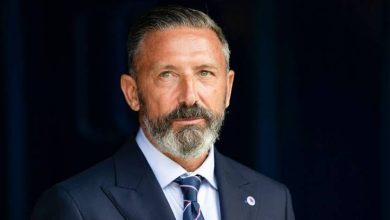
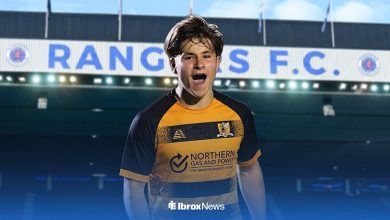
For Derek McInnes and Lawrence Shankland, that moment happened somewhere in the middle of the 2025–26 Scottish Premiership season, on a training pitch in Edinburgh, in the middle of a title race that came closer to ending Celtic’s dominance than anything Scottish football had produced in years. And now, as the summer of 2026 unfolds and a new Rangers era takes shape at Ibrox, the story of that partnership — and of the text message that signalled its continuation — is one that deserves to be told in full.
Because the message Shankland sent McInnes over the summer, with its deliberate vagueness, its knowing wink, and its unanswered promise of something significant to come, captures something essential about what this transfer means and what this relationship represents. And McInnes’s decision not to answer it — to maintain the mystery, to let the situation develop at its own pace, to keep his cards close while everything around him was catching fire — reveals a manager who is as comfortable with the human dynamics of football as he is with the tactical ones.
This is not just a story about a transfer. It is a story about trust, about timing, and about the kind of manager-player bond that can change the course of a football season.
Derek McInnes had just returned from the first week of his summer holiday when things started moving quickly. The Rangers job had been offered. The decision had been made. The details were being finalised. And somewhere in the middle of all of that — while the first week of rest was giving way to the chaos that would define the following weeks — his phone buzzed.
It was Lawrence Shankland.
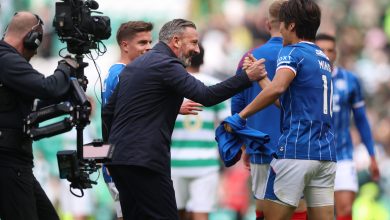
McInnes revealed the exchange with the kind of understated amusement of a man recounting a moment he clearly enjoyed. His striker — who had worn the captain’s armband under McInnes at Hearts last season, who had been the focal point of their title challenge, and whose future at Tynecastle had been the subject of intense summer speculation — had put two and two together and come up with a message that managed to be simultaneously innocent and loaded with meaning.
“He sent me a couple of messages over the summer,” McInnes revealed. “I was keeping in touch with him about the World Cup and his involvement. Then he sent me a wee message saying: ‘I’ll maybe see you in a couple of weeks…’ with a couple of wee eyes. And I never answered that… but we’ve since spoken.”
The winking emoji. The deliberately vague timeline. The plausible deniability of “maybe.” Shankland knew exactly what he was saying, and McInnes knew exactly what Shankland was saying, and both of them were wise enough not to put anything more explicit into writing while the details of one of the summer’s most significant managerial appointments were still being finalised.
It is a small detail in the grand scheme of a summer that has seen Rangers hire a new manager, complete multiple signings, and begin the most ambitious rebuild of their squad in years. But it tells you something important about the dynamic between these two men — the easy familiarity, the shared understanding, and the mutual trust that will underpin everything Rangers try to achieve in the season ahead.
To understand why the Shankland-McInnes reunion at Ibrox matters so much, you need to understand the history that runs beneath it — a relationship that goes back years and has produced some of the best football of both men’s careers.
McInnes first signed Shankland when the striker was a young player at Aberdeen — a signing that reflected the manager’s eye for talent and his ability to identify players whose best days were still ahead of them. That first professional relationship planted the seed of a partnership that would blossom years later in Edinburgh and is now about to reach its fullest expression at Ibrox.
When McInnes arrived at Hearts ahead of the 2025–26 season, he inherited a squad that contained one of the most naturally gifted goalscorers in Scottish football — a striker who had already proven his quality over multiple seasons but who had endured a difficult campaign the previous year, weighed down by responsibility and let down by the players around him.
McInnes saw what Shankland needed before he even joined the club properly. “I used to watch him doing interviews and I could see the weight of responsibility on him, that burden,” the Rangers manager recalled. “And I thought that was unfair on him. He was the only player at Hearts expected to score goals. I thought he needed a bit of help.”
That insight — the recognition that a goalscorer’s form is not simply about technique or fitness but about the environment in which they operate and the support structure that surrounds them — speaks to a managerial intelligence that goes far beyond reading a spreadsheet of statistics. McInnes understood Shankland as a person, understood what was weighing on him, and knew exactly what kind of environment would unlock the best of a striker who had been carrying too much alone.
The results, when McInnes and Shankland finally worked together, were extraordinary. “A few seasons ago under Naisy, I thought Lawrence was brilliant,” McInnes said, referencing Steven Naismith’s early tenure as Hearts manager. “The season where he shouldered so much responsibility at Hearts, he was the only one who was really scoring regularly. Then the season before I arrived, it wasn’t quite so good for him.”
Under McInnes at Hearts last season, Shankland thrived. Goals came regularly. The weight that had been visible in those interview clips lifted. And Hearts, built around their captain’s goals and leadership but supported by a team that took collective responsibility for scoring, pushed Celtic all the way to the final day of the season in one of the most compelling title races Scottish football had produced in years.
There is an element of poetic justice in how the Shankland signing at Rangers actually came about — a contractual detail that turned a potential source of frustration into a remarkable piece of transfer fortune.
When Shankland signed his contract extension at Hearts, a clause was included that allowed him to leave for a set fee — or potentially for nothing under specific circumstances. When Rangers triggered that clause this summer, it meant one of Scottish football’s most prolific strikers arrived at Ibrox for free. Not a penny in transfer fees. A player who would have cost significant money in any normal transfer market, available on terms that made the deal almost too good to be true.
McInnes was philosophical about the circumstances when asked to reflect on losing his captain at Hearts only to inherit him at his new club. “It was disappointing at the time, as the Hearts manager,” he admitted. “But equally now it’s a nice little present to turn up to.”
That ability to find the positive in every situation — to take what could have been a story of losing a player and reframe it as a story of gaining one — is characteristic of a manager who maintains perspective and keeps his focus on the opportunities rather than the obstacles. And in this case, the opportunity is genuinely extraordinary.
Shankland at Ibrox, for free, under a manager who understands him completely and has already demonstrated the ability to get thirty goals or more from him in a single season. In the context of Rangers’ rebuild, that is not just a good signing. It is potentially a transformative one.
James Tavernier spent eleven years at Rangers. He was not just a right-back or a captain — he was an institution, the embodiment of a particular era at the club, a player whose consistency and commitment over more than a decade gave the entire squad a reference point for what it means to represent Rangers at the highest level.
His departure leaves a captaincy vacancy that McInnes has been refreshingly honest about — he has not yet decided who will succeed Tavernier, and he is not pretending to have made that decision.
“I think, just similar to what I had at Hearts, Lawrence was the captain but I had a lot of key captains within that,” McInnes said when the captaincy question was raised. “I would like the dressing room to have as many of those types as possible. But there are no conversations, discussions or any real thoughts yet. I’ve not given it too much thought at the minute.”
The honesty in that response is telling. A manager who has just arrived at a club, who is in the middle of a busy transfer window, who has a squad that is still taking shape — the last thing he needs is to make a premature captaincy decision that he might want to revisit once he has had the chance to assess his players properly in a pre-season environment.
But the subtext of everything McInnes has said about Shankland suggests that the striker remains the frontrunner for the armband if the manager does decide to carry the Hearts captaincy arrangement over to Ibrox. The language McInnes uses about his striker — “brilliant captain,” “gravitas,” “how the other players looked up to him” — is the language of a manager describing a leader, not just a goalscorer.
Jack Butland and John Souttar have both worn the armband at various points in recent Rangers history, and both remain senior figures in the dressing room whose leadership qualities McInnes will want to harness. But Shankland, as the most experienced player in the current group who has worked directly and recently under McInnes’s management, has a natural claim on the captaincy that the others cannot quite match.
“Someone needs to take the team down the tunnel,” McInnes acknowledged. “But Monday to Friday, I need as many captains on the training pitch as possible.”
That final sentence is the key one. McInnes is not looking for a captain who wears the armband and leaves the leadership to the badge. He is looking for a dressing room full of leaders — players who demand standards of themselves and their teammates every single day, who push each other in training, who create the culture that winning football clubs require. Shankland has always been that kind of player. And bringing that mentality to Ibrox, into a dressing room that needs a new identity under a new manager, could prove just as important as any goal he scores.
It would be easy to reduce Lawrence Shankland to a set of statistics — goals scored, games played, conversion rates, expected goals figures. And the statistics are genuinely impressive, because Shankland is one of the most reliable goalscorers in Scottish football history at this level.
But McInnes has consistently spoken about Shankland in terms that go beyond the numbers, and that broader assessment of what the striker contributes deserves to be taken seriously.
“When he turned up for the pre-season work in Spain, he walked in and I could see how he was with the players,” McInnes recalled from last summer. “The confidence, the maturity, how he trained, how he behaved, what he demanded. How the other players looked up to him was really quite telling for me.”
A striker who walks into a pre-season camp and immediately commands the respect and attention of his teammates is a rare thing. Most players — even experienced professionals — take weeks to establish themselves in a new environment. Shankland, clearly, does not work that way. His presence is felt immediately, his standards are established quickly, and the players around him respond to that energy in a way that lifts the entire group.
That quality — the ability to raise the standards of those around you simply by being present and being yourself — is what separates good footballers from great leaders. And it is exactly what Rangers need in the coming season, as a new manager attempts to reshape a dressing room culture and instil the collective belief necessary to mount a genuine title challenge.
“I think it’s important that you don’t put too much pressure on any player,” McInnes added. “But Lawrence is a proven goalscorer at the Premiership level and he should be someone who will put targets on himself and meet them in a Rangers shirt.”
That balance — setting high expectations while avoiding the kind of crushing burden that damaged Shankland’s form in the season before McInnes arrived at Hearts — is the fine line that the Rangers manager will need to walk. He has already done it once. The evidence suggests he can do it again.
McInnes’s own assessment of Shankland’s potential at Rangers is quietly staggering. “He missed three months,” the manager noted when reflecting on last season. “For me, if he hadn’t been injured for those three months, he would have got his 30 goals and arguably been the Player of the Season.”
Thirty goals. In a season disrupted by three months of absence. At a club that has access to better players, a bigger budget, and a larger squad than Hearts. The implication is clear — in McInnes’s mind, Shankland at Rangers, fully fit, properly supported, and playing in a team built to maximise his qualities, is capable of reaching scoring heights that would make him one of the most prolific strikers in Scottish football’s recent history.
The remaining pieces of the summer rebuild — Ross McCrorie at right-back, Ben Godfrey in central defence, Cammy Devlin potentially adding steel in midfield, and possibly Lewis Ferguson bringing creativity from central midfield — are all being assembled with the understanding that they need to serve Shankland as well as serve the team. A striker of his profile needs service. He needs runners around him, wide players who can deliver crosses, midfielders who can find him with forward passes in dangerous areas.
McInnes has done this before. He knows exactly how to build a team around a striker who scores prolifically — and he knows exactly how this particular striker works, what he needs, and what he is capable of producing when everything is right.
The text message with the winking emoji was a small, private moment in a summer full of big, public ones. But it captures something essential about what Rangers are building — a partnership between a manager and a striker who understand each other completely, who trust each other completely, and who are now being given the biggest possible stage on which to demonstrate what they can achieve together.
The reunion is complete. The season is coming. And at Ibrox, the combination of McInnes and Shankland is about to find out exactly how good it can be.