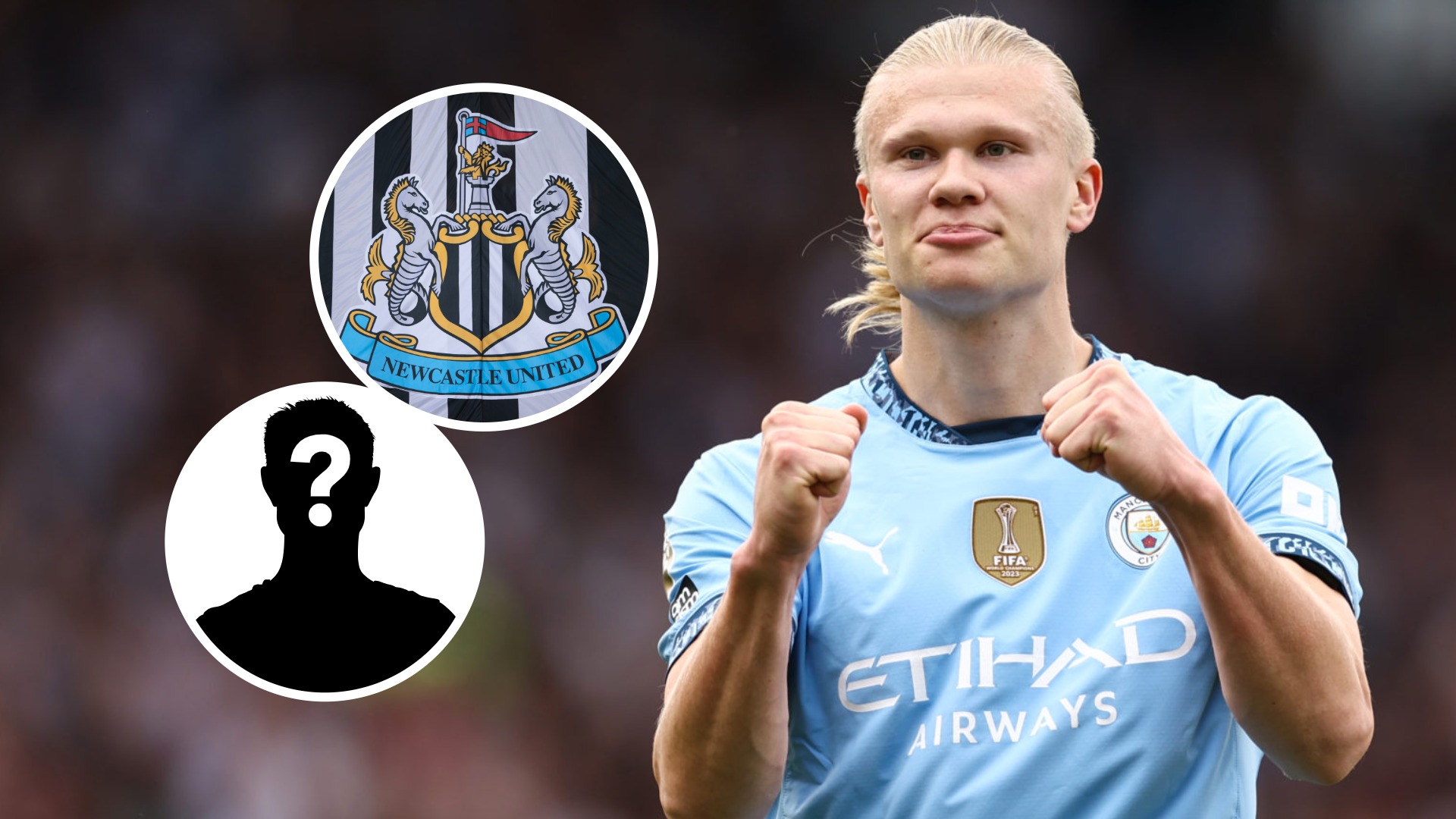
The tension inside the Etihad Stadium on February 21, 2026, was the kind that only a Premier League title race can generate. Manchester City were chasing consistency, momentum, and ultimately the league crown. Newcastle United arrived with their usual blend of physical dominance and attacking pace, determined to disrupt the reigning champions’ rhythm. By the final whistle, City had secured a hard-fought 2-1 victory, but the match left behind more than just three points. It sparked controversy, ignited tempers, and prompted a pointed five-word message from Erling Haaland aimed squarely at Newcastle defender Dan Burn.
The clash between Haaland and Burn became one of the defining narratives of the evening. From the opening minutes, it was clear that Burn’s assignment was to disrupt the Norwegian striker’s influence. Haaland, known primarily for his ruthless finishing, found himself in a battle that was less about delicate movement and more about raw strength. Burn leaned into him, tugged at shirts, contested every aerial ball, and refused to give him even a yard of space. It was an old-school defensive display against one of the modern game’s most lethal forwards.
Burn’s aggressive approach earned him a yellow card early in the contest, setting the stage for a delicate balancing act. Every subsequent challenge carried risk. Yet the towering defender managed to walk that tightrope for the remainder of the match, committing three fouls in total but avoiding a second booking. His physicality frustrated Haaland repeatedly, and at one point the City striker needed to be restrained after tempers flared following a particularly forceful grapple.
The moment encapsulated the intensity of the encounter. Haaland, typically ice-cold in front of goal, showed flashes of irritation. Burn had managed to do what few defenders consistently achieve: get under his skin. The Newcastle defender’s strategy was clear — prevent Haaland from building rhythm, deny him the clean runs into the box, and make every touch uncomfortable.
Yet football matches are rarely defined by a single duel. Despite Burn’s efforts, City found ways to prevail. The champions demonstrated patience in possession, probing Newcastle’s defensive lines and exploiting moments of disorganization. Haaland, even when unable to score, remained central to City’s attacking patterns. His movement dragged defenders away, his hold-up play created passing lanes, and his presence alone demanded constant attention.
The controversy, however, extended beyond the physical battle. Newcastle felt aggrieved by several officiating decisions. One flashpoint involved Haaland’s arm catching defender Malick Thiaw in the face during an aerial challenge. Appeals for further punishment were dismissed, with officials concluding that the striker had not used his arm as a weapon. The decision did little to soothe Newcastle’s frustrations.
From their perspective, the officiating inconsistencies compounded an already challenging evening. Burn himself experienced a bruising night. On one set piece, he managed to power a header into the net only to see the assistant’s flag raised for offside. In another incident, he was struck in the chest during a forceful challenge from Bernardo Silva, who had already been cautioned. Newcastle supporters believed a second yellow could have been justified. Instead, play continued, fueling the sense that the Magpies were on the wrong side of marginal calls.
Newcastle manager Eddie Howe addressed the refereeing decisions carefully after the match. He stopped short of direct condemnation but admitted that his side did not seem to benefit from key calls. Howe’s measured tone reflected his broader managerial philosophy — competitive yet composed. Still, the subtext was unmistakable: Newcastle believed the officiating had influenced the game’s momentum.
On the other side, Pep Guardiola praised Newcastle’s resilience and physical attributes. Guardiola described them as an “incredible team,” highlighting their speed up front and strength in midfield. He acknowledged the difficulty of beating them three consecutive times and hinted at the looming challenge of facing them again in the FA Cup. His comments carried genuine respect, underscoring the competitive evolution of Newcastle under Howe’s leadership.
But it was Haaland’s reaction after the final whistle that dominated headlines. Taking to social media platform X, he posted an image of Burn tugging at his shirt. The caption read simply: “Another day in the office.” Five words, understated yet loaded with meaning. The message suggested resilience, perhaps even amusement. For Haaland, grappling with defenders is routine. Physical marking, shirt-pulling, and constant jostling are part of the job description.
The phrase carried a subtle edge. It implied that Burn’s tactics, while persistent, were nothing extraordinary. To Haaland, it was just business as usual. The post quickly circulated among fans, igniting debate across social media. Some praised the striker’s composure and wit. Others viewed it as a dig at Burn, a reminder that despite the defender’s efforts, City had emerged victorious.
The psychology of elite sport often unfolds in these micro-moments. A social media post can amplify a rivalry, extend a contest beyond the pitch, and fuel anticipation for the next encounter. Haaland’s five words did precisely that. They added a narrative layer to what was already a fiercely contested match.
From a tactical standpoint, the duel between Haaland and Burn illustrated contrasting philosophies. Burn relied on proximity and disruption. Haaland adapted by drifting wider, dropping deeper, and occasionally switching flanks to evade close marking. Even without scoring, he influenced the flow of play. Modern center-forwards are increasingly judged not solely on goals but on overall contribution — pressing, link-up play, defensive set-piece coverage.
Guardiola has often spoken about the evolution of Haaland’s game. While his goal-scoring record remains extraordinary, performances like this highlight his expanding skill set. Drawing defenders out of position created opportunities for teammates. Occupying Burn centrally opened channels for overlapping runs. The physical duel became a strategic chess match.
For Newcastle, Burn’s display was emblematic of their fighting spirit. They refused to be intimidated at the Etihad. Their defensive organization, combined with direct transitions, kept City cautious. Even in defeat, they demonstrated why they remain one of the league’s most formidable sides.
The broader implications of the result were significant. City’s victory kept pressure on their title rivals, reinforcing the fine margins that define championship races. Each point carries amplified importance in the latter stages of the season. Momentum can swing dramatically based on single matches, and this win provided both confidence and continuity.
For Newcastle, the defeat was frustrating but instructive. Competing toe-to-toe with City reinforced their credentials as genuine contenders. Addressing moments of indiscipline and capitalizing on scoring opportunities could prove decisive in future high-stakes encounters.
The match also reignited discussions about officiating standards in the Premier League. Physical contests are inherent to English football, yet consistency remains the benchmark supporters crave. Determining intent, particularly in aerial challenges, is notoriously subjective. The decision not to penalize Haaland more severely for the arm-to-face incident divided opinion. Such controversies are unlikely to disappear, especially when title ambitions are involved.
Haaland’s social media message, however, ensured the spotlight lingered on the personal duel. Rivalries thrive on narrative continuity. The next meeting between these sides will inevitably reference this encounter — the grappling, the yellow card, the viral post. Football’s drama extends beyond ninety minutes; it lives in memory and anticipation.
In many ways, the episode underscored Haaland’s mentality. Elite strikers must embrace physical confrontation without losing focus. They are targeted relentlessly, often double-marked, and scrutinized for every reaction. By framing the experience as routine — “Another day in the office” — Haaland projected resilience. He suggested that adversity fuels rather than unsettles him.
Burn, meanwhile, demonstrated the value of disciplined aggression. Walking the line after an early booking requires composure. While he could not prevent City’s victory, he limited Haaland’s direct impact on the scoreboard. For defenders, such moral victories carry weight, even if they remain unofficial.
As the 2025/2026 campaign progresses, moments like these accumulate significance. Title races are not decided solely by tactical diagrams or statistical models. They hinge on mindset, psychological edges, and the ability to thrive amid controversy. City’s triumph over Newcastle was as much about endurance as elegance.
Guardiola’s admiration for Newcastle reflects an awareness of evolving competition. The Premier League’s intensity continues to escalate. Physical prowess, tactical adaptability, and emotional intelligence intersect weekly. This match embodied those elements.
Ultimately, the story of the evening can be distilled into duality: confrontation and composure. On the pitch, Haaland and Burn collided repeatedly, each testing the other’s limits. Off it, a succinct social media post extended the narrative arc. Five words encapsulated a battle that statistics alone cannot capture.
Football thrives on these layers — athletic contest, managerial nuance, officiating debate, and digital discourse. Manchester City secured three points, Newcastle departed with frustration, and supporters were left dissecting every frame of the confrontation.
When the two sides meet again, the memory of shirt tugs, yellow cards, and viral captions will linger. Haaland’s message may have been brief, but its resonance endures. In elite football, even the simplest statements can echo loudly.
And so, what began as another Premier League fixture evolved into a study of rivalry, resilience, and reputation. Manchester City marched forward in pursuit of silverware. Newcastle regrouped, their competitive fire undiminished. Between them stood a striker and a defender locked in combat, reminding everyone that in the Premier League, every duel tells a story — and sometimes, five words are enough to keep it alive.