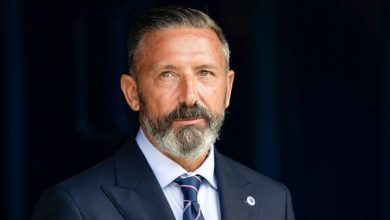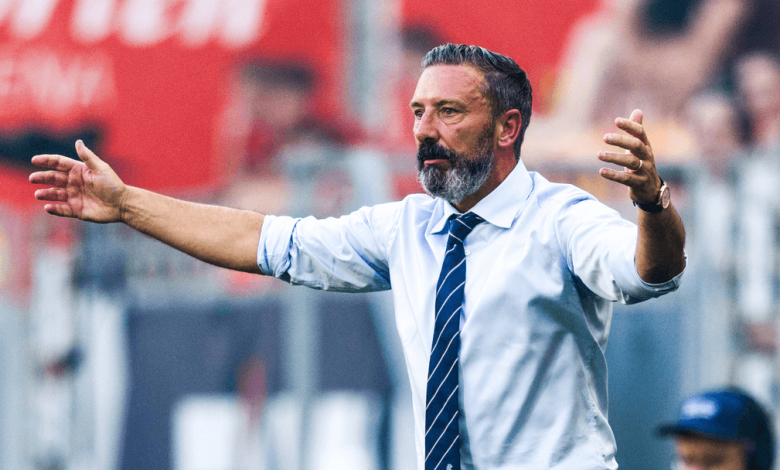
Derek McInnes is still waiting for his first win as Rangers manager after a 2-1 home defeat to Hibernian on Sunday 9 August 2026 — a result compounded by a serious injury to star striker Youssef Chermiti and overshadowed by a contentious VAR-awarded penalty. The defeat has generated a wave of online commentary, much of it far more damning than the facts of the match actually support. Before drawing conclusions, it’s worth separating what’s verified from what’s been invented or exaggerated elsewhere.
Rangers have now gone three competitive matches without a win under McInnes: a 1-1 draw away to Dundee United on the opening weekend, a 2-1 Europa League qualifying defeat away to Jagiellonia Białystok, and Sunday’s loss to Hibernian. That leaves Rangers with one point from two Premiership games, five points behind Celtic, who have played the same number of matches
Hibernian’s win — their first Premiership victory of the season — came via a first-half Josh Campbell penalty, after referee Don Robertson was sent to the pitch-side monitor by VAR and reversed his initial call, ruling that Rangers’ Vanja Dragojević had fouled Jason Kerr at a corner. Rangers hit back through a Miguel Chaiwa header from a Djeidi Gassama cross with the game deep into its closing stages, only for substitute Callum Wright to snatch a stoppage-time winner for Hibs.
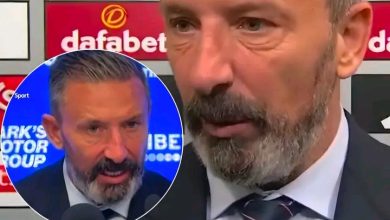
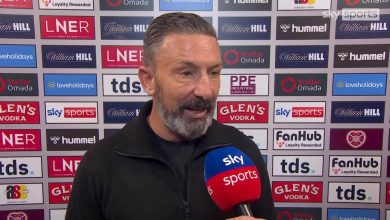
McInnes did not simply “blame the referee and move on,” as some coverage has implied. Speaking afterwards, he was fairly candid about his side’s shortcomings, conceding Rangers had been “a wee bit pedestrian” and “reluctant to try to break lines,” while praising Hibernian boss David Gray for setting his team up well defensively. His full quote ran: “I didn’t think we were brilliant, but I do think a lot of things transpired against us… I know people will say it’s a lot worse than what it was, but the outcome isn’t great, and we get that; we accept that.”
He did maintain that Rangers were “the better team” over the 90 minutes and called the penalty “harsh,” but this sat alongside — not instead of — an acknowledgment of his side’s flaws. He also referenced the frustration Rangers supporters have carried through “15 years” without sustained success, framing his side’s slow start within that broader context rather than using it as an excuse
One area where the real story is significantly worse than some early coverage suggested: Chermiti’s injury. He was stretchered off in the first half after a collision near the touchline and left the stadium in a boot and knee brace. McInnes said in his immediate post-match comments that he was hoping for “some luck on the scan,” but a subsequent club statement confirmed Chermiti had suffered an ACL injury and would be “out of action for a significant period of time” — in practice, likely most or all of the remainder of the season. This is a genuinely serious blow for Rangers, not a minor knock, and it followed the club rejecting a reported £22 million bid from Galatasaray for the player only hours before kick-off. Chairman Andrew Cavenagh has since said Rangers have no regrets about that decision or about starting Chermiti in the game
The VAR intervention has been the most contentious element of the match, and it’s a legitimate subject of debate — but not because it single-handedly proves Rangers’ “defensive organisation” collapsed, as some analysis has claimed. The dispute, as raised by Rangers chief executive Jim Gillespie at the club’s shareholder meeting the following morning, centres on whether Robertson’s original no-penalty call met the “clear and obvious error” threshold required for VAR to recommend a review at all, not on whether contact occurred. Gillespie said the club was “baffled” by the decision and had already contacted the SFA’s head of referees, Willie Collum, to seek an explanation Claims that don’t hold up
A number of specific claims circulating about this match — including a widely shared analysis piece — don’t check out against verified reporting:
There is no evidence Rangers played a “4-3-3” with a deliberate Dragojević-over-Diomande selection dispute driving the penalty. No mainstream source describes the formation in these terms, and there’s no reporting of McInnes facing internal criticism for that specific selection call.
Claims of a debutant central defender (“Olwethu Makhanya”) being directly exposed for the goals are not corroborated by match reports from Sky Sports, the Scotsman, or Hibs-focused outlets covering the same fixture.
There is no credible report of an SPFL-ordered replay of this match. Separate claims to that effect, circulating on low-quality sports sites, do not appear anywhere in Scottish football’s mainstream press or in any SPFL or SFA statement.
These kinds of specific, confident-sounding details are a common feature of low-effort or AI-generated sports content: they read as plausible tactical analysis but don’t correspond to anything actually reported by journalists who covered the match
What is verifiably true: Rangers are winless in three games, sit five points off the pace early in the season, have lost their first-choice striker to a long-term injury, and are embroiled in a genuine, ongoing dispute with the SFA over VAR standards — a dispute that predates this incident and involves a separate, unresolved row over a touchline ban imposed on McInnes for comments made in his previous job at Hearts. Chairman Cavenagh has also told shareholders he expects three to five further signings before the transfer window closes, with the defence understood to be a priority area, alongside a move already advanced for PSV winger Couhaib Driouech.
Three winless matches into a new managerial reign is a small sample, and it’s reasonable for supporters and pundits to have concerns about the start McInnes has made. But those concerns are better served by sticking to what’s actually known — a difficult opening schedule, a major injury absence, a contested penalty and a manager who has been reasonably self-critical in his public comments — than by attributing invented tactical specifics or a formation-by-formation “crisis” narrative that isn’t supported by the reporting on this match.