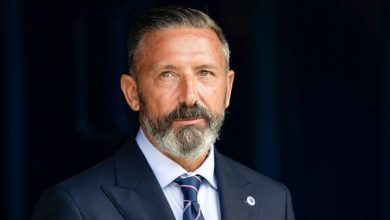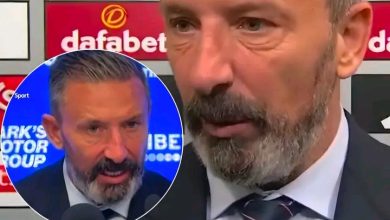
Managerial honeymoons are supposed to buy a little patience. Derek McInnes has not been afforded much of one. Excluding brief caretaker spells, no permanent Rangers manager has begun a tenure as poorly as McInnes has over his first four competitive matches. That is not a subjective take from a disgruntled fan on a phone-in — it is simply where the results sit after a Europa League exit that has now pushed the club into a Conference League play-off against the Czech side Jablonec.
The manner of the exit stings as much as the outcome. A 1-1 draw at Ibrox on the night was not enough to overturn a first-leg deficit against Jagiellonia Białystok, a Polish side that few inside Ibrox would have expected to be discussing as continental conquerors of Rangers before a ball was kicked. The aggregate scoreline finished 3-2 in the visitors’ favour, and long before the final whistle sounded, sizeable pockets of the home support had already begun the walk back to the car parks and train stations around Edmiston Drive — a visible, unmistakable verdict delivered with their feet rather than their voices.
It is worth pausing on the historical echo here, because it is not a flattering one for the current regime. This time last season, Russell Martin took charge of Rangers and endured a similarly faltering opening, one from which he never really recovered before being dismissed in early October. The parallel will not be lost on anyone inside the marble halls at Ibrox, nor on the section of the support already wondering aloud whether history is repeating itself with unnerving speed. McInnes was appointed, in part, because he was seen as the safe, known quantity — a manager who had engineered a genuinely impressive would-be title challenge at Hearts the previous season, dragging Celtic into a fight that few had predicted. Rangers hoped some of that momentum, and crucially some of that squad chemistry, could be transplanted to Glasgow. Four games in, the early signs suggest transplantation is proving far more complicated than anticipated.
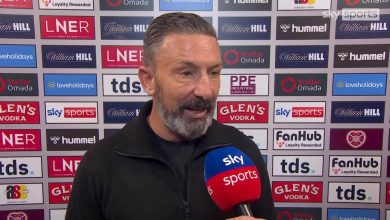
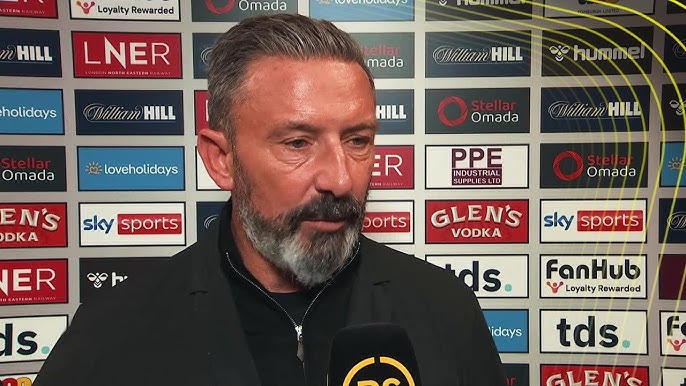
To his credit, McInnes has not hidden behind vague platitudes in the aftermath of the Jagiellonia defeat. His assessment has been unusually blunt for a manager barely a month into the job. He has openly acknowledged that despite a summer outlay running into the millions across nine incoming signings, the group he has assembled simply is not yet good enough for the level of competition Rangers are being asked to compete at. It is a striking admission — the sort of thing many managers would only say behind closed doors, if at all, for fear of undermining a fragile dressing room or handing ammunition to critics.
His central point is that Ibrox as an institution — the resources, the expectation, the size of the fixture list across domestic and European competition — is built for sustained participation in the Champions League and Europa League, but that the players currently available to him are not yet capable of meeting that standard consistently. He was equally candid in placing this current malaise within a longer arc, tracing it back to the underwhelming manner in which last season petered out under previous management, when Rangers finished third in the Premiership — a position he himself has characterised as unacceptable for a club of Rangers’s stature and history.
There is also a tactical honesty in how he has spoken about his team’s inability to sustain performance levels across a full ninety minutes. This has become something of a recurring theme, not just for this Rangers side under McInnes but seemingly inherited from the tail end of the previous regime. Matches in which promising periods of control and territorial dominance are followed by alarming collapses in structure, discipline, and composure. When pressed on whether the crowd’s audible frustration — the boos that rang out at full time — were justified, McInnes did not attempt to shield his players or himself from that judgement. He conceded the second-half performance simply did not meet the standard required, and that while there have been passages of genuinely encouraging football across the opening month, none of the four fixtures so far have produced anything close to a complete, sustained ninety-minute display.
The tactical story of the Jagiellonia second leg deserves closer scrutiny, because it illustrates a pattern that will worry Rangers supporters more than the raw result itself. McInnes made a half-time-adjacent decision to withdraw Norwegian midfielder Thelo Aasgaard in favour of the more defensively oriented full-back Ross McCrorie, simultaneously shifting the team’s shape from a back three to a flat back four. The stated logic, according to McInnes himself, was twofold: he felt Aasgaard was not receiving the ball often enough in dangerous areas, and he believed a change of structure would free up his wide players — presumably hoping for quicker, more direct combinations down the channels — to get more involved higher up the pitch.
It is a defensible piece of in-game reasoning on paper. Teams do sometimes need to sacrifice a nominal creative presence in central areas in order to generate width and overloads elsewhere. But football management is ultimately judged on outcomes, and by that measure the change backfired badly. Former Rangers midfielder Andy Halliday, speaking in the aftermath on BBC Radio Scotland’s Sportsound programme, offered a pointed but fair critique: the theory behind the switch made logical sense in isolation, but in practice it simply did not work. His sharper observation was that the players most directly affected by the reshuffle — wide forwards Djeidi Gassama and Daisuke Yokota — had actually been receiving the ball in advanced, threatening positions relatively frequently during the first half, undercutting the very premise that prompted the change. Removing the extra body in central midfield, in Halliday’s reading, did not solve a service problem so much as it created a control problem, leaving Rangers unable to dictate tempo or retain possession in the periods that mattered most.
This is the kind of detail that tends to compound managerial pressure quickly. It is one thing to lose a continental tie to a well-drilled, well-organised opponent. It is another to lose control of a match through a self-inflicted tactical adjustment that, by the analysis of respected former players, solved a problem that did not clearly exist while creating one that did.
Timing has not been kind to McInnes. Just as Rangers absorbed the Jagiellonia defeat, news broke that striker Youssef Chermiti would be sidelined for what has been described as a significant period with a knee injury — a considerable blow given the 22-year-old’s importance to the attacking line, and made doubly frustrating by the fact that Rangers had only recently turned down a substantial transfer offer for the player. Losing a frontline striker to long-term injury immediately after rejecting serious transfer interest in him is the sort of cruel footballing irony that tends to compound a difficult week into a genuinely alarming one.
The upshot is that Rangers now find themselves needing to recruit a replacement centre-forward in addition to the wingers and defensive reinforcements McInnes had already identified as priorities before the window closes. The club, by his own account, is working hard to bring in what he has termed the “necessary type of players,” with PSV Eindhoven’s Moroccan winger Couhaib Driouech reportedly close to becoming the next name added to an already lengthy list of summer arrivals — nine new faces have already walked through the door at Ibrox this summer, a startling number for a squad that, on the evidence of four matches, still looks unbalanced and short of cohesion.
Halliday’s assessment of the squad’s construction has been particularly cutting. He has suggested that a club with Rangers’s transfer budget and squad-planning resources simply should not find itself this imbalanced so deep into the transfer window, and has been specific about what he believes is still required: as many as three recognised centre-halves, a genuine left-back, and two or arguably three wide players capable of performing at a European standard. Yet Halliday was careful to note that this is not solely a resourcing problem — he pointed out that the players already available to McInnes ought to have been sufficient to navigate a run of matches against Dundee United, Hibernian, and Jagiellonia Białystok without controversy. In his view, the underlying quality is there in patches; what is missing is the consistency, cohesion, and composure to turn that quality into results.
Few storylines around this Rangers reboot carried more intrigue heading into the season than the reunion between McInnes and Lawrence Shankland, the Scotland international striker whose partnership with the manager at Hearts had produced a title race that genuinely troubled Celtic. The hope inside Ibrox was obvious: replicate that chemistry, hand Shankland the captaincy, and use the pairing as the emotional and tactical spine of the rebuild.
Four games in, that plan is being tested in ways few would have predicted. Former Rangers striker Steven Thompson has been among the more sympathetic observers of Shankland’s early struggles, framing them not as a talent problem but as an adjustment problem — the particular, suffocating weight of representing a club with Rangers’s history and expectation, layered on top of the pressure of captaincy and the frustration of a stumbling start. Thompson’s argument is essentially psychological: at previous clubs, an underhit pass or a heavy touch might draw a few groans from supporters and be quickly forgotten. At Ibrox, under the current climate, every misplaced pass and hesitant decision is amplified, scrutinised, and remembered. Thompson has been careful to frame this as a mental adjustment rather than anything physical or technical — Shankland, in his view, simply needs time to recalibrate to a fanbase and a stage that reacts differently to imperfection than anything he has previously experienced in his career.
That framing matters, because it speaks to a broader leadership vacuum some observers believe is emerging around the captaincy itself. Halliday has gone considerably further than Thompson on this point, using the current uncertainty to make a provocative recruitment suggestion: that Rangers should move immediately to re-sign 34-year-old former captain James Tavernier, who has remained a free agent since his release from the club this past summer. It is, by Halliday’s own admission, not going to be a popular suggestion among a fanbase eager to move forward rather than back. But his reasoning centres on exactly the qualities he feels are currently absent from the group — the ability to perform under intense scrutiny without retreating from responsibility, a willingness to make mistakes in full view of a demanding crowd without being visibly rattled by them, and a track record of never hiding from pressure across a long Ibrox career. For Halliday, the current talk of building a “new leadership group” and cultivating fresh characters within the dressing room misses the point somewhat — true leadership, in his assessment, is demonstrated precisely in moments like Thursday night, and it is that specific quality Tavernier embodied more consistently than anyone else who has wo the armband recently.
Whether Rangers actually entertain such a reunion remains to be seen, and there are obvious footballing and financial reasons why re-signing a released 34-year-old might not fit neatly into a squad rebuild aimed at freshness and modernisation. But the fact that a respected former player is publicly floating the idea, barely weeks into a new managerial era, is itself a signal of how unsettled the mood around the captaincy and the wider dressing room has become.
Perhaps the most revealing barometer of where things currently stand is not the media analysis but the raw, unfiltered reaction of supporters themselves. The range of sentiment is wide, but the overall temperature is unmistakably hot.
At one end sit those who have already run out of patience entirely, arguing that McInnes has done nothing in his opening month to suggest he is capable of arresting Rangers’s decline, and that continuing with the current appointment risks compounding an already damaging summer with a wasted season. Some supporters have pointed to the scale of summer investment as an aggravating factor rather than a mitigating one — the logic being that spending heavily and still producing performances this underwhelming is arguably worse than treading water with a threadbare squad, because it suggests deeper structural or tactical issues rather than simply a lack of resources.
At the other end, there remains a more measured, patience-oriented contingent urging calm. Their argument rests on context: look at the players genuinely available, they say, and ask honestly whether any manager could be expected to produce polished, dominant performances this early into a squad rebuild featuring nine new faces still bedding in. This group tends to view four matches as an almost meaninglessly small sample size from which to draw sweeping conclusions about a manager’s suitability, and argues that time — the very commodity increasingly in short supply at Ibrox historically — is exactly what McInnes deserves before judgement is passed.
In between sit those simply exhausted by the pattern rather than any single result — supporters pointing out, with a mixture of dark humour and genuine frustration, that they cannot recall a single match under McInnes so far in which the team has not been jeered off the pitch by full time. Others have reached for historical comparison as their preferred shorthand for decline, with some drawing an unflattering line back to the Mark Warburton era in the Scottish Championship, suggesting the current side’s lack of cohesion and fight would struggle even against that vintage of Rangers side — a deliberately provocative comparison, but one that captures the depth of anxiety currently swirling around the club
Where does this leave Rangers and McInnes? In practical terms, the Conference League play-off against Jablonec now represents an unplanned but unavoidable opportunity to arrest the slide and offer supporters something resembling reassurance before domestic business resumes in earnest. European qualification failures have a habit of shaping narratives around Scottish clubs disproportionately, both financially and psychologically, and Rangers will be acutely aware that a further stumble against Czech opposition would deepen a crisis that, four games in, is already being discussed in historically unflattering terms.
The transfer business still to be concluded — headlined by the expected arrival of Driouech, and the still-unresolved search for a striking option in the wake of Chermiti’s injury — will matter enormously in shaping the next chapter. So too will McInnes’s own willingness to adapt tactically after a first real setback, rather than doubling down on approaches that, by the analysis of respected former players, are not yet delivering control or consistency.
What is clear is that the goodwill generated by his successful spell at Hearts, and by the reunion with Shankland that many hoped would recreate lightning in a bottle, has already been tested more severely and more quickly than anyone at Ibrox would have wanted. Scottish football’s history is littered with managers who arrived with genuine credibility and momentum only to find that the particular pressures of Ibrox operate on a different scale entirely. Whether McInnes proves an exception to that pattern, or simply the latest name added to it, may become clearer in the coming weeks — but for now, the early verdict from both pundits and supporters alike is that this rebuild has begun in considerably rockier fashion than anyone at the club would have hoped.