Min-Su Must Return: Predicted Rangers Lineup To Face Celtic In The League Cup


Rangers host bitter rivals Celtic at Ibrox on Sunday afternoon in the quarter-final of the Scottish League Cup, and with a full house of home support roaring them on in a stadium free of any away fans, Derek McInnes has a genuine opportunity to use the atmosphere as a weapon. The draw has been kind to Rangers in terms of home advantage, but the visitors arrive at Ibrox as reigning Scottish champions in outstanding form, meaning McInnes cannot afford to get his selection wrong if his side are to book a place in the last four of the competition.
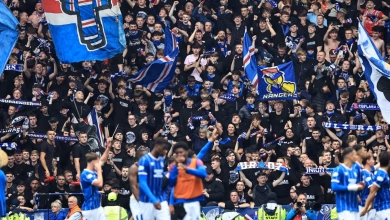
This weekend’s quarter-final comes with an unusual backdrop. Following the ugly scenes that marred the clubs’ Scottish Cup meeting back in March, when fans clashed on the pitch after Celtic’s penalty-shootout win at Ibrox, this weekend’s tie will be played without a single away supporter inside the stadium. That decision, applied to all Old Firm fixtures this season, could work in Rangers’ favour: a stadium packed exclusively with home fans should generate an intensely hostile atmosphere for Celtic to try and silence, and McInnes will hope his players can feed off that energy from the first whistle.
On the pitch, the story of the season so far has been one of contrasting trajectories that have gradually converged. Celtic have been irresistible domestically, riding an emphatic winning run through the opening weeks of the campaign and looking every bit the form side in Scottish football. Rangers, by contrast, endured a difficult start under new manager Derek McInnes before finding their feet, and they head into Sunday on the back of a run of good results that has restored some belief around Ibrox. Even so, with the champions boasting greater strength in depth and quality across the pitch, most observers still rate Celtic as favourites on paper. That makes it all the more important for McInnes to get his approach right and ensure his side capitalise on home advantage rather than being overrun by a Celtic side full of confidence.
In goal, Ivor Pandur looks certain to continue, having brought a welcome sense of calm and stability to the Rangers backline. The Croatian has conceded just once across Rangers’ recent run of four straight victories, a record that reflects both his own improving form and a defence that has become increasingly difficult to break down. That solidity will be tested severely on Sunday given the attacking talent Celtic possess in the final third, but Pandur’s recent performances suggest he is well equipped to handle the occasion.
Rangers’ back line for Sunday looks set to be shaped heavily by the absentees at full-back. With Kosta Nedeljkovic sidelined by a foot problem and Tuur Rommens missing through a groin issue, McInnes is left short of natural options in the wide defensive positions. Dujon Sterling looks the man best placed to retain his place on the right-hand side ahead of Ross McCrorie, while on the opposite flank James Penrice remains the only recognised out-and-out left-back available for selection, making his inclusion something close to a formality regardless of recent form.
Through the middle, Rangers appear to have found a pairing that offers a measure of composure and reliability that had been missing earlier in the season. Olwethu Makhanya and Manny Fernandez look set to continue as the central defensive partnership, a duo that has helped stabilise a backline previously prone to costly errors. Their form leaves versatile defender Ben Godfrey continuing to compete for a starting spot rather than being guaranteed one, underlining just how much competition for places has increased at the back as Rangers’ form has improved
In the centre of the pitch, Nicolas Raskin looks set to continue as the side’s deep-lying playmaker, dictating tempo from a slightly withdrawn position. With transfer speculation surrounding the Belgian, including reported interest from Besiktas, having settled down at least until the winter window, Raskin should be able to focus fully on his football, and his importance to how Rangers build attacks from deep makes him one of the first names on the team sheet.
Alongside him, Dan Neil looks the man best equipped to complete a double pivot in central midfield, edging out alternatives such as Vanja Dragojevic, Cammy Devlin and Tochi Chukwuani on account of his well-rounded contribution both in and out of possession. That pairing of Raskin and Neil offers a blend of composure and energy that should help Rangers control the tempo of the game against a Celtic side capable of dominating possession if given too much time on the ball.
Perhaps the most significant selection call facing McInnes concerns the makeup of his attacking midfield unit, and specifically the inclusion of Kim Min-Su. With Daisuke Yokota ruled out for months after undergoing groin surgery, and Badredine Bouanani having impressed with his direct dribbling and end product down the right-hand side since arriving on deadline day, the shape of the front line is largely set on one flank. Djeidi Gassama, too, appears to have nailed down his place on the opposite side, giving Rangers a settled look in the wide areas of an attacking midfield three.
That leaves the number 10 role as the key decision. Min-Su, primarily a left-winger by trade, has impressed when deployed centrally in a more advanced playmaking role, showcasing a level of creative spark that Rangers have missed since he was left out for the win over St Mirren. With his degree of quality in the final third, the case for restoring him to the side for such an important fixture looks strong, and McInnes may well feel that Sunday’s derby, with its need for craft and invention against a well-organised Celtic defence, is exactly the stage on which Min-Su should be
Up front, Rangers find themselves in the unusual position of having strength in depth in attack despite losing two of their most potent forwards to injury. Both Lawrence Shankland and Youssef Chermiti remain sidelined, the former with a serious hamstring tear and the latter following ACL surgery, robbing McInnes of his first-choice striking options. Even so, Rangers retain three recognised centre-forwards capable of leading the line, a testament to the depth built into the squad over the summer.
Kevin Kelsy was given the nod to start in midweek, but he could make way this weekend for the more versatile Ryan Naderi, who has recently operated effectively in a deeper, quasi-number 10 role and set up a crucial goal for substitute Bojan Miovski in the closing stages of the win over St Mirren. Miovski himself has built a reputation as an effective option from the bench, having scored a dramatic late winner in that same fixture, and he could once again be viewed as a “super sub” option to bring on if Rangers need a fresh spark later in the game. The presence of three credible options in the middle of the attack gives McInnes genuine flexibility over how he wants to approach the game, whether that means starting with a more physical presence to occupy Celtic’s central defenders or opting for a forward better suited to combination play with those around
Based on current form, fitness and the balance of the squad, the Rangers side to face Celtic on Sunday is likely to line up as follows: Ivor Pandur in goal; a back four of Dujon Sterling, Olwethu Makhanya, Manny Fernandez and James Penrice; a central midfield pairing of Nicolas Raskin and Dan Neil; an attacking trio of Badredine Bouanani, Kim Min-Su and Djeidi Gassama just behind the front man; and one of Ryan Naderi, Kevin Kelsy or Bojan Miovski leading the line as the central striker.
That shape reflects both the practical reality of Rangers’ current injury list and the tactical qualities McInnes will want to call upon against a Celtic side capable of dominating spells of the game through possession. With genuine width and directness on both flanks in Bouanani and Gassama, control through the centre of the pitch via Raskin and Neil, and a rejuvenated creative outlet in Min-Su, Rangers have the tools to trouble Celtic’s defence if the team performs to its potential
Beyond the individual selection calls, Sunday’s quarter-final represents a significant early test of how far Rangers have progressed under McInnes since his difficult start to the campaign. Facing the champions at home, with the backing of a full and exclusively partisan Ibrox crowd, offers Rangers a real chance to make a statement, both in terms of their prospects in the League Cup and in the context of the wider Old Firm rivalry this season. Given the quality Celtic possess in every area of the pitch, McInnes’s side will need to be at their organised, disciplined best defensively while making the most of the attacking talent available to them, particularly if Min-Su is indeed restored to provide the creative spark that has been missing at times this season.
For Celtic, the visit to Ibrox comes at a point when they are enjoying one of their best runs of form in years, and their strength in depth means they will arrive full of confidence regardless of the hostile atmosphere they are likely to encounter. That contrast, between a Celtic side sweeping aside domestic opposition and a Rangers team still rebuilding its own identity and confidence under a new manager, is what makes Sunday’s tie such a compelling watch. Whichever side manages its selection headaches more effectively, and whichever set of players rises to the occasion in front of a raucous home support, is likely to have the edge in what promises to be another tightly contested chapter in one of football’s fiercest rivalries.
As kick-off approaches, several sub-plots will be worth following closely. The first is simply whether McInnes does indeed restore Min-Su to the side, given how directly that decision could shape Rangers’ ability to create chances against a well-drilled Celtic defence. The second is which of Rangers’ three recognised strikers gets the nod to lead the line, a decision that could hinge as much on how McInnes wants to approach the game tactically as on recent goalscoring form. And the third is how Rangers’ makeshift full-back pairing of Sterling and Penrice cope against a Celtic attack renowned for stretching defences in wide areas.
With so much still to be decided in terms of team selection, and with the added intensity that always accompanies an Old Firm fixture, Sunday’s clash promises to be a fascinating watch. Rangers have the platform, in terms of home advantage and an increasingly settled starting shape, to make life difficult for Celtic. Whether McInnes’s men can convert that platform into a place in the last four of the League Cup will depend on getting these selection calls right, and on producing a performance to match t# Min-Su Must Return: Predicted Rangers Lineup To Face Celtic In The League Cup
Rangers host bitter rivals Celtic at Ibrox on Sunday afternoon in the quarter-final of the Scottish League Cup, and with a full house of home support roaring them on in a stadium free of any away fans, Derek McInnes has a genuine opportunity to use the atmosphere as a weapon. The draw has been kind to Rangers in terms of home advantage, but the visitors arrive at Ibrox as reigning Scottish champions in outstanding form, meaning McInnes cannot afford to get his selection wrong if his side are to book a place in the last four of the competition.
This weekend’s quarter-final comes with an unusual backdrop. Following the ugly scenes that marred the clubs’ Scottish Cup meeting back in March, when fans clashed on the pitch after Celtic’s penalty-shootout win at Ibrox, this weekend’s tie will be played without a single away supporter inside the stadium. That decision, applied to all Old Firm fixtures this season, could work in Rangers’ favour: a stadium packed exclusively with home fans should generate an intensely hostile atmosphere for Celtic to try and silence, and McInnes will hope his players can feed off that energy from the first whistle.
On the pitch, the story of the season so far has been one of contrasting trajectories that have gradually converged. Celtic have been irresistible domestically, riding an emphatic winning run through the opening weeks of the campaign and looking every bit the form side in Scottish football. Rangers, by contrast, endured a difficult start under new manager Derek McInnes before finding their feet, and they head into Sunday on the back of a run of good results that has restored some belief around Ibrox. Even so, with the champions boasting greater strength in depth and quality across the pitch, most observers still rate Celtic as favourites on paper. That makes it all the more important for McInnes to get his approach right and ensure his side capitalise on home advantage rather than being overrun by a Celtic side full of confidence.
In goal, Ivor Pandur looks certain to continue, having brought a welcome sense of calm and stability to the Rangers backline. The Croatian has conceded just once across Rangers’ recent run of four straight victories, a record that reflects both his own improving form and a defence that has become increasingly difficult to break down. That solidity will be tested severely on Sunday given the attacking talent Celtic possess in the final third, but Pandur’s recent performances suggest he is well equipped to handle the occasion.
Rangers’ back line for Sunday looks set to be shaped heavily by the absentees at full-back. With Kosta Nedeljkovic sidelined by a foot problem and Tuur Rommens missing through a groin issue, McInnes is left short of natural options in the wide defensive positions. Dujon Sterling looks the man best placed to retain his place on the right-hand side ahead of Ross McCrorie, while on the opposite flank James Penrice remains the only recognised out-and-out left-back available for selection, making his inclusion something close to a formality regardless of recent form.
Through the middle, Rangers appear to have found a pairing that offers a measure of composure and reliability that had been missing earlier in the season. Olwethu Makhanya and Manny Fernandez look set to continue as the central defensive partnership, a duo that has helped stabilise a backline previously prone to costly errors. Their form leaves versatile defender Ben Godfrey continuing to compete for a starting spot rather than being guaranteed one, underlining just how much competition for places has increased at the back as Rangers’ form has improved.
In the centre of the pitch, Nicolas Raskin looks set to continue as the side’s deep-lying playmaker, dictating tempo from a slightly withdrawn position. With transfer speculation surrounding the Belgian, including reported interest from Besiktas, having settled down at least until the winter window, Raskin should be able to focus fully on his football, and his importance to how Rangers build attacks from deep makes him one of the first names on the team sheet.
Alongside him, Dan Neil looks the man best equipped to complete a double pivot in central midfield, edging out alternatives such as Vanja Dragojevic, Cammy Devlin and Tochi Chukwuani on account of his well-rounded contribution both in and out of possession. That pairing of Raskin and Neil offers a blend of composure and energy that should help Rangers control the tempo of the game against a Celtic side capable of dominating possession if given too much time on the ball.
Perhaps the most significant selection call facing McInnes concerns the makeup of his attacking midfield unit, and specifically the inclusion of Kim Min-Su. With Daisuke Yokota ruled out for months after undergoing groin surgery, and Badredine Bouanani having impressed with his direct dribbling and end product down the right-hand side since arriving on deadline day, the shape of the front line is largely set on one flank. Djeidi Gassama, too, appears to have nailed down his place on the opposite side, giving Rangers a settled look in the wide areas of an attacking midfield three.
That leaves the number 10 role as the key decision. Min-Su, primarily a left-winger by trade, has impressed when deployed centrally in a more advanced playmaking role, showcasing a level of creative spark that Rangers have missed since he was left out for the win over St Mirren. With his degree of quality in the final third, the case for restoring him to the side for such an important fixture looks strong, and McInnes may well feel that Sunday’s derby, with its need for craft and invention against a well-organised Celtic defence, is exactly the stage on which Min-Su should be reintroduced.
Up front, Rangers find themselves in the unusual position of having strength in depth in attack despite losing two of their most potent forwards to injury. Both Lawrence Shankland and Youssef Chermiti remain sidelined, the former with a serious hamstring tear and the latter following ACL surgery, robbing McInnes of his first-choice striking options. Even so, Rangers retain three recognised centre-forwards capable of leading the line, a testament to the depth built into the squad over the summer.
Kevin Kelsy was given the nod to start in midweek, but he could make way this weekend for the more versatile Ryan Naderi, who has recently operated effectively in a deeper, quasi-number 10 role and set up a crucial goal for substitute Bojan Miovski in the closing stages of the win over St Mirren. Miovski himself has built a reputation as an effective option from the bench, having scored a dramatic late winner in that same fixture, and he could once again be viewed as a “super sub” option to bring on if Rangers need a fresh spark later in the game. The presence of three credible options in the middle of the attack gives McInnes genuine flexibility over how he wants to approach the game, whether that means starting with a more physical presence to occupy Celtic’s central defenders or opting for a forward better suited to combination play with those around him.
Based on current form, fitness and the balance of the squad, the Rangers side to face Celtic on Sunday is likely to line up as follows: Ivor Pandur in goal; a back four of Dujon Sterling, Olwethu Makhanya, Manny Fernandez and James Penrice; a central midfield pairing of Nicolas Raskin and Dan Neil; an attacking trio of Badredine Bouanani, Kim Min-Su and Djeidi Gassama just behind the front man; and one of Ryan Naderi, Kevin Kelsy or Bojan Miovski leading the line as the central striker.
That shape reflects both the practical reality of Rangers’ current injury list and the tactical qualities McInnes will want to call upon against a Celtic side capable of dominating spells of the game through possession. With genuine width and directness on both flanks in Bouanani and Gassama, control through the centre of the pitch via Raskin and Neil, and a rejuvenated creative outlet in Min-Su, Rangers have the tools to trouble Celtic’s defence if the team performs to its potential.
Beyond the individual selection calls, Sunday’s quarter-final represents a significant early test of how far Rangers have progressed under McInnes since his difficult start to the campaign. Facing the champions at home, with the backing of a full and exclusively partisan Ibrox crowd, offers Rangers a real chance to make a statement, both in terms of their prospects in the League Cup and in the context of the wider Old Firm rivalry this season. Given the quality Celtic possess in every area of the pitch, McInnes’s side will need to be at their organised, disciplined best defensively while making the most of the attacking talent available to them, particularly if Min-Su is indeed restored to provide the creative spark that has been missing at times this season.
For Celtic, the visit to Ibrox comes at a point when they are enjoying one of their best runs of form in years, and their strength in depth means they will arrive full of confidence regardless of the hostile atmosphere they are likely to encounter. That contrast, between a Celtic side sweeping aside domestic opposition and a Rangers team still rebuilding its own identity and confidence under a new manager, is what makes Sunday’s tie such a compelling watch. Whichever side manages its selection headaches more effectively, and whichever set of players rises to the occasion in front of a raucous home support, is likely to have the edge in what promises to be another tightly contested chapter in one of football’s fiercest rivalries.
As kick-off approaches, several sub-plots will be worth following closely. The first is simply whether McInnes does indeed restore Min-Su to the side, given how directly that decision could shape Rangers’ ability to create chances against a well-drilled Celtic defence. The second is which of Rangers’ three recognised strikers gets the nod to lead the line, a decision that could hinge as much on how McInnes wants to approach the game tactically as on recent goalscoring form. And the third is how Rangers’ makeshift full-back pairing of Sterling and Penrice cope against a Celtic attack renowned for stretching defences in wide areas.
With so much still to be decided in terms of team selection, and with the added intensity that always accompanies an Old Firm fixture, Sunday’s clash promises to be a fascinating watch. Rangers have the platform, in terms of home advantage and an increasingly settled starting shape, to make life difficult for Celtic. Whether McInnes’s men can convert that platform into a place in the last four of the League Cup will depend on getting these selection calls right, and on producing a performance to match the occasion in front of their own supporters at Ibrox.he occasion in front of their own supporters at Ibrox.