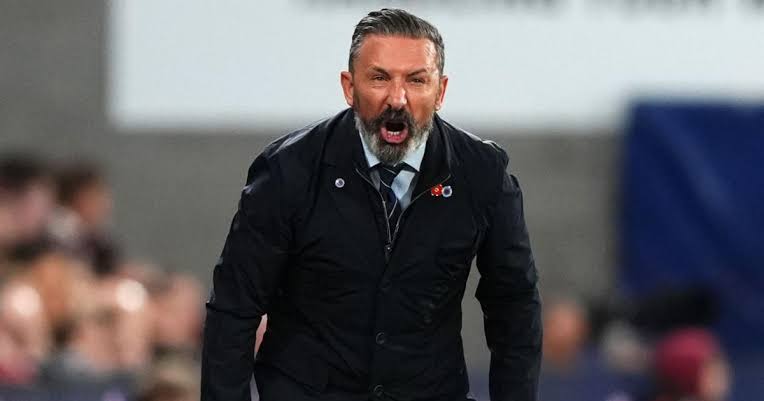
Most managers are happy to celebrate a place in a cup final. They leave the criticism until Monday, bask in the afterglow for a few hours and let the supporters enjoy their night. Derek McInnes is not most managers. Within minutes of watching Rangers squeeze past Aberdeen at Hampden on Saturday evening, he was already picking holes in his own team’s display, and the particular hole he chose to pick was a significant one. Rangers had dominated the ball, fired in shot after shot and still needed an eighty-third-minute goal to settle a game that should have been won long before. For the manager, that was not a cause for comfort. It was a warning sign, and he was determined to make sure everyone heard it.
The numbers tell the story with brutal clarity. After dominating possession and registering twenty-five shots, only five of which were on target, McInnes said that it was not good enough. That is a startling ratio. A team that takes twenty-five shots and hits the target with only a fifth of them is not creating high-quality chances, or it is wasting the ones it does create, and probably both. In a semi-final against a team that had lost three of its last four league matches, those figures should have been enough for a comfortable victory. Instead, Rangers needed a late goal from close range to avoid extra time, and the manager knows how lucky they were not to be punished.
His assessment went beyond a single match. In his own words, the possession and shot totals were similar to what the team produces most weeks, with too few efforts on target and poor decision-making, and he made it clear that the problem is a recurring one rather than a one-off. That is a significant admission. It means that the weakness exposed at Hampden is not a blip but a pattern, and it suggests that the team’s attacking play has been hiding a flaw behind a series of good results. Rangers are unbeaten in eleven matches, but the manager is telling the squad that winning is not the same as playing well, and that the margins of those victories have been narrower than they should have been.
The language he used was telling. McInnes described the performance as ponderous at times, saying that the team had been slow when it needed to be quick. That is an accurate description of what many supporters saw. For long periods, Rangers passed the ball sideways and backwards in front of a compact Aberdeen block, waiting for an opening that rarely came. When they did attack with pace, the final ball let them down, or a shot was blocked, or a decision was made too late. The Read Rangers report noted that the team increased the tempo after the break, but the final ball or finish was missing, and the back door was left open. That combination of dominance and inefficiency is exactly what the manager was talking about.
To understand why he is so concerned, you have to look at what the team has achieved so far and what it still needs to do. McInnes arrived in the summer with a squad that had been rebuilt in a hurry, and the early weeks were rocky, with a European exit, a home defeat to Hibernian and a draw at Dundee United. Since then, the improvement has been dramatic. It is now nine wins and two draws since the Jablonec defeat, and the team has reached a cup final in the manager’s first few months in charge. That is a significant achievement, and it would be easy to assume that everything is on track. But the manager clearly feels that the underlying performances do not yet match the results, and that complacency would be dangerous.
The key issue is the quality of decision-making in the final third. Rangers have plenty of talented attackers, and they get into good positions on a regular basis, but too often they choose the wrong option at the crucial moment. A winger shoots when he should pass, a striker passes when he should shoot, and a midfielder delays a through ball until the defender has recovered. These are small errors, but they add up, and they explain why a team can have twenty-five shots and still struggle to score. McInnes referred to this directly, pointing out that bad decisions were a factor. It is the kind of observation that can only come from a coach who watches the game with a clear understanding of what could have been.
The most revealing part of his comments concerned Ryan Naderi, the man who scored the winner. McInnes said that he had always believed in the striker’s ability to be in the right place when the ball arrives in dangerous areas, noting that Naderi had shown this throughout pre-season and in training. But he added that the team does not feed him enough, and that it makes too many poor decisions in the build-up. That is a double-edged compliment. It praises the forward while criticising everyone else, and it suggests that Naderi’s scoring record could be much better if his teammates gave him more opportunities. It is also a pointed message to the wingers and midfielders, who are responsible for supplying the chances.
Which brings us to the misfiring stars of the headline. Several of Rangers’ attackers have been struggling to convert their talent into end product, and the statistics are not flattering. Djeidi Gassama has gone nine games without a goal and has just one in fourteen appearances this season. Minsu Kim, at twenty years old, has yet to open his account despite creating a series of near-misses, and the Rangers Review has argued that his numbers do not tell the full story of his impact. Badredine Bouanani, the Man of the Match at Hampden, admitted that he should have scored one or two himself. Individually, each case has its own explanation, but collectively they point to a team-wide problem with finishing.
It is worth pausing on the Kim example, because it illustrates the difficulty of judging attackers by numbers alone. One Rangers Review analyst argued that goals and assists do not tell the full story, pointing to the winger’s chance creation, dribbling ability and intelligence in the final third. That is a fair point, and it is one that applies to many wingers. A player can contribute enormously to a team’s attacking play without scoring or assisting, simply by dragging defenders out of position, making runs that create space for others and holding the ball under pressure. But there comes a point where the lack of numbers is too conspicuous to ignore, and that is where McInnes seems to be heading. The manager is telling his players that effort and potential are no longer enough, and that they need to deliver.
The same goes for the competition between the wingers. Gassama, Bouanani and Kim are all vying for places, and the manager has been rotating them according to form and opponent. The warning about stats puts all three on notice. Whoever scores or assists in the coming weeks will have a strong claim to a starting place in the final, while those who do not will be left behind. That kind of competition can be healthy, because it forces players to raise their standards, but it can also create pressure. The challenge for McInnes is to strike the right balance between demanding more and maintaining confidence, and his public comments suggest that he is willing to take the risk.
There is also a tactical dimension to the issue. Rangers have been playing a 4-4-2 for most of the autumn, with two strikers and two wide midfielders, and the system has produced results. But it also demands that the wingers contribute in both attack and defence, and it can leave them isolated when the team is under pressure. If the wide players are not good enough at finishing or delivering crosses, the system loses its effectiveness. McInnes has hinted that he may be willing to change things if needed, and the Scotsman reported that he had been planning a change before the winning goal arrived. That suggests that he is aware of the problem and is considering solutions.
Looking back at the evening, there are several moments that illustrate what the manager was saying. In the first half, Bouanani had a gilt-edged opportunity after a lovely first touch, but he failed to convert it. Later, he beat his marker and delivered a cross that was poorly judged. Raskin had a close-range effort that was brilliantly saved, and Minsu forced a stop from an Aberdeen goalkeeper who was rarely troubled. These were all chances that a more clinical team would have taken, and each of them could have changed the course of the game. The fact that none of them did is why the manager was so frustrated, and why he spoke so bluntly afterwards.
It is also worth remembering the context in which he made those comments. Rangers had just won a semi-final and reached a final, and the mood in the stadium was jubilant. It would have been easy for McInnes to join in the celebration and say that results are all that matter. Instead, he chose to emphasise the work that remains, and to remind the players that reaching the final is only the first step. Rangers still need to complete the mission on 13 December, and McInnes knows it will not be seen as good enough simply to reach the final. That is the mark of a manager who has been through enough cup campaigns to know that the most important match is the last one.
His experience in these situations is considerable. McInnes has taken teams to numerous domestic cup semi-finals and finals, and he has seen how quickly the mood can change when expectations are not met. He knows that a team that scrapes through on the strength of a late goal can just as easily be beaten in the final by an opponent who punishes its inefficiency. That is why he is so insistent on improving the attacking standards. If Rangers carry the same lack of clinical edge into December against Hearts or Hibernian, they could find themselves on the wrong end of a result, and the wait for silverware will stretch into a fourth year.
There is a historical parallel that makes the point. Teams that win trophies are rarely the ones that dominate possession and fire off shots from distance. They are the ones that make the most of their chances, that take the opportunities they are given and that defend solidly when necessary. Rangers have shown the second quality in abundance, with a defence that has kept more clean sheets than any in the league. The missing ingredient is the first, and the manager clearly sees that as the priority. If the team can improve its finishing, it will become a much more formidable opponent, and the final will look like a very different prospect.
For the supporters, the message is both encouraging and sobering. It is encouraging because it shows that the manager is aware of the issues and is determined to fix them. He has a track record of improving teams, and his willingness to criticise his own side publicly suggests that he is not afraid of difficult conversations. It is sobering because it reminds us that the team is still a work in progress, and that the long unbeaten run has not solved every problem. The task ahead is to turn good performances into great ones, and that will take time and effort.
The squad itself has the quality to do it. Rangers have a talented group of attackers, with a mixture of experience and youth, and many of them have shown flashes of brilliance. Kevin Kelsy has scored regularly this season, Naderi has proved himself a reliable finisher, and the wingers have the skill to create chances. The challenge is to put it all together, to make the right choices at the right moments and to convert the opportunities that arise. If they can do that, the numbers will start to improve, and the warnings will quickly be forgotten.
In the meantime, the manager will use the weeks before the final to work on the details. Training sessions will focus on shooting, decision-making and movement in the penalty area, and the players will be reminded of the standards expected of them. McInnes is a coach who places great emphasis on preparation, and he will want to ensure that the team is ready for the pressure of the occasion. The competition for places will provide extra motivation, and the players who respond best to the criticism will be the ones who play in the final.
It would be wrong to be too negative, though. Rangers have just reached a cup final, they are unbeaten in eleven matches, and they have a manager who is clearly capable of getting the best out of his squad. The semi-final was far from perfect, but it was a win, and in knockout football, that is what matters. The criticism is a sign of ambition rather than disappointment, and it reflects a desire to improve rather than to complain. A manager who is satisfied with mediocre performances is unlikely to win trophies, and McInnes is clearly not that kind of manager.
In the end, the message is a simple one. The stats are not good enough, and the players know it. Twenty-five shots and five on target is a ratio that will not win finals, and the manager has made it clear that he expects more. Whether it is Gassama finding his shooting boots, Kim opening his account, Bouanani converting his chances or Naderi continuing to profit from good service, the improvement has to come from everyone. If it does, Rangers will go into December with every chance of lifting a trophy. If it does not, the same questions will be asked again, and the answers will be harder to find