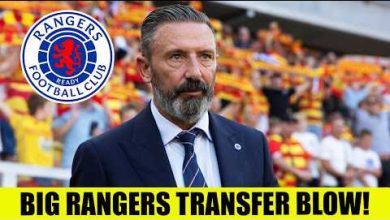
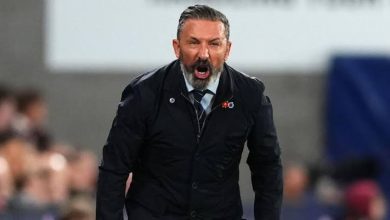
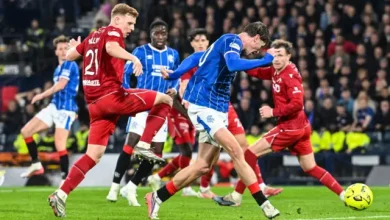
He played for Scotland and Rangers – but ended up penniless and cleaning toilets


Stranraer is a ferry town on the far south-west edge of Scotland, a place people tend to pass through on the way to somewhere else. Kevin Kyle grew up there in the 1980s, the son of a referee, with an older brother called Mark. Football was always going to be the thing. By the time he was a teenager, the game had pulled him out of Galloway and into the youth systems of bigger clubs, and one of them, Sunderland, would shape the next decade of his life.
He was a big, strong centre-forward who could hold the ball up, win headers and finish when the chance came, and who played with a cheerful ease. Pundits and radio presenters liked him because he was never short of something to say. Years later, a journalist writing about him recalled expecting the hilarious figure from those post-match interviews, the grinning Stranraer face with the microphone in front of it. That memory matters, because the Kevin Kyle people saw in public was funny and likeable, and it was not obviously the whole story.
He came through at Sunderland and made his first-team debut in 2001 in a 1-0 win at Southampton. The club’s own archive notes that he made 109 appearances for Sunderland, though another of their pages puts the figure at 91. Whichever count you trust, he was a regular in a squad that went through some of the most turbulent years in the club’s modern history
Those were strange, volatile seasons on Wearside. Sunderland were a Premier League club one year and a Championship club the next, and a young striker had to learn his trade while the team around him was constantly being reshaped. Kyle did it well enough to earn recognition. He won the North East Football Award for young player of the year in 2004, and the international call-ups arrived too. He went on to win ten full caps for Scotland and scored one goal, and he had already played for the under-21s, making 14 appearances at that level.
If you had stopped the clock in 2004 and asked anyone in the north-east of England where Kyle’s career was heading, the answer would have been positive. He was in his early twenties, he was scoring, and he had a Scotland cap to his name. A good career in the Premier League and a long Scotland involvement looked possible.
His own account suggests the pressures were building by then. Players on Premier League salaries have enormous amounts of free time. They train in the morning and are finished by lunchtime, which leaves long afternoons to fill. For some men that means golf, for some it means video games, and for a few it means a phone and a betting account
Kyle’s gambling is the thread running through nearly every account of his life, and it was not a secret. He spoke about it, sometimes with a startling frankness. He once admitted to blowing £7,000 a week on bets, a figure that sounds almost abstract until you set it against what an ordinary supporter in the stands earns in a year. In a 2010 interview, he said that he had all the money years earlier at Sunderland and Coventry and wasted it gambling.
It is worth being precise about what this kind of addiction looks like, because the popular picture of it is usually wrong. It is not a story of a man who is obviously reckless and out of control. A professional footballer with a gambling problem can look entirely normal in the dressing room. He turns up, trains, plays and jokes. The damage happens on a screen and in a bank account, out of sight, and it grows.
For footballers it is also, tragically, close to an occupational hazard. The combination of high income, idle time, a competitive personality and a culture in which betting is treated as harmless fun creates ideal conditions for it. Kyle himself later argued that the problem in Scottish football was far wider than people admitted. He claimed that hundreds of Scottish players broke the betting rules every week, and he put the number at close to 300 at senior level alone, before you even reached the junior game. Whether or not you accept his arithmetic, the point he was making is that what happened to him was not unusual.
The real tragedy, as he described it, was that the money he lost was money he did not have to lose. A career that could have set him and his family up for life was instead being fed into a machine.
What followed was the kind of career that looks, on paper, like a series of short stops. Kyle moved around. He went on loan to Wolves and Hartlepool, spent time at Coventry City, and had further loan spells at Huddersfield and Rochdale. His journey eventually took in eleven clubs, which is a long list for a player who started so brightly.
Injuries were part of the picture. Hips and ankles are hard on a big striker, and a hip problem in particular would trouble him for years. But as one match report put it, a gambling problem and injuries saw him flit through football, and the two things fed each other. A player who is not playing has more time on his hands. A player with money worries is not at his best on the pitch.
Then, for a while, it worked. Kyle returned to Scotland and signed for Kilmarnock, and the home environment suited him. In the 2009–10 season he scored 16 goals in 43 league appearances, easily the best return of his later career, and it earned him a move to Hearts. He had stability, he was fit, and he was playing with a freedom that had not always been there before. It was a settled spell at Killie of about 18 months that led to Edinburgh.
At Hearts, though, the injuries returned. He underwent a further operation on his hip in January 2012 and was released from his contract that March. He was thirty, without a club and with a body that was starting to refuse what he asked of it
The Rangers move came at one of the most unusual moments in the club’s history. Rangers had collapsed financially that summer. The old company had gone into liquidation, and the club was restarting at the very bottom of the Scottish league structure, in the Third Division. For a striker who had played in the Premier League, it was an unexpected landing place.
Kyle had said publicly that he would be open to a move to Ibrox. He accepted an invitation to train with the club, and on 7 August 2012 he signed a one-year contract. He made his debut the same day, coming off the bench at home to East Fife in the League Cup. One report put his wages at £2,000 a week, a long way from what he had earned in his Sunderland days.
It should have been a fresh start. Instead it was brief. He made eight appearances for Rangers and scored three goals, and niggling injuries meant he started only four games at Ibrox before leaving by mutual consent in March 2013. He hoped for another chance in the top flight and was pursuing it that summer, saying he would approach any club willing to take him. After a spell at Ayr United, the club where it had all begun, he stepped away from professional football in 2014.
Years later, he was blunt about how the Rangers experience had affected him. He said that playing for the new Rangers had sickened him so much that he decided to give the game up. That is one account from one source, and a website with a very obvious bias reported it, so it is best treated as his own reading of events. What is clear is that the period ended his enthusiasm for the sport.
The story that gave this article its headline broke in 2014. A newspaper reported that Kyle was working on a ship, and the details were striking enough to run with photographs. He was said to be based on the Regina Baltic at Lerwick’s Mairs Quay, a 16-hour, 400-mile trip from Ibrox.
The account was that he was stacking boxes and cleaning. Another report described 12-hour shifts stacking cargo at the port of Lerwick, in the Shetland Islands, for a modest £400 a week. A third, which was a hostile tabloid-style repost, claimed that managers had asked colleagues not to talk about his footballing past. That last detail came from unnamed sources, so I would treat it with caution.
The contrast was the story. Here was a man who had been on £10,000 a week, in a stadium in front of thousands, now working a night shift on a freight vessel at the edge of the country. The press loved it, and the phrase that stuck was the toilet cleaning.
It is worth saying that nothing about honest work deserves contempt. The best version of the story is not “look how far he fell.” It is that a man who had been burned by money and fame chose a job that was steady, physical and anonymous. He later talked about money in terms that suggest some peace with it. In that 2010 interview he said that money is not everything, and by 2014 he seemed to be living that out
Headlines like “penniless and cleaning toilets” work because they are simple. They offer a tidy moral about greed, waste and comeuppance. But they flatten a more complicated person.
First, “penniless” is a strong word. What the reporting actually supports is that Kyle had lost large sums gambling, that he was in debt at points, and that he was working for a modest wage. Those facts are serious, but they are not identical to being destitute, and it is not clear from the public record exactly what his finances looked like at any given moment
Second, the framing treats the job as a punishment. A ship’s storeman or cleaner is doing necessary work. Kyle did not seem to see it as humiliating. If anything, the shift away from football looked like relief for a man who had spent years under a pressure he could not manage.
Third, the story hides how common it is. Footballers’ careers are short, the incomes are front-loaded and the support after retirement is patchy. A player who peaks at 23 may be out of the game at 33, with no obvious second act. Add an addiction and the margin for error vanishes. The reason the Kyle case travelled so widely is that people recognised a pattern, not that it was a one-off.
There is also the darker note in the reporting. At one stage he gave an interview in which he said he would be “better off dead”. That line is a reminder of what sits underneath the tabloid framing. Gambling addiction is associated with serious mental health struggles, including thoughts of suicide, and the humour of the post-match grin was not the full measure of what he was carrying.
The part of the story that gets less attention is that it did not end on the ship. Kyle later worked in the oil industry and as a baggage handler on the ferries between Cairnryan and his native Stranraer area, which is its own kind of homecoming. Having left home to chase a career in England, he ended up back on the water that connects his hometown to the rest of the world.
He also found a voice. In 2018 he sat down for an interview on the YouTube channel Open Goal with former Rangers midfielder Simon Ferry. He described it as something that could be quite good, though he did not know how to filter things, which is probably why it worked. The candour that had made him a favourite with radio presenters turned into a second career as a media personality. He talked openly about the money, the addiction, the injuries and the dressing rooms, in a way that few former players are willing to.
He has also been associated with campaigning against betting, particularly aimed at young people. One report notes that he devoted time to campaigning against gambling, especially for the young. That feels right. A man who knows exactly how the habit takes hold has something to say to a teenager with a betting app and a new bank account.
And there is the darts. He is, by several accounts, rather good at it, and the sport has given him a way to compete without the weight of a professional career pressing on him.
It would be easy to end with a neat moral, and I am wary of it. Stories like Kyle’s tempt people to say that he threw away his chances, that he should have known better, that anyone given that money should have been sensible. That reading is comfortable, because it lets everyone else off the hook.
The harder truth is that addiction does not respond to good advice or good intentions. A talented young man with money and spare time walked into a trap that has caught many before him and since, and the football industry, which celebrates the lifestyle and takes the advertising money, offered him very little protection. The question worth asking is not why Kyle gambled but why a system that produces so many young men with so much money and so little structure is surprised when some of them struggle.
What is admirable about him is what he did next. He took the work that was available, he told the truth about what had happened, and he used his platform to warn others. The headline wanted a cautionary tale. What the record shows is a man who hit a very low point and rebuilt a life on more modest terms, and who was brave enough to talk about it.
For a boy from Stranraer who once played for Scotland and Rangers, that may turn out to be the more important achievement.