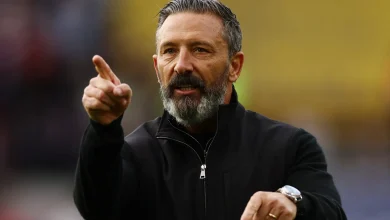
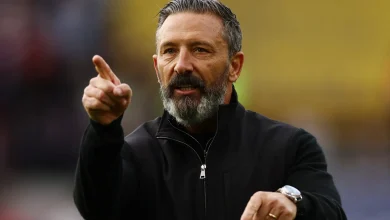
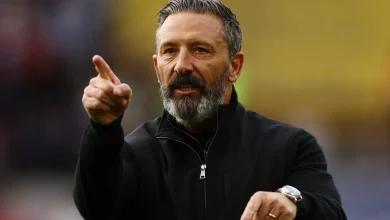
The Motherwell manager is unhappy with what happened during yesterday’s clash! 🔥 He has now called for a rematch, sparking fresh controversy!


Start with the tone, because it is the opposite of fuming. Johansson’s summary of the night was compact: tough start, tough ending, good stuff in the middle. That is not the language of a manager preparing a grievance. It is the language of someone assessing a match in three phases and finding two of them unsatisfactory. He accepted that conceding so late was hard, and then he moved straight to what his players were doing. By his own account, his team were fighting a lot in the last 15 to 20 minutes when Rangers were putting the heat on them, but did not have the energy to keep the pressure up. A manager who thought the result was stolen would be talking about the officials or the deflection. Johansson talked about energy.
His self-criticism went further. He said the team failed in both the beginning and the end of the match, because they did not lift aggressively enough into pressing. That is a coaching complaint, not a complaint about luck. Motherwell’s whole approach, as the club’s own materials describe it, depends on aggression. Before the match Johansson had said that when his team play Rangers they want to see aggression and to go toe-to-toe. On Saturday, by his own assessment, they did not do that for long enough, and the first twenty minutes show it. Rangers took the lead after eight minutes, as the club’s match report noted, in what it called a simple affair, and had almost all of the early play. A manager who builds his plan on pressing and watches his team fail to press has a clear problem to solve.
The detail he added about the opening goal is the closest he came to a grievance, and it is a small one. He said he did not think Rangers should have been given the free kick that preceded their first goal, but immediately added that his team should defend much, much better on the corner that followed. That is a revealing sentence structure. He raises a point about the decision, which a manager is entitled to do, and then withdraws its force by saying the defending was the real problem. I have not seen the footage, so I cannot say whether the free kick was right. The point is that Johansson himself did not make it the centrepiece. He put it in a clause and moved on.
That detail also corrects something I wrote earlier. In my first account of the match I described the opening goal as coming from a Kim corner, which is how several reports put it. Johansson’s version suggests a free kick led to a corner and the corner produced the goal. The difference is small, but it shows how easily the sequence of a set-piece goal gets simplified in match reports.
The most interesting part of his analysis is about an injury. He said the early loss of Ibrahim Said was a major blow, which came in the same spell as the opening goal. His reasoning was not just about losing a good player but about who came on. He explained that the substitutes available, many of them in offensive positions, were not ready to play more than 30 to 45 minutes at high intensity. That is a candid admission from a manager about the limits of his squad. It means that when Said went off, Motherwell did not simply swap one attacker for another. They lost a level of energy and quality that could not be replaced, and the plan of pressing hard had to be rethought on the fly.
It also helps explain the shapeof the second half. Johansson said his team recovered, equalised from a set play after a good attack, and then faded. The fading was a physical story. A team that has to press aggressively and has used up its best options early is likely to tire, and Rangers, who were fresher and better stocked, took over. Johansson said Rangers took complete control for the last 15 to 20 minutes and his side did not have the energy to keep up the intensity. The match data supports him. Rangers completed far more passes at a higher accuracy, won more than twice as many duels and had more dangerous attacks, and the pressure grew as the night went on. The winning goal, a deflection off Martin Moormann or a Ryan Naderi finish depending on whose record you trust, arrived at the end of a long period of Rangers pressure, not out of nowhere.
There is real credit in his response for his goalkeeper. Johansson called Alex Paulsen’s performance fantastic and said it was tough on him and on the rest of the players. Nine saves is a lot, and it is the reason the match was still level at the end. Johansson’s choice to single out Paulsen suggests that he saw the match as one that his team deserved to take something from, but his wider comments show he knew the shape of the evening did not support that. A goalkeeper who makes nine saves is a goalkeeper whose defence is being tested heavily, and a manager who praises him is also, indirectly, describing a team that was under pressure.
Look at the larger context of Motherwell’s season and the tone makes more sense. The club’s own coverage reminds us that there was a real low point earlier this autumn. Johansson himself acknowledged that the squad lost six straight matches, though in that run they faced Celtic, Rangers and Hearts. That is a brutal sequence for any side, and it explains why a defeat at Fir Park to the second-placed team is not treated as a disaster. Since then the picture has improved. They were unbeaten in three before Saturday: a 1-1 draw at Dundee United, a last-minute goal from St Johnstone that denied them a win in Perth, and a 1-0 victory over St Mirren at Fir Park. Those results gave the club momentum before the international break, and Johansson had said his team used the break to work on the training pitch, take some time off and play a friendly against St Mirren.
His philosophy, as he described it, is a measured one. He said that from his perspective he would never get too low or too high. That is a useful key to everything he said on Saturday. A manager who has lived through six straight defeats and come out the other side learns not to be rattled by a narrow loss. He also said that because the team knows how it wants to play, it is easy to pinpoint the problems and where it needs to improve. That is exactly how he approached the Rangers defeat. He identified the problems in the pressing, the defending of the set piece and the energy levels, and he identified them in terms of what the team can control.
The preparation for the match shows how seriously he took it. Before the game he said he would take lessons from the earlier meeting at Ibrox. In that match, a 1-0 win for Rangers in September, Rangers had almost sixty per cent of the possession and created several chances. Johansson said he learned from that game that you have to take care of defensive transitions against a team like Rangers. That is a tactical observation about the moments when a team loses the ball and has to reorganise, which is where Rangers are at their most dangerous. On Saturday, by his own account, Motherwell failed in exactly that area at the start. He said that when they win the ball back they give it away again, and Rangers get momentum. The lesson he said he had learned was one the team did not manage to apply for the first twenty minutes.
He had also said, in the build-up, that these fixtures mattered to him personally. He told reporters that he came to Motherwell for many reasons, but that matches like this one were part of it. That is the kind of statement that suggests a manager who relishes the big occasion and does not see Rangers as an opponent to be feared. It explains why his post-match comments were not shaped by resentment. He wanted the match, wanted the challenge and was honest when his team fell short of what he hoped for. A manager who talks like that is not looking for excuses, and it would be out of character for him to demand a replay.
The suggestion of a rematch is also impossible in practical terms. Scottish Premiership results stand, and there is no procedure for a manager to request a replay except in circumstances so unusual, such as a match abandoned or a player ruled ineligible, that none applies here. A manager who wanted to protest a decision would do so through the usual channels, by writing to the Scottish FA or raising the matter in a press conference. Johansson did none of these things on Saturday, and nothing I have seen suggests he has since. The word rematch in the post is probably a distortion of the fact that the two teams met earlier this season at Ibrox, or of the way one outlet described Saturday’s match as a rematch of that game. The Scotsman’s preview used exactly that framing, saying Motherwell would take their Ibrox lessons into Saturday night’s rematch. A headline writer can turn that sentence into a demand with very little effort.
The way this kind of post works is worth spelling out, because it happens constantly around football. A social media account takes a real event, such as a manager speaking after a defeat, and wraps it in alarming language. It uses a siren emoji, a promise of controversy and a claim that fans will have plenty to say. It does not link to a source. Instead it points to the comments, where the real purpose emerges: engagement, and probably a link to a site that earns money from clicks. The details are chosen to provoke, and the facts are an afterthought. A reader who checks the real quotes finds a manager being fair and self-critical, and the gap between that and the post’s claims is the whole point of the trick.
There is a reason these posts focus on managers and referees. Anger sells, and a manager who is supposedly fuming at an opponent is a more compelling story than one who calmly assesses a defeat. The truth is rarely as dramatic. In this case, Johansson’s calm assessment is arguably more interesting than a rant would have been, because it tells us how a young team is developing and where its limits lie.
His comments about that young team deserve more attention than they have received. He pointed out that his is the youngest team in the league alongside Dundee United, and said that the team will improve and has a lot more to come. That is a significant statement about how Motherwell are being built. A squad of young players will make mistakes in pressing, in defending set pieces and in managing energy through a match, and they will also improve faster than an older group. Johansson’s framing of the defeat as part of a developmental process is consistent with everything else he said. He is not asking for a replay because he is not treating the result as an injustice. He is treating it as information.
It also explains the energy problem. Young players often have the legs for the first hour and struggle to maintain intensity in the final stretch, particularly when they are asked to press aggressively. The decline in the last twenty minutes was a familiar pattern for a team that relies on youthful energy and has a limited bench. Johansson said as much when he talked about the substitutes not being ready for more than a short spell at high intensity. That is a recruitment and development question as much as a tactical one, and it will shape how Motherwell approach January, when clubs have a chance to add depth.
From the other side, Derek McInnes had his own view, and it confirms that the match was the kind of result that satisfies without dazzling. He called the performance top class, saying his team mixed the game up well, pressed strongly and were aggressive, and that the only thing missing was an earlier winning goal. He said he was disappointed that it took so long. That is a manager who thinks his team deserved to win and is mildly frustrated at the margin. The two managers’ assessments fit together neatly. Rangers dominated and were delayed by an excellent goalkeeper, and Motherwell competed hard and then ran out of energy. Neither is describing an injustice.
The numbers back up that shared reading. Rangers’ passing accuracy and duel count tell of a team in control, and Paulsen’s nine saves tell of how much effort it took to beat a defence that was also resolute. A late goal in a match like that is the natural conclusion. If anything, the surprise is that it took so long, which is the point McInnes made himself.
What should be said, finally, about the idea that this was a controversial result? It was not, in any serious sense. There was a debatable free kick before the opening goal, and Johansson mentioned it, mildly. There was a deflection on the winner, which is a feature of football and not a scandal. And there was the usual argument among supporters about which team deserved what. None of these is a basis for a demand for a replay or for a manager to be fuming. The match was close, competitive and decided by narrow margins, and the people most closely involved have described it in those terms.
For Motherwell, the practical question is what comes next. They are tenth, they have shown signs of improvement and they have a manager who understands what the team needs. The areas he identified, pressing, set-piece defending and squad depth, are all fixable, and January offers a chance to address some of them. A young team that loses narrowly to the second-placed side, plays well in the middle of the match and takes the lessons on board is a team moving in the right direction, even if the result does not show it.
For Rangers, the lesson is more cautionary than it looks. A win that depends on a late deflection against a team with a thin bench is a good result, but it also shows how close the margin was. If the energy had held, or if Said had stayed on, the story might have been a draw. That does not diminish the win, but it does suggest that the unbeaten run owes something to resilience as well as to dominance, and that matches like this one can go either way.
In the end, the headline that prompted all this was wrong, but the story behind it was more interesting than the story it invented. A manager spoke honestly after a defeat, took responsibility for his team’s failings and looked ahead. That is not the stuff of viral outrage, and it is why posts like the one you found rely on invention. The real Johansson said his team was tough to beat in the middle of the match, wanted to be more aggressive at the start and ran out of energy at the end. He praised his goalkeeper, mentioned one decision he disagreed with and moved on. If there was fury, it was directed at his own team’s lapses, and if there was a call for anything, it was for improvement. That is a far more honest account than the one the post gave, and a far better guide to what to expect when the two teams next meet.